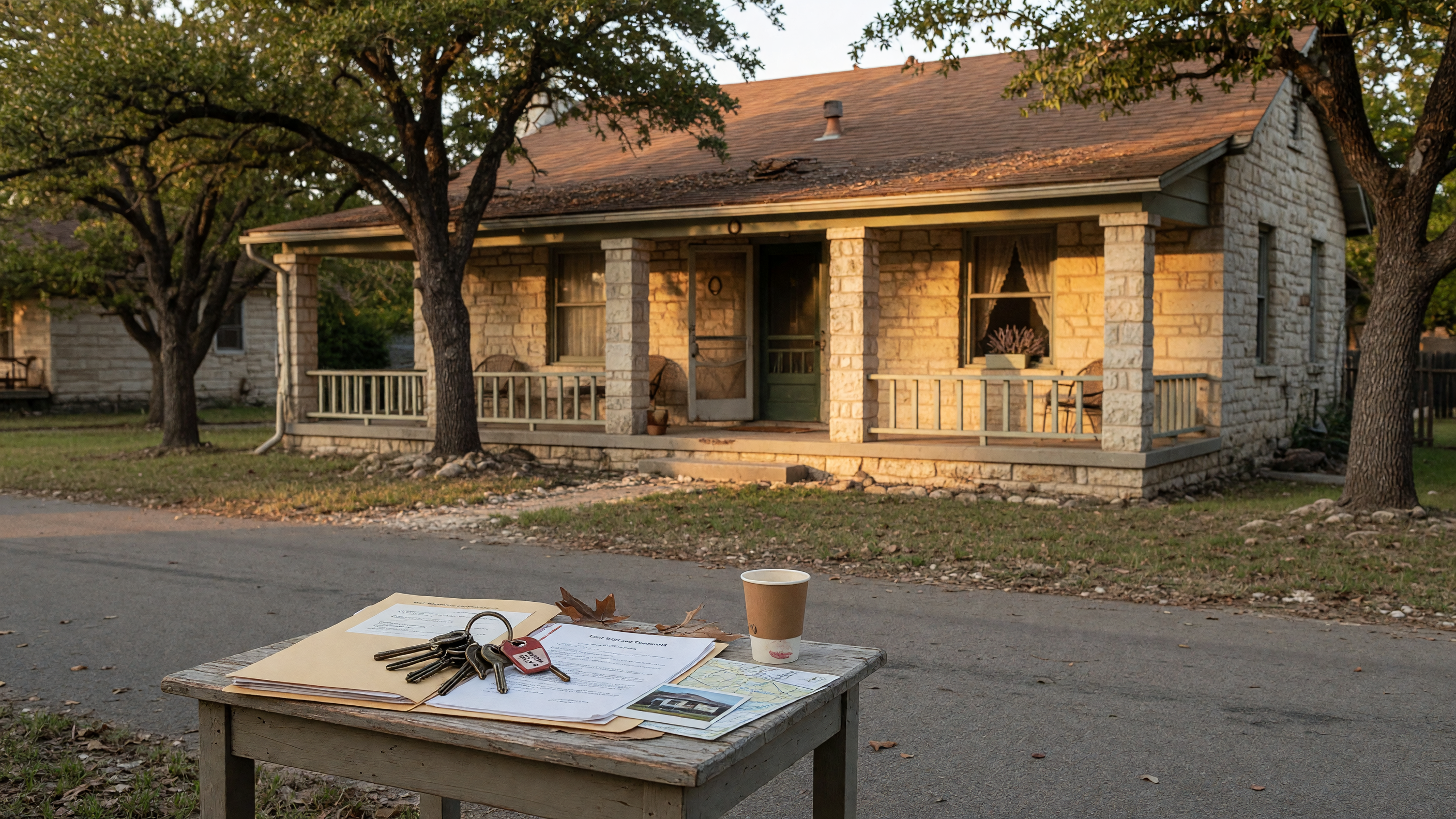

You're the executor of an estate. A loved one has passed, and their house — a home you visited for holidays, for Sunday dinners, maybe only a handful of times in your life — now falls under your authority. You need to sell it. The buyer asks for a seller's disclosure. And your stomach drops.
How are you supposed to tell someone whether the roof leaks, the foundation shifts, or the plumbing backs up when you never slept a single night under that roof?
Probate attorneys and real estate professionals who work with executors will tell you: that anxiety is completely normal. The disclosure form asks you to make legally binding statements about a property you may have walked through maybe twice. It feels like a trap. But here's the thing — Texas law anticipated your situation. The legislature wrote a specific exemption into the Property Code for exactly this reason, and it gives you real protection. Not a loophole. A deliberate, reasoned protection.
Let's walk through what the law says, what it means, and where the real risks are — in plain English, the way a trusted advisor might explain it over a cup of coffee.
This article provides general educational information about Texas real estate disclosure law and executor duties. It is not legal advice. Every estate is unique. Consult a licensed Texas estate attorney for guidance specific to your situation.
Key Takeaways
- The statutory disclosure form is not required for executors, but known material defects must still be disclosed.
- Knowledge you gain during probate — from estate documents, inspection reports, insurance files, or conversations — becomes disclosable.
- You owe fiduciary duties to the estate's beneficiaries; concealing known problems can create personal liability.
- Document what you know and what you disclose, in writing.
- Use the right tools: TXR 2502 for third-party information, clear "as-is" contract language, and proper deed types.
The Core Question: What Does the Law Actually Say?
Texas requires most sellers of residential property to provide a Seller's Disclosure Notice — the multi-page form that asks about roof condition, foundation, plumbing, electrical, flooding history, and dozens of other specifics. Consider a professional inspection — our checklist covers what to look for. That requirement is set out in Texas Property Code § 5.008 [1].
But Section 5.008 also lists specific exemptions — situations where the disclosure form is not required. And one of those exemptions, subsection (e)(5), says the disclosure requirement does not apply to a transfer "by a fiduciary in the course of the administration of a decedent's estate, guardianship, conservatorship, or trust" [1].
That's you. As a court-appointed executor or administrator selling estate property on behalf of the estate, you are a fiduciary, and the transfer you're making is in the course of administering the estate. The statutory disclosure form simply does not apply to you.
The Texas Legislature created this exemption for a very practical reason. The Seller's Disclosure Notice is built on a premise: that the seller personally occupied the home and has firsthand knowledge of its condition. An executor usually can't meet that premise. Forcing an executor to fill out the form would force them to either guess (creating false statements under oath) or refuse (stalling the sale). Neither outcome helps anyone. So the legislature carved you out [1][4].
"A seller of residential real property comprising not more than one dwelling unit located in this state shall give to the purchaser of the property a written notice as prescribed by this section... The notice is not required for a transfer... by a fiduciary in the course of the administration of a decedent's estate, guardianship, conservatorship, or trust."
Independent vs. Dependent Administration: Why It Changes the Game
The § 5.008(e)(5) disclosure exemption applies regardless of which type of administration your estate uses. But the type of administration — independent or dependent — changes everything about how you sell the property, and that has real implications for disclosure strategy.
Independent Administration
- • The executor has broad authority to list, market, negotiate, and close the sale without returning to court for each step
- • The will must expressly authorize independent administration, or all heirs must agree to it
- • The executor can sign the deed and close without a court-confirmed sale order
- • Disclosure strategy is still critical — but the executor moves faster, with fewer procedural friction points that could derail a deal
- • Most Texas estates with a well-drafted will proceed this way
Dependent Administration
- • Every significant action — including selling real property — requires prior court approval
- • The executor must petition the court for permission to sell, obtain a court-ordered appraisal, and then return to court for an order confirming the sale — all governed by Texas Estates Code Chapter 356 (see Subchapter E for Public Sale and Subchapter F for Private Sale of real property under dependent administration) [11]
- • The buyer's contract is contingent on court confirmation — a public hearing where other bidders can appear and offer more
- • Disclosure strategy becomes even more important here: the court confirmation hearing exposes the sale to scrutiny, and a buyer who later claims they weren't told about a defect can raise issues that affect or challenge the confirmation process or lead to post-closing claims
- • Common when there is no will, when the will doesn't authorize independent administration, or when heirs cannot agree
Here's the practical takeaway: the disclosure exemption protects you from the form in either scenario. But under dependent administration, the sale itself is a public, court-supervised process. Any disclosure failure that surfaces later doesn't just create a lawsuit risk — it can undermine the validity of the court order that authorized the sale in the first place. The stakes are higher. Err on the side of documenting exactly what you disclosed, to whom, and when.
The Exemption Is Not a License to Hide Problems
This is where a lot of executors get confused — and where a lot of well-meaning people get into trouble. The Section 5.008 exemption means you don't have to fill out the form. It does not mean you can conceal problems you actually know about.
Texas law provides a statutory safe harbor from the disclosure form, but Texas common law imposes a separate, broader obligation: sellers must disclose known material defects — facts that would affect a buyer's decision to purchase the property or the price they'd pay — even when the statutory form isn't required [6]. A material defect is something that a reasonable buyer would consider important in deciding whether to buy or how much to offer. A cracked foundation is material. A squeaky cabinet hinge is not. Our probate real estate agent page explains how we help executors navigate the disclosure process.
Here's a table that helps clarify the distinction between what the exemption protects you from and what it doesn't:
| What the § 5.008 Exemption Does Protect You From | What the Exemption Does Not Protect You From |
|---|---|
| Having to complete and sign the standard TREC Seller's Disclosure Notice form for conditions you don't know about [1] | Concealing a known roof leak, foundation crack, flood history, or termite damage that you personally know about [6] |
| Being required to answer specific questions about systems you never maintained (HVAC age, plumbing material, electrical panel details) [1] | Hiding information from inspection reports or insurance claims that came into your possession during the estate administration [7] |
| Facing liability for failing to provide the statutory disclosure notice — the exemption is a complete defense [4] | Facing liability for fraudulent nondisclosure or active concealment of a known defect — these are entirely separate claims [6][7] |
| Having to guess or make representations about conditions you genuinely don't know about [1] | Staying silent when a buyer directly asks you a question about the property and you know the truthful answer [2] |
Think of it this way: the exemption is a shield against being forced to make statements you can't verify. It is not a cloak for hiding statements you can verify. If you know the water heater flooded the garage three years ago, and you say nothing, the exemption won't protect you — because the problem isn't that you failed to fill out a form. The problem is that you knowingly withheld a material fact [7].
Let me address a common misconception directly: an "as-is" contract — which is standard in most probate and estate sales — does not relieve an executor of the duty to disclose known material defects. "As-is" speaks to warranties: it tells the buyer the estate isn't guaranteeing the property is defect-free. It does not speak to fraud: it doesn't give the seller permission to conceal defects they actually know about. Texas courts have drawn this line consistently [6][7]. If you know the foundation is cracked and the buyer doesn't, the as-is clause won't save you when they find out. You can sell as-is — just don't sell as-if-you-didn't-know.
The Deed You Sign Speaks Volumes — Even Before You Say a Word
Speaking of legal tools that shape how the estate's position is understood, there's one more that deserves attention: the deed itself. Most home sellers sign a General Warranty Deed — the gold standard that promises the buyer the title is clean all the way back to the original land grant. The seller is personally vouching for the entire chain of title, forever. An executor cannot and should not do this. You didn't own the property before the decedent died. You have no way to know — let alone guarantee — what happened with the title in 1987.
So what does a prudent executor use instead? One of two instruments:
Special Warranty Deed
Warrants title only against claims that arose while the estate held the property. The executor is saying: "During the time the estate owned this property, nobody did anything to cloud the title. Before that? That's on the buyer to verify."
This is the most common choice for executor sales in Texas. It's honest, it's protective, and it tells buyers exactly where the estate's knowledge ends.
Executor's Deed
A deed specific to fiduciary transfers — often used in dependent administrations where the court order confirming the sale provides the buyer's protection. It conveys whatever interest the estate holds without express warranties.
In a dependent administration, the court confirmation process itself gives the buyer comfort — the judge has reviewed the sale, and the deed is executed pursuant to a court order.
Your estate attorney should always review and approve the specific deed form before execution.
Here's why this connects directly to disclosure strategy: the type of deed you deliver signals to buyers — before they read a single disclosure — that this is not a typical owner-occupant sale. A Special Warranty Deed or Executor's Deed immediately telegraphs that the seller is a fiduciary, not someone who lived in the home and can personally vouch for its history. That signal alone often shifts buyer expectations in a productive way. They understand they're buying from an estate, that the usual warranties don't apply, and that their own due diligence matters more than usual. Pair that deed choice with clear, honest disclosures about what you do know, and you've built a transaction framework that is transparent from the deed up.
One final note: never let a buyer or an inexperienced agent convince you to sign a General Warranty Deed "just to keep things simple." As an executor, you are not personally in a position to warrant the title history. Doing so exposes you — and potentially the estate — to warranty claims you have no way to defend. Your estate attorney should review and approve the deed form before you sign anything.
What You Know vs. What You're Required to Say
This is the mental model that probate professionals point to again and again. Separate what you actually know from what you could theoretically find out. The law only cares about the first category — your actual, personal knowledge [2][6].
But "actual knowledge" is broader than many executors think. It's not just what you saw with your own eyes. It includes what you learned through the probate process: inspection reports you commissioned, insurance claim histories you reviewed, conversations with neighbors who told you about the flood in 2019, death certificates that reference a cause of death related to a property condition (such as carbon monoxide from a faulty furnace), and documents the deceased left behind that reference property issues.
| Scenario | Do You Know It? | Must You Disclose It? |
|---|---|---|
| You visited the house twice for holidays. You never saw any problems. | No | No — You have no personal knowledge of defects. You are protected by the exemption. |
| You ordered a pre-listing inspection and it revealed a cracked foundation and a failing HVAC compressor. | Yes | Yes — You now have actual knowledge from a professional report. Withholding it creates exposure [6]. |
| The deceased told you years ago that the garage flooded and water penetrated the foundation during heavy rain, but you never saw it yourself. | Yes | Yes — Secondhand knowledge from a reliable source is still knowledge. Disclose it as exactly what it is: "Deceased reported flooding during heavy rain; executor has not personally observed this condition." |
| A neighbor mentions during a casual conversation that the roof was replaced in 2018 after hail damage. | Yes | Potentially — A roof replacement is generally positive information, but it may also imply prior damage. Disclose what you were told and try to verify with records [2]. |
| You reviewed the deceased's homeowner's insurance file and found a claim for water damage in 2020. | Yes | Yes — Insurance claim history is one of the most important categories of knowledge an executor can acquire. Disclose the nature of the claim and what remediation was performed [7]. |
| You have no idea whether the house has ever had termites because you never lived there and no one told you. | No | No — You genuinely don't know. The exemption protects you from having to investigate or guess. |
The "Never Lived in It" Factor: Firsthand vs. Secondhand Knowledge
There's a meaningful legal difference between what you know because you lived it and what you know because you learned it — and Texas law recognizes this distinction.
An executor who lived in the deceased's home — perhaps a surviving spouse or an adult child who moved in to provide care — is in a fundamentally different position than an executor who lives three states away and visited twice a year. The executor who lived in the home has firsthand observational knowledge: they know which light switch is finicky, which corner of the garage takes on water after a heavy storm, whether the HVAC struggled last August. That kind of knowledge is harder to claim ignorance about if it goes undisclosed.
The executor who never lived in the home has a much narrower knowledge base. They know what they've been told, what they've read in documents, and what they've observed during limited visits. The law does not require them to go beyond that — to hire inspectors, to interview neighbors, to pull building permits — unless there's a specific reason to do so. The statutory exemption exists precisely because the legislature understood that the executor who never lived in the house shouldn't be treated like an owner-occupant [1][3].
But here's the nuance: once you do learn something — through an inspection, through a document, through a conversation — you can't un-learn it. The "never lived in it" factor is a shield for what you don't know. It's not an eraser for what you later discover.
Executor Who Lived in the Home
- • Has firsthand knowledge of systems, quirks, and repair history
- • Still qualifies for the § 5.008 exemption as a fiduciary [1]
- • But common-law duty to disclose known defects is broader because their knowledge is broader [6]
- • Harder to claim ignorance of recurring issues (sump pump failures, seasonal leaks, HVAC struggles)
- • Should err heavily on the side of disclosure — their firsthand knowledge creates a higher bar
Executor Who Never Lived in the Home
- • Knowledge is limited to what they've been told, read, or observed during visits
- • Fully qualifies for the § 5.008 exemption — exactly the scenario the legislature wrote it for [1][4]
- • Duty extends to anything they learn during probate: inspection reports, insurance claims, conversations [7]
- • Strongly consider ordering a pre-listing inspection — it's the single best risk-management tool available
- • Document everything: what you knew, when you learned it, and what you disclosed
What You Might Learn During Probate — Even Without Living There
The probate process itself can surface information about the property that becomes "actual knowledge" — and therefore becomes disclosable. Here are the most common ways an executor learns things they need to share:
- Insurance claim history — including CLUE reports. When you review the deceased's homeowner's insurance file, you may discover past claims for water damage, fire, storm damage, or liability. These claims often describe the underlying condition in detail. If you've read the claims file, you have knowledge [7]. You can also request a CLUE (Comprehensive Loss Underwriting Exchange) report from LexisNexis — a national database that tracks insurance claims tied to the property over the past seven years. As the executor managing the estate's affairs, you have standing to request this report on behalf of the property, which can surface claim history you might otherwise miss entirely. One practical warning: CLUE reports can sometimes take weeks for an estate to successfully pull due to identity verification requirements with a deceased individual — request the report the moment letters testamentary are issued to avoid this bottleneck.
- Death certificates. If the death certificate references a cause related to a property condition — carbon monoxide poisoning from a faulty furnace, a fall caused by a broken stair — that information is material and may need to be disclosed if it indicates an ongoing hazard.
- Inspection reports you commission. If you order a pre-listing inspection (which is often a smart move), everything in that report becomes your knowledge. You can't un-read it. Choose this path with your eyes open.
- Neighbor conversations. Neighbors often volunteer information during the estate process: "We always worried about that tree limb," or "The previous owner had a lot of plumbing work done." What you hear becomes what you know [2].
- Repair invoices found in the home. If you find receipts, invoices, or contractor estimates while clearing out the property, read them. They may reveal recurring issues or incomplete repairs that a buyer needs to know about.
Death in the Home and Other Stigma Factors: What Texas Law Says
This question comes up in nearly every estate sale, and understandably so. The owner passed away in the home — sometimes from natural causes, sometimes from an accident. Does the executor have to disclose that?
Texas law is clear on this point — and the answer may relieve you. Texas Property Code § 5.008(c) states explicitly:
"A seller or seller's agent shall have no duty to make a disclosure or release information related to whether a death by natural causes, suicide, or accident unrelated to the condition of the property occurred on the property or whether a previous occupant had, may have had, has, or may have AIDS, HIV related illnesses, or HIV infection."
That is the full statutory exemption language, and it is short and powerful. You have no duty to disclose that the decedent passed away in the home — whether from natural causes, suicide, or an accident that was unrelated to the physical condition of the property. This is particularly relevant for probate sales, where the owner's death in the home is not unusual. The legislature made a deliberate policy judgment: these facts can stigmatize a property and reduce its value, but they don't speak to the physical condition a buyer is actually buying.
There is an important boundary, however. The exemption applies to deaths that are unrelated to the condition of the property. If the death was caused by a property condition — carbon monoxide poisoning from a faulty furnace, a fatal fall caused by a broken stair — that underlying condition remains a material fact you must disclose. The death itself is not disclosable under the statute; the dangerous condition that caused it is.
Critical warning: homicides and deaths resulting from felony crimes are not covered by § 5.008(c). The statutory protection is carefully worded — it applies only to deaths by natural causes, suicide, or accident. It does not extend to homicides (murders) or deaths resulting from a felony crime committed on the property. Texas courts widely consider these to be material stigmas that must be disclosed. If the decedent's death on the property was a homicide, or if a prior occupant was the victim of a violent crime on the premises, the § 5.008(c) safe harbor does not apply, and you should consult your estate attorney about your disclosure obligations. This is not a gray area — it is a hard boundary in the statute.
Also worth noting: while § 5.008(c) relieves you of a duty to disclose, it does not prohibit you from disclosing if you choose to. Some executors prefer to be upfront — particularly with buyers who ask directly — because transparency builds trust and prevents the buyer from feeling misled if they learn about the death from a neighbor after closing. This is entirely your call, and there's no wrong answer. The statute simply says you can't be held liable for staying silent on this topic.
The Fiduciary Duty Angle: Why Hiding Problems Can Backfire
Which brings us to the bigger picture. Disclosure rules govern what you tell the buyer, but an executor's obligations run much deeper. You also owe strict duties to the estate and its beneficiaries — and those duties can be even more demanding than what the buyer expects.
Under Texas Estates Code Section 351.101, an executor must "take care of estate property as a prudent person would take of that person's own property" [3]. That's the statutory standard. And Texas Estates Code Section 351.001 incorporates the common-law fiduciary duties that apply to trustees — including a duty of full disclosure to beneficiaries of all material facts that might affect their rights [3][8].
What does this mean in practice? It means that hiding a known defect doesn't just risk a lawsuit from the buyer — it risks a lawsuit from the beneficiaries of the estate. If you conceal a foundation problem to get the house sold faster, and the buyer later sues the estate for fraud, the beneficiaries can turn around and sue you for breaching your fiduciary duty. They can argue that your concealment cost the estate money — either through the lawsuit itself or through the lost opportunity to address the problem transparently and negotiate a fair deal.
And here's the part that catches executors off guard: fiduciary duty claims against executors can expose you to personal liability — meaning your personal assets can be at risk beyond what the estate itself holds [8]. The estate might be closed by the time the lawsuit arrives, but your personal exposure lingers.
Fiduciary Reality Check
Disclosure protects you. When you disclose a known defect openly and clearly, you have done your job as a fiduciary. You have given the buyer the information they need to make their own decision. You have given the beneficiaries a transparent accounting of what was disclosed and why. The disclosure itself is your shield.
Concealment exposes you. When you hide a known defect, you have created the exact situation that fiduciary duty law exists to prevent: a person with authority and information using that position to the detriment of the people they're supposed to protect. Courts take this seriously [8].
Beneficiaries have standing to sue executors for breach of fiduciary duty, and these claims are not uncommon. Heirs who believe the executor mishandled the sale — including by failing to disclose defects that later lead to post-sale litigation — have standing to bring claims for breach of fiduciary duty. These claims can reach the executor's personal assets [8].
Practical Guidance: What a Prudent Executor Should Do
So what does all of this add up to in practical terms? Here's a framework that seasoned probate agents and estate attorneys in Texas consistently recommend:
Invoke the statutory exemption clearly.
Have your estate attorney include language in the purchase agreement that explicitly references the § 5.008(e)(5) exemption and identifies the seller as a court-appointed fiduciary selling estate property. This creates a documented legal basis for not completing the standard disclosure form [1].
Consider ordering a pre-listing inspection — but know the tradeoff.
A pre-listing inspection gives you information to share transparently, helps you price the property accurately, and reduces the chance of surprises during the buyer's inspection period. But everything the inspector finds becomes your knowledge. If you're going to order one, plan to disclose what it reveals. In the view of most estate real estate professionals, the transparency is almost always worth it [5].
Disclose what you know in a written notice — using the right form for the job.
You are exempt from the statutory disclosure form, but Texas practitioners have several tools for getting known facts to buyers. The standard TREC Seller's Disclosure Notice (OP-H) provides a baseline, but most Texas agents default to the more thorough Texas REALTORS® Seller's Disclosure Notice (TXR 1406), which covers more ground and is the form buyers and their agents are used to seeing. When you need to pass along third-party information — insurance claims history, older inspection reports your attorney shared with you, or something a neighbor mentioned — without vouching for its accuracy, the Texas REALTORS® Notice of Information from Other Sources (TXR 2502) is built for exactly this purpose. It lets you say: "Here is what someone else told us; we haven't independently verified it." If a formal form doesn't fit, you can still write a simple one-page notice: "The executor makes the following disclosures based on information known as of [date]." List what you know. Be specific. "Deceased reported garage/foundation water penetration during heavy rain in 2018; executor has not personally observed this condition." This protects you and helps the buyer [2].
Err on the side of disclosure.
When in doubt, disclose. A disclosed defect may affect the sale price, but an undisclosed defect can destroy the sale entirely — and create liability that follows you long after the closing. The question to ask yourself is not "Can I get away with not mentioning this?" but "Would a reasonable buyer want to know this before making an offer?" [6].
Document everything.
Keep a file showing what you knew, when you learned it, what you disclosed, and to whom. If a dispute arises two years after closing, your contemporaneous records are your best defense. A simple dated log — "June 15: Reviewed insurance claim file. Noted water damage claim from 2020. Disclosed to buyer's agent same day." — can be worth more than any legal argument. For an extra layer of protection and discoverability, keep this documentation in the estate file maintained by your estate attorney — the same file that holds the will, the letters testamentary, and the court filings. That way, if a question arises years later, the disclosure record is preserved alongside the rest of the estate's formal legal record, not buried in a personal email folder that might be lost or deleted [5].
Sell "as-is" with clear language.
Market the property with explicit "As-Is, Where-Is" language. This tells buyers upfront: the estate is not making representations about condition beyond what has been specifically disclosed. Pair the as-is framework with whatever known-fact disclosures you're making. The two work together: the as-is clause tells buyers they're buying without warranties, and your disclosure tells them what you actually know [5].
How to Disclose Known Defects in Practice
Once you know something material, the next question is how to disclose it. The good news: you don't need a law degree to do this right. Here's the framework that probate real estate professionals recommend:
Write a short "Executor's Statement of Known Property Conditions." This can be a one-page document — no special formatting required — that lists every material fact you're aware of. Keep it simple and specific. Date it. Sign it. Provide it to the buyer alongside the purchase agreement. Here's what the format looks like in practice:
Executor's Statement of Known Property Conditions
Property: [address]
Estate of: [decedent name]
Date: [date]
Prepared by: [executor name], court-appointed executor
The undersigned executor makes the following disclosures based on information known as of the date above. The executor has not occupied the property and makes no representation as to conditions beyond those specifically listed below. This statement is provided in lieu of the statutory Seller's Disclosure Notice pursuant to Texas Property Code § 5.008(e)(5).
Known Conditions:
1. [Describe each known defect with specificity: what, where, when you learned of it, and whether you've personally observed it.]
2. [Example: "Deceased reported water penetration in the garage during heavy rain — executor has not personally observed this condition."]
3. [Example: "Pre-listing inspection dated [date] identified a crack in the foundation at the southeast corner. Report provided to buyer."]
What the Executor Does Not Know:
The executor has no personal knowledge of any defects in the condition of the roof, plumbing, electrical, HVAC, foundation (except as noted above), or other systems beyond what is stated here. The buyer is encouraged to conduct their own inspections.
Signed: ___________________________
Date: ___________________________
Have your estate attorney review any disclosure language before sharing it with a buyer. The attorney's role is not to discourage disclosure — it's to make sure the language is accurate, doesn't accidentally create warranties you can't fulfill, and aligns with the estate's legal position. A thirty-minute attorney review of your disclosure statement is cheap insurance compared to what a poorly worded disclosure can cost.
Work with a probate-experienced real estate agent who routinely handles these with title companies. An agent who has closed multiple estate sales knows what title companies and lenders expect to see in the disclosure package. They've solved the same problems before. They can tell you whether the title company will want your disclosure statement on a specific form, whether the lender will require a supplemental statement, and how to navigate the back-and-forth without stalling the deal. Beyond process logistics, a probate-experienced listing agent will be fluent in the TXR forms that matter most — TXR 1406 for the seller's disclosure and TXR 2502 for passing along third-party information — and will understand estate-sale nuances like the § 5.008(e)(5) exemption, the 7-day termination trap in § 5.008(f), and how to structure an as-is sale so it holds up. While the executor retains the ultimate legal responsibility for truthful disclosure, a knowledgeable agent makes the process dramatically smoother and helps the estate avoid the procedural missteps that can unravel a deal. This is a specialized competency — not every agent has it, and it's worth asking about directly when you're choosing who to work with.
On that note: real estate licensees have their own independent disclosure obligations under Texas law. A good agent will help surface issues, recommend the right forms, and guide the disclosure conversation — but the ultimate responsibility for truthful disclosure of what the executor knows rests with the executor. Your agent is a navigator, not a substitute for your own judgment.
One more practical note: many title companies and lenders are familiar with probate sales. They routinely accept a simple written statement — like the Executor's Statement above — that acknowledges the disclosure exemption while listing any known conditions. This is not exotic territory for them. If your agent or attorney tells you the title company needs a specific format, that's usually easy to accommodate. The key is starting the conversation early, so the title work doesn't stall while the parties sort out what form the disclosure should take.
Executor Best-Practices Checklist
- Review all estate documents, insurance files, and any prior inspection or repair records. Before you say "I don't know anything," make sure you actually don't. The insurance file, the deceased's desk drawers, and the garage workbench often contain receipts and reports that tell a story about the property.
- Consider commissioning a pre-listing inspection — for the estate's benefit. This isn't about satisfying a buyer. It's about pricing accurately, documenting the property's condition on your own terms, and surfacing any surprises before they become negotiating leverage for the buyer. If the inspection reveals issues, you can price them in transparently rather than having the deal unravel during the buyer's inspection period.
- Document in writing what you know and what you do not know. Put your knowledge — and the limits of your knowledge — on paper before you go to market. A one-page statement written at the start is your best evidence two years later if a dispute arises.
- Consult the estate attorney before signing any disclosure or contract language. Even if the language looks benign, run it past counsel. The disclosure you attach to the contract can become an exhibit in litigation. Let the attorney confirm it says what you think it says and nothing more.
- Disclose known issues transparently to facilitate a smoother, faster sale. Counterintuitive as it sounds, disclosure usually speeds up a probate sale — not slows it down. Buyers who know what they're getting don't walk away during the option period, don't demand last-minute renegotiations, and don't sue after closing. Transparency reduces surprises, and surprises are what kill estate deals.
A Tactical Trap to Watch For: The 7-Day Termination Right in § 5.008(f)
Here's a scenario that has played out more than once, and it's one every executor and their agent needs to understand before signing a contract. Under Texas Property Code § 5.008(f), if a seller is required to provide a disclosure notice but fails to do so, the buyer gains the right to terminate the contract for any reason within seven days of receiving the notice — even if the notice reveals nothing objectionable. It is an automatic, unconditional walk-away right.
Here's why this matters for an executor sale — and where it becomes a tactical trap. You are exempt from providing the statutory Seller's Disclosure Notice under § 5.008(e)(5). That means you are not a seller who must provide the notice. But if nobody affirmatively tells the buyer that — if the contract is silent or, worse, if someone accidentally checks the wrong box — the buyer (and the buyer's agent) may operate under the assumption that the notice is still coming. When it doesn't arrive, they may claim the clock on their 7-day termination right never started. And suddenly, days before closing, the buyer has a legal off-ramp they can use for any reason — cold feet, a better deal elsewhere, or simply leverage to renegotiate the price.
The fix is straightforward but it must be done correctly. On the TREC One to Four Family Residential Contract, Paragraph 7(B) addresses the Seller's Disclosure Notice. The agent must mark Paragraph 7(B)(3), which states that the disclosure notice is not required because the seller is a fiduciary selling estate property under § 5.008(e)(5). This puts the buyer on written notice — in the contract itself — that the exemption applies and no statutory disclosure notice is coming. Done correctly, the 7-day termination clock under § 5.008(f) never starts because the statute's trigger — a seller's failure to provide a required notice — never occurs.
Don't Leave This to Chance
If Paragraph 7(B)(3) is not marked — or if someone marks 7(B)(1) or 7(B)(2) by mistake — the contract effectively says a disclosure notice is required. That opens the door for the buyer to claim later that they never received it and assert the 7-day termination right under § 5.008(f) at the worst possible moment. This is not something you want to discover during the option period when the buyer's agent calls and says their client is walking.
Practical advice: before signing the contract, physically confirm that Paragraph 7(B)(3) is checked. Point to it. Ask your agent to confirm it aloud. Have your estate attorney review it. This single checkbox is a small detail that carries an outsized risk — and it's entirely avoidable with thirty seconds of attention.
The Risks of Staying Silent
Let me be direct about what can happen if you know about a significant problem and decide not to disclose it:
| Risk | Who Can Sue | What They Can Claim | Potential Exposure |
|---|---|---|---|
| Post-sale fraud claim | The buyer | Fraudulent nondisclosure, statutory fraud under Texas Business & Commerce Code § 27.01, common-law fraud [7] | Actual damages, possibly exemplary damages and attorney's fees |
| DTPA violation | The buyer | Texas Deceptive Trade Practices Act — knowing misrepresentation or failure to disclose [7] | Up to treble (3x) economic damages, plus attorney's fees |
| Beneficiary lawsuit | Estate beneficiaries (heirs) | Breach of fiduciary duty under Estates Code §§ 351.001, 351.101 [3][8] | Personal liability — can reach executor's personal assets, not just estate assets |
| Rescission | The buyer | Court-ordered unwinding of the sale — buyer returns the property, estate returns the purchase price [6] | Complete reversal of the transaction plus costs; estate may have already distributed funds to beneficiaries |
The DTPA Hammer: Triple Damages, Plus the Other Side's Lawyer
Under the Texas Deceptive Trade Practices Act, if a buyer proves you knowingly withheld a material defect to induce them into signing a contract, the court doesn't just award their actual economic damages. It can triple those damages — and tack on their attorney's fees on top [7]. That means a $40,000 foundation repair becomes a $120,000 judgment, plus whatever the buyer's lawyer billed to get there.
This is not a remote hypothetical. The DTPA was written to punish exactly this behavior — a seller who has information the buyer can't reasonably get on their own, and uses that asymmetry to close a deal. The "I never lived in it" defense doesn't help here, because the DTPA doesn't ask whether you lived there. It asks whether you knew. If you knew and you stayed silent to make the sale happen, the math gets ugly fast [7].
For context: a buyer who discovers a hidden defect after closing typically has two years from the date they discovered it — or should have discovered it — to bring a DTPA claim. That clock can start ticking months or even years after you've closed the estate and distributed the proceeds. The lawsuit arrives long after you thought the matter was settled.
One more thing worth saying clearly: an "as-is" contract clause does not protect you from fraud claims. Texas courts have consistently held that an as-is clause does not insulate a seller from liability for fraud, fraudulent nondisclosure, or active concealment of known defects [6][7]. The as-is language addresses warranties — it says the seller isn't warranting that the property is defect-free. It does not address fraud — it doesn't give the seller permission to lie or hide. Those are two completely different legal concepts.
Texas: Buyer-Beware Meets the Duty to Disclose
All of this risk analysis leads to a natural question: what's the baseline? Where does Texas law actually start from when it comes to who bears the burden of discovering property defects? Texas is, at its foundation, a caveat emptor state — Latin for "let the buyer beware." The starting principle is that a buyer has the responsibility to inspect the property and satisfy themselves about its condition [6]. You might hear a real estate agent or even a lawyer say "Texas is a buyer-beware state," and that statement is technically true.
But it's also misleading if you stop there. Because Texas law has layered a significant exception onto the buyer-beware foundation: the seller's duty to disclose known material defects [6]. A buyer cannot discover what a seller already knows and hides. The law recognizes this, and Texas courts have consistently held that a seller who knows about a material defect that the buyer could not reasonably discover through ordinary inspection has a duty to speak up [2][6].
Here's the practical interaction: a buyer is expected to hire an inspector, walk the property, and do their own due diligence. The buyer owns the risk of defects they could have found through reasonable inspection. But the seller owns the risk of defects they knew about and didn't disclose. The two principles coexist: buyer-beware for discoverable problems, seller-disclose for hidden ones you know about.
Bottom line: Don't let anyone tell you that "Texas is a buyer-beware state, so you don't have to say anything." That's an oversimplification that can get you sued. The buyer-beware principle applies to conditions the buyer could discover. The duty-to-disclose principle applies to conditions the seller actually knows about and hides. As an executor, you want to satisfy both: let the buyer inspect, and tell them what you know [6].
Frequently Asked Questions
I'm the executor, but the will hasn't been probated yet. Does the exemption still apply to me?
You need to be formally appointed by the court before the fiduciary exemption under § 5.008(e)(5) applies. Until letters testamentary or letters of administration are issued, you don't yet have legal authority to sell the property at all — and the exemption only covers transfers made "in the course of the administration of a decedent's estate" by a court-appointed fiduciary [1]. If you haven't been appointed yet, focus on getting the probate process started and securing the property in the meantime.
What if I'm an heir who inherited the house and I'm selling it myself — not through the estate?
This is one of the most important distinctions in the whole area. If the estate has been closed and the property was distributed to you as an heir — meaning you now own it in your own name and you're selling it as your own property — the § 5.008(e)(5) fiduciary exemption no longer applies. You are now a regular seller, and the standard disclosure requirements generally apply. The exemption only covers transfers made by the fiduciary during the administration of the estate [1][4]. If you're in this position, talk to your real estate agent and an attorney about your disclosure obligations as an individual seller.
What about the federal lead-based paint disclosure for older homes?
The Texas § 5.008 exemption only applies to the state seller's disclosure requirement. The federal lead-based paint disclosure (42 U.S.C. § 4852d) is a separate federal requirement for homes built before 1978. The executor exemption does not override federal law. If the property was built before 1978, consult your agent and attorney about lead-based paint compliance even while invoking the state disclosure exemption [5].
Can I just tell buyers "the estate knows nothing about the property" and leave it at that?
If that statement is true — meaning you genuinely know nothing about the property's condition — then yes, the exemption protects you from having to say more. But the statement "the estate knows nothing" is itself a factual representation. If you do know something — you read the insurance claim file, you saw the water stain on the ceiling, your uncle told you about the foundation work — then saying "we know nothing" is a false statement. And false statements create liability. The safer approach: say exactly what you know and exactly what you don't. "The executor has no personal knowledge of defects beyond those specifically disclosed in this notice" is honest and defensible [2].
Should I talk to the neighbors before listing?
This is a judgment call. Neighbors can be an excellent source of information about the property's history — and anything they tell you becomes potential knowledge you may need to disclose. If you're comfortable with that tradeoff, neighbor conversations can help you prepare a more complete picture for buyers. If you'd rather keep your knowledge base narrow and rely on the statutory exemption, you're not required to go canvassing the neighborhood. There's no legal duty to proactively investigate beyond what's reasonable [2].
Does the exemption cover me if the buyer claims I should have known about something I genuinely didn't know?
Yes — this is exactly what the exemption is designed for. If a buyer later discovers a defect that you genuinely did not know about and had no reason to know about, the § 5.008(e)(5) exemption provides a strong defense against claims based on "failure to disclose." You can't disclose what you don't know. The exemption exists because the legislature recognized that an executor selling a home they never lived in simply cannot be expected to have the same knowledge as an owner-occupant [1][4]. However, the strength of this defense depends on your good faith. If there were red flags you ignored or documents you deliberately didn't read, a court may find that you "should have known" — and that's a different situation entirely [8].
Understanding probate house appraisal Texas requirements is an important part of the disclosure process for executors.
Sources
- Texas Property Code § 5.008 — Seller's Disclosure of Property Condition. The core statute governing seller disclosure requirements and exemptions, including the fiduciary exemption at subsection (e)(5). statutes.capitol.texas.gov
- TREC Seller's Disclosure Notice (Form OP-H) and TREC guidance. Texas Real Estate Commission. The standard disclosure form and accompanying guidance on when it is and is not required. trec.texas.gov
- Texas Estates Code §§ 351.001, 351.101 — Executor's Duty of Care. The statutory and common-law fiduciary duties imposed on executors in administering estate property. statutes.capitol.texas.gov
- "Texas Probate Seller Disclosure: Key Facts for Personal Representatives." A practical overview of how the statutory exemption applies to executors and administrators selling estate property. texasprobaterealestate.com
- "Seller Disclosures for Estate Sales in Texas: 2026 Guide." Guidance covering the fiduciary exemption, as-is sales, and practical steps for executors. altituderealestatetx.com
- "It's No Secret: Disclosure Obligations of Sellers and Their Brokers." Texas REALTORS® Magazine, May 2021. A thorough article on the interaction between Texas's buyer-beware foundation and the seller's duty to disclose known material defects. texasrealestate.com
- "As Is in Texas Residential Transactions" and "Disclosure Obligations of Sellers and Their Brokers." LoneStarLandLaw.com. Analysis of how as-is contract language interacts with fraud, DTPA claims, and the common-law duty to disclose. lonestarlandlaw.com
- "Does an Executor Breach Their Fiduciary Duty By Failing to Disclose?" Freeman Law. Analysis of Texas fiduciary duty law as it applies to executor disclosure obligations and personal liability risks. freemanlaw.com
- Texas Business & Commerce Code § 27.01 — Fraud in Real Estate Transactions. The statutory fraud provision that applies to real estate sales, providing for actual and exemplary damages in cases of fraudulent nondisclosure or misrepresentation. statutes.capitol.texas.gov
- "Texas Seller Disclosure Requirements — What You Must Disclose (2026)." Overview of disclosure obligations, exemptions, and the risks of nondisclosure under Texas law. templetxhomes.net
- Texas Estates Code Chapter 356 — Sale of Estate Property (Subchapter E: Public Sale; Subchapter F: Private Sale). The statutory procedures governing the sale of real property under dependent administration, including court petition requirements, appraisals, and confirmation hearings. statutes.capitol.texas.gov
Need to Talk Through Your Situation?
Every estate is different, and the application of these rules to your specific property depends on facts that no article can cover. If you're an executor, administrator, or heir navigating a probate property sale in the Texas Hill Country or greater San Antonio area, the team at Texas Probate Home Sales is glad to have a confidential conversation — no pressure, no pitch, just practical guidance grounded in day-to-day experience with these situations.
Educational Notice: This article provides general educational information about Texas real estate disclosure law and executor duties. It does not constitute legal advice. The application of Texas Property Code § 5.008 and related law to your specific situation depends on facts and circumstances unique to your estate. Always consult a licensed Texas estate attorney for guidance tailored to your situation.
Related Resources
Scope note: This article focuses on residential single-family homes. Rules and practices can differ slightly for multi-unit properties, commercial real estate, and rural or agricultural properties — if your estate involves one of these, consult an attorney and an agent with specific experience in that property type.