Probate Guide

The Probate Process

The executor's journey from authority through closing — everything you need to understand about the process before, during, and after the sale.

Selling a home during probate is rarely a simple listing transaction. It involves legal authority, property control, insurance, title investigation, carrying costs, family dynamics, and careful timing. This guide walks through each phase of the executor's journey — from the moment you're appointed through the day you hand over the keys.

Navigating the Process: A Visual Guide

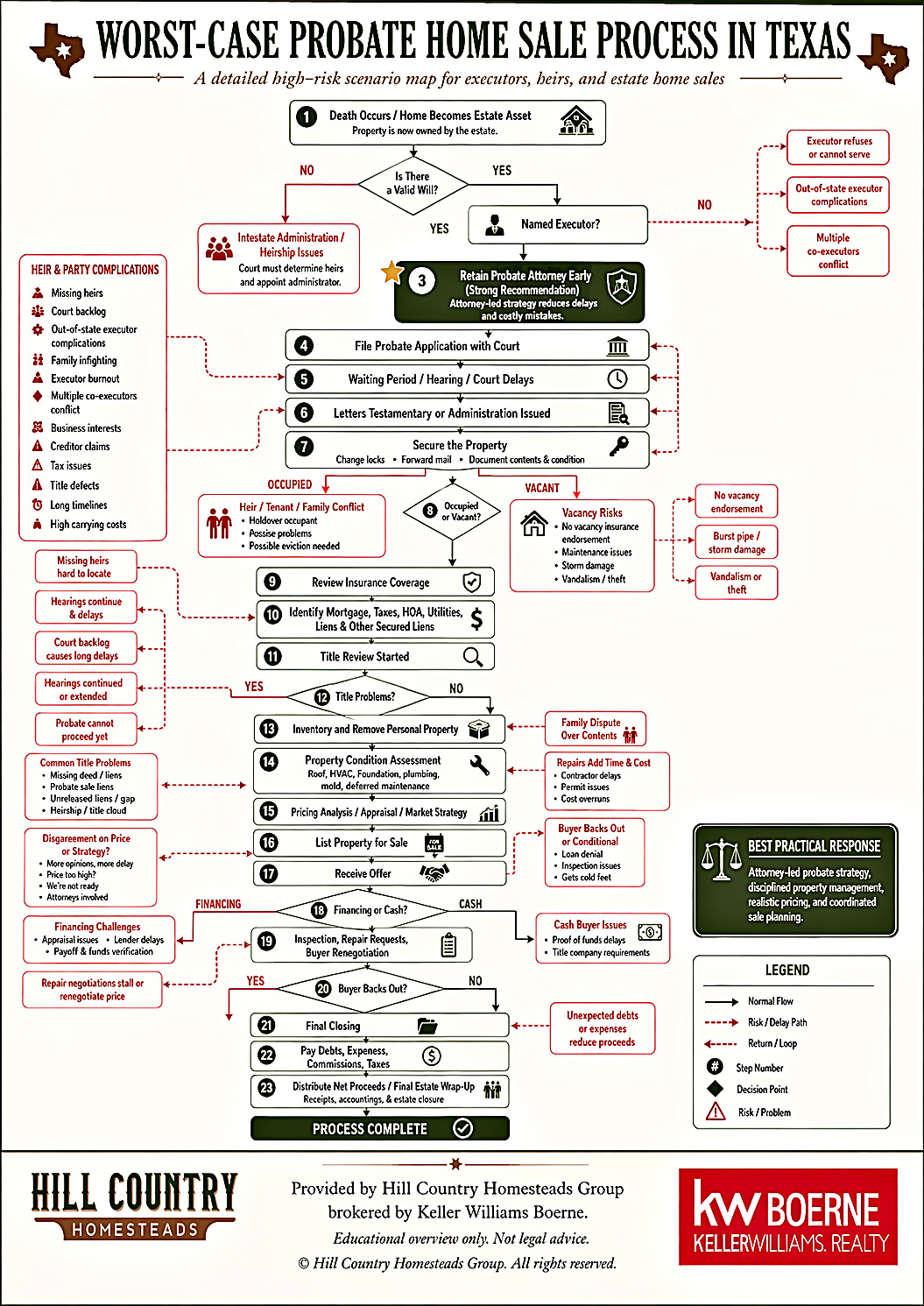
The flowchart below illustrates the worst-case probate home sale process in Texas — from the owner's death through distribution of proceeds — including branching risk and delay paths. It gives you the full picture before we walk through each step in detail.

Flowchart showing the worst-case probate home sale process in Texas, illustrating 23 numbered steps from the owner's death through distribution of proceeds, with branching risk and delay paths highlighted in red.
Worst-Case Probate Home Sale Process in Texas — scroll horizontally on mobile to view detail.
1

Authority and Decision-Making

Everything starts with authority. Before you can list, sign, negotiate, or sell, you need to know who actually has the legal right to make decisions and sign documents. That might be the executor named in the will, an administrator appointed by the court, a trustee, a surviving spouse, co-owners, or beneficiaries under specific circumstances.

Don't assume the most vocal family member has authority. Authority comes from the court, not from family consensus. Verify it through proper legal channels.

Build Your Professional Core Team Early

The earlier you assemble the right professionals, the smoother the process moves. Your core team typically includes:

  • Estate attorney — your legal guide through probate
  • Real estate agent experienced with estate sales — someone who understands probate timelines and court coordination
  • Title company — to surface liens, title defects, and ownership questions
  • CPA — for tax implications of the sale and estate
  • Insurance agent — to confirm coverage during the estate period
  • Cleanout and estate-sale companies — for personal property
  • Appraiser and contractors — for condition assessment

Build Your Working File and Timeline

Create a master file with the will, court filings, letters testamentary or administration, trust documents, deed, title policy, mortgage, taxes, HOA, insurance, utilities, surveys, repair invoices, and leases. Build a master timeline with legal milestones, property-security tasks, cleanout deadlines, listing-prep steps, court/title dependencies, and carrying costs by month.

2

Immediate Property Control

The moment you have authority, secure the property. This isn't about being paranoid — it's about protecting the estate from loss, disputes, and insurance complications.

Secure Access

Change or rekey locks if appropriate. Collect all keys, garage remotes, and alarm codes. Document who is allowed to enter. Reduce casual family traffic. A house with uncontrolled access is far more likely to suffer missing items, disputes, and insurance headaches.

Protect the Paper Trail

Gather deed records, mortgage mail, tax notices, insurance correspondence, HOA notices, utility bills, and contractor invoices. Forward or monitor mail so late notices don't pile up unnoticed. Open a simple tracking log showing what arrived, when it arrived, and what action was taken. Missing mail can translate into missed premiums, tax penalties, HOA issues, or a delayed closing.

Preserve Condition from Day One

Basic maintenance guidelines: mowing, edging, leaf removal, porch cleanup, pest control, pool service, HVAC checks, leak checks, and routine walkthroughs after storms. Vacant properties deteriorate faster than families think. Small maintenance neglect can quickly become buyer-facing condition stigma.

3

Insurance, Utilities, and Service Continuity

Determine Occupancy Status

Is the property occupied, partially occupied, or vacant? The answer affects insurance, liability, utility costs, and maintenance requirements.

Confirm Coverage Immediately

Ask the insurance agent whether the current policy remains effective after death, whether vacancy endorsements or different coverage are needed. Do not assume existing coverage is sufficient.

Decide What Stays On

Decide what services stay on (water, electricity for HVAC), what gets reduced, and what gets shut off. This decision affects carrying costs, property condition, and insurance compliance.

4

Contents, Personal Property, and Occupancy

The real-estate plan and the contents plan are separate things. Treat them that way from the start.

  • Document the home room by room before anything moves. Photographs and a written inventory protect everyone.
  • Decide early what will be kept, sold, donated, discarded, or transferred. The longer this decision is delayed, the more it slows down the real-estate timeline.
5

Cash Position and Carrying Costs

Estate homes cost money every month they remain unsold. Building a realistic monthly burn-rate estimate early helps you understand the true cost of delay.

  • Identify where the estate's operating cash will come from.
  • Document who paid what and why. Every expense should be tracked and documented.
  • Include mortgage payments (if any), property taxes, insurance, utilities, HOA dues, and maintenance in your monthly estimate.
6

Title, Debt, and Lien Investigation

Title issues are among the most common causes of delayed or failed estate sales. Surface them early.

  • Confirm exactly how title is held. Joint tenancy, tenancy in common, community property — each has different implications for authority and sale.
  • Surface every debt tied to the property. Mortgages, HELOCs, tax liens, HOA liens, contractor liens — anything that could encumber the title.
  • Hunt for hidden title defects before the house hits the market. A title company can run a search and surface issues that might otherwise derail the closing.
7

Probate and Sale Timing Checkpoints

Confirm Authority Before Going Too Far

Don't invest time and money in repairs, cleaning, or marketing before confirming you have the legal authority to sell. Premature activity can create problems.

Coordinate the Team

The attorney, title company, and listing agent need to be on the same timeline. Coordinate early and maintain regular communication.

Anticipate Slowdowns

Court scheduling, holiday periods, title defects, and family disagreements all affect timing. Build buffer time into your plan.

8

Family Dynamics and Beneficiary Management

The house is often the most emotional asset in an estate — and the most expensive to mishandle.

  • Establish communication rules at the outset. Who gets updates, how often, and through what channel?
  • Resolve predictable conflict points before the listing goes live. Pricing disagreements, repair decisions, personal property disputes — address them early.
  • Keep a documented decision trail. Every major decision should be documented. This protects the executor and creates clarity for all parties.

The selling process has its own set of considerations.

From condition and pricing through disclosure, marketing, contract negotiation, and closing — the selling guide covers everything that happens once the property is ready for market.

Educational Notice: This guide provides general educational information about probate real estate in Texas. It does not constitute legal, tax, or financial advice. Always consult a qualified Texas estate attorney and appropriate licensed professionals for guidance specific to your situation.