

When a loved one passes away, the last thing anyone wants to think about is money. The house is full of memories, the paperwork is overwhelming, and the family needs time to grieve. Nobody is in a rush to make decisions about real estate when they are still processing a loss.
But here is the reality that every executor and family should understand as early as possible: the moment a home goes from occupied to unoccupied, it stops generating value and starts consuming it. Every single month that property sits without a clear plan, the estate is paying — in property taxes, insurance premiums, maintenance obligations, HOA dues, utility minimums, and the slow erosion of market value that comes from deferred attention.
None of this is meant to add pressure to an already difficult situation. It is meant to replace guesswork with numbers. When families understand the actual monthly cost of inaction, they are in a much better position to make decisions that protect the estate's value — and ultimately, the heirs' inheritance.
This article provides general educational information about estate property carrying costs in Texas and is not legal, tax, or financial advice. Every estate, property, and family situation is different. Consult a licensed Texas estate attorney, CPA, and other qualified professionals for guidance specific to your circumstances.
1. Property Taxes — They Never Stop
Texas has no state income tax, which means property taxes carry a heavier load than in most other states. See our Boerne property tax guide for details on ongoing tax obligations. For estate properties, this creates an immediate and non-negotiable monthly expense — one that does not pause for probate proceedings, family deliberation, or emotional readiness.
In the Hill Country counties where most estate properties in this market are located, effective property-tax estimates commonly range from just under 1% to around 1.9%, while selected combined local taxing scenarios can run higher [1]:
| County | Example Planning Rate | Annual Tax on $450K Home | Monthly Cost |
|---|---|---|---|
| Bexar County | 1.55% | $6,975 | $581 |
| Kendall County | 1.86% | $8,370 | $698 |
| Bandera County | 1.01% | $4,545 | $379 |
| Comal County | 0.96% | $4,320 | $360 |
Rates are rounded planning examples compiled from local taxing-unit rate sources. They are not guarantees and should be replaced with the property's actual tax bill before making estate decisions.
The Homestead Exemption Problem
When the homeowner was alive and occupying the property, the homestead exemption likely reduced the taxable value significantly. Texas law requires school districts to provide a $140,000 residence homestead exemption for a qualifying principal residence. Homeowners age 65 or older or disabled may receive an additional $60,000 school-district exemption. Counties that collect farm-to-market or flood-control taxes must provide a $3,000 residence homestead exemption, and other local taxing units may offer optional exemptions [2].
After the homeowner dies, the exemption does not automatically transfer to the estate. However, the exemption may not be lost in every case. A surviving spouse with a life estate who continues to occupy the home may qualify to maintain the exemption. An heir who occupies the inherited property as a principal residence may also qualify under the inherited-residence homestead rules, provided the required documentation is filed with the local appraisal district [2, 14]. The exemption is most at risk when no qualifying person occupies the home. Losing the $140,000 school-district homestead exemption can add meaningful annual taxes, but the amount should be calculated using the applicable school-district tax rate. Other local exemptions, if available, must be analyzed separately.
The bottom line: the estate is often paying more in property taxes than the homeowner was paying while alive. And those taxes are due regardless of whether probate has been resolved, whether heirs have agreed on a plan, or whether the property is occupied.
Under Texas Tax Code § 31.02, property taxes are due on receipt of the tax bill and generally become delinquent if not paid before February 1 of the year following the tax year. Once delinquent, penalties and interest are governed by Texas Tax Code Chapter 33 [3]. For planning purposes, estate homes that often lack the homestead exemption may face an illustrative combined local rate of around 1.86% of assessed value — translating to roughly $698 per month on a $450,000 property. But legally, Texas property taxes are annual taxes. If the annual bill is not paid before the delinquency date, penalties, interest, and possible collection costs apply to the unpaid balance — money that comes directly out of the estate's eventual proceeds.
2. Insurance — The Cost Goes Up When You Need It Most
Most families do not realize that their loved one's homeowner's insurance policy may not adequately cover a vacant or unoccupied property. Our property insurance guide explains Hill Country coverage requirements. Coverage depends on the policy, but the Texas Department of Insurance warns that most companies stop coverage if a house is vacant for 60 days or more, although liability coverage may continue [4]. Executors should notify the insurance agent promptly when a home becomes vacant or unoccupied and confirm whether a vacancy endorsement, unoccupied dwelling endorsement, or replacement policy is required. This is not a minor policy detail — it is a coverage gap that can leave the estate exposed to catastrophic loss.
Insurance costs vary sharply by carrier, replacement cost, construction type, location, claim history, coverage amount, deductible, and vacancy status. For planning purposes, executors should use the current policy premium and request a written quote for vacancy or unoccupied-dwelling coverage rather than relying on a statewide average.
Annual Insurance Cost Comparison
Illustrative comparison for a $450,000 Hill Country home. Actual premiums vary by carrier, replacement cost, coverage amount, deductible, construction type, location, claims history, vacancy status, and policy terms. TDI guidance supports the vacancy-coverage risk; executors should request a written quote for the specific property.
Vacant vs. unoccupied — the distinction matters. Insurance companies treat these two conditions very differently. A property is generally considered unoccupied when the owner is absent but furniture, appliances, and personal belongings remain — the home looks lived-in even though no one is there. A property is vacant when it is completely empty: no furniture, no curtains, no personal items at all. Vacant properties face much higher premiums, potential coverage denial, or outright policy cancellation. The practical difference can be thousands of dollars per year — or worse, a denied claim after a loss.
Insurance Tip: Ask Before Moving Anything
Do not assume that leaving furniture behind preserves coverage. Some insurers distinguish between vacant and unoccupied property based on furnishings, utilities, intended use, and actual occupancy, but the policy language controls. Before removing furniture, shutting off utilities, or leaving the property unattended for an extended period, ask the insurance agent how the carrier defines vacancy and unoccupancy — and get the answer in writing.
Some carriers charge more for vacancy or unoccupied-dwelling endorsements, depending on the property, carrier, and coverage terms. But compare it to the alternative. If the property suffers a fire, burst pipe, storm damage, or theft while sitting uninsured or underinsured, the estate absorbs the full loss. Water damage, mold remediation, theft, vandalism, or storm damage can easily turn into a five-figure estate expense if the property is uninsured, underinsured, or not inspected regularly [4]. The practical point is simple: confirming proper coverage is usually far less expensive than discovering after a loss that the estate was uninsured or underinsured.
There is also a fiduciary dimension to this. As the estate's executor, there is a legal duty to protect estate assets. Under Texas Estates Code § 351.101, an executor or administrator must take care of estate property as a prudent person would take care of that person's own property and must keep estate buildings in good repair, absent extraordinary casualties or court order [5]. Allowing insurance coverage to lapse on an estate property — or failing to obtain a vacancy endorsement when the property is clearly unoccupied — could expose the executor to personal liability. This is not hypothetical. It is the kind of oversight that creates real legal exposure.
3. Maintenance — A Vacant Home Still Needs Attention
There is a common misconception that an empty house does not need maintenance. The opposite is true. A vacant home in the Texas climate requires more proactive care, not less — because there is no one there to notice problems as they develop.
Here is what routine maintenance looks like for a typical Hill Country estate property:
| Category | Monthly Cost | Notes |
|---|---|---|
| Lawn care & landscaping | $150–$300 | Mowing, edging, leaf removal, seasonal treatment. HOA violations for neglected yards can add fines of $50–$200/day. |
| Pool maintenance | $125–$200 | If applicable. An unmaintained pool becomes a health hazard and insurance liability within weeks. |
| HVAC servicing | $50–$75 | Monthly filter checks and seasonal tune-ups. Neglected HVAC systems are a common source of expensive emergency repairs. |
| Pest control | $40–$80 | Quarterly treatments and monthly inspections. Vacant homes attract termites, rodents, and wasps quickly. |
| Periodic inspections | $50–$100 | Weekly walkthroughs or management visits to check for leaks, intrusion, and system failures. |
| Total maintenance range | $415–$755/mo | Average: ~$500/mo or $6,000/yr |
Illustrative estimates based on typical Hill Country vendor pricing for a mid-range residential property. Actual costs vary by property size, condition, service provider, and contract terms. HOA fine ranges reflect common provisions in Hill Country community governing documents.
The critical point is that deferred maintenance compounds. A routine lawn or pest-treatment visit that gets skipped for a few months can result in HOA fines, emergency remediation, or structural damage. An HVAC failure, termite infestation, neglected pool, or water leak can quickly turn into a four- or five-figure repair issue. Small, predictable expenses become large, unpredictable ones when they are ignored.
4. HOA Dues and Penalties — The Debt That Compounds
Many Hill Country properties — particularly in Boerne, Fair Oaks Ranch, and the newer subdivisions around San Antonio and New Braunfels — are governed by homeowners associations. HOA obligations do not pause when a homeowner dies. Monthly or quarterly dues continue to accrue, and the penalties for non-payment can escalate quickly.
Typical HOA dues in the Hill Country range from $100 to $300 per month, depending on the community's amenities and services [7]. Over the course of a probate proceeding that takes 12 to 18 months, unpaid dues can accumulate to $1,200 to $5,400 — before penalties and interest are added.
How HOA Debt Compounds Over Time
Ranges shown at $150–$300/mo base dues. Late fees, interest, and collection costs are additional.
Here is where the real danger lies: most Texas HOA governing documents allow the association to secure unpaid assessments with a lien against the property. That lien may have to be resolved before a title company will insure a sale. In some cases, unpaid assessments can also create foreclosure risk, although Texas law imposes important procedural limits, including court-order requirements for many property owners' association assessment-lien foreclosures [7].
Beyond the financial mechanics, the practical impact is real: an HOA lien complicates and delays the sale process. Title companies will flag the lien, buyers' title insurance underwriters will require it to be cleared, and the closing timeline extends while the estate scrambles to resolve the debt. A $1,800 HOA lien can easily add $5,000 to $10,000 in holding costs during the delay it creates.
5. Mortgage Payments — The Largest Silent Cost
If the estate home carries a mortgage, that payment does not pause for probate. The lender's obligation is to the note, not to the estate's timeline. Every month the mortgage goes unpaid, missed payments can trigger default, late fees, acceleration, foreclosure activity, and payoff complications that can interfere with a sale.
The scale of this cost depends on the remaining balance, but consider a realistic scenario for a Hill Country property:
Example: $300,000 Mortgage at 6.5% Interest
Monthly payment (P&I)
$1,896
Interest accrues daily
$54.11/day
6 months unpaid
$11,376
in payments alone
12 months unpaid
$22,752
+ late fees & penalties
24 months unpaid
$45,504
+ foreclosure risk
Beyond the raw payment amount, a mortgage in default triggers a cascade of consequences. Late fees typically range from 3% to 5% of the missed payment. The lender may accelerate the loan, demanding the entire remaining balance immediately. Foreclosure proceedings in Texas — which can proceed relatively quickly through the state's non-judicial foreclosure process — can result in the loss of the property at auction, often at a price well below market value [8].
The homeowner's death can complicate foreclosure, especially when probate administration is opened or when notice must be directed to heirs, the estate, or a personal representative. Texas still permits nonjudicial foreclosure in many deed-of-trust situations, but probate can create additional procedural risks, delays, and legal issues. The practical point for heirs is simple: do not assume probate stops the lender. Contact the servicer and estate attorney immediately.
For heirs, the emotional impact of losing a family home to foreclosure is severe. For the estate, it represents a worst-case financial outcome: the loss of the single largest asset, often for a fraction of its worth. The cost of making mortgage payments during probate is significant. The cost of foreclosure — whether judicial or non-judicial — is incalculable.
It is worth noting that successors in interest — heirs or executors who inherit a mortgaged property — may have rights to communicate with the loan servicer and continue making payments, according to the Consumer Financial Protection Bureau (CFPB) [15]. However, they need to work with the lender properly: notifying the servicer of the borrower's death, establishing their status as successor in interest, and maintaining open communication to avoid unnecessary default. Acting promptly can prevent many of the complications described above.
6. Utility Decisions — Do Not Shut Them Off Blindly
The instinct to cut utilities on an empty house is understandable, but utility decisions should be made deliberately. In many Texas estate homes, limited electricity and climate control should remain active to protect the structure, security system, and interior condition. Water, gas, irrigation, and pool equipment should be evaluated property by property with the insurance agent, plumber, and property manager. In some vacant homes, leaving water on creates major leak risk; in others, shutting it off creates odor, trap, irrigation, or maintenance problems.
Minimum utility costs for a vacant Hill Country home typically run $150 to $300 per month [4]:
- Electricity: $75–$150/month to run the HVAC at a conservative maintenance range, such as approximately 78°F in summer and 65°F in winter, unless the insurance carrier, HVAC contractor, or property manager recommends otherwise.
- Water: $30–$60/month minimum to keep P-traps sealed and prevent pipe stagnation.
- Gas: $25–$50/month if the property uses gas for heating or hot water.
The insurance implications are important. Some policies impose vacancy, maintenance, heat, water-shutoff, inspection, or reasonable-care requirements. Executors should ask the insurance agent what utilities must remain active, what inspections are required, and what steps are needed to keep coverage in force.
7. Opportunity Cost — The Money the Estate Is Not Making
Carrying costs are the money the estate is actively spending. Opportunity cost is the money the estate could be earning if the asset were liquidated and the proceeds were invested. This is the hidden cost that rarely shows up on any bill or statement — but it is often the largest single cost of delay.
Consider the math: a $450,000 estate property generates zero income while it sits vacant. Meanwhile, the estate is paying roughly $2,020 per month in carrying costs (excluding mortgage). If those same funds were invested conservatively — even in a high-yield savings account earning 4% to 5% annually — they would generate meaningful interest income.
Instead, the estate is losing over $2,000 per month. The spread between what the money could be earning and what it is actually costing is the true opportunity cost. Over 12 months, the difference between liquidating and holding can be substantial.
$450,000 Estate: Sold vs. Held
If Sold at Month 0
- Net proceeds after 6.5% selling costs: $420,750
- Invested at 4.5% for 12 months: +$18,934
- 12-month position: $439,684
If Held 12 Months (no mortgage)
- Sale price: $450,000
- Carrying costs: −$24,240
- Deferred repairs: −$8,000
- Selling costs: −$29,250
- 12-month position: $388,510
Estimated difference: $51,174 before accounting for market movement. Illustrative scenario using Kendall County tax rate, $450K property value, and average Hill Country carrying costs. Actual results vary by property, county, and market conditions.
8. Depreciation vs. Appreciation Risk — What the Market Might Do
Real estate markets move in cycles. The Hill Country and San Antonio metro area have seen strong appreciation over the past decade, but recent data suggests the market is mixed across segments. Recent Kendall County data does not show a simple price collapse; it shows a slower, more selective market. In Redfin's most recent published reading for Kendall County (February 2026), the median sale price was about $550,000, down 6.5% year over year, with median days on market of 129 [9]. For estate properties, the risk is less about a guaranteed market decline and more about time, condition, carrying costs, and buyer selectivity. In the broader San Antonio market, Redfin reported a median sale price of about $265,000 over the three months ending August 2026, down 1.9% year over year, with median days on market of about 58 [9].
For estate properties, the depreciation risk is amplified by two factors specific to probate situations:
- Deferred maintenance erodes value faster than market depreciation. A home that needs $10,000 in maintenance today will likely need $20,000 to $30,000 in reactive repairs after 12 months of neglect. Buyers in the Hill Country are discerning — they notice deferred maintenance, and they discount their offers accordingly.
- Carrying costs directly erode equity. Every dollar the estate spends on taxes, insurance, maintenance, and HOA dues during the holding period is a dollar that comes out of the eventual net proceeds. On a $450,000 home, 18 months of carrying costs can consume over $36,000 of the estate's equity — regardless of what the market does.
The counterargument — that the market might appreciate enough to offset carrying costs — is possible, but it should not be assumed without property-specific and market-specific evidence. On a $450,000 home with $24,240 in annual carrying costs, the property would need to gain about 5.4% in one year just to offset carrying costs before repairs, opportunity cost, and market risk. Recent Kendall County data shows a market where median sale prices have slipped and days on market have climbed [9]. The estate is essentially making a speculative bet with the heirs' inheritance when it holds a depreciable asset instead of converting it to cash.
9. Step-Up in Basis — The Hidden Tax Incentive to Sell Sooner
One of the most powerful — and most overlooked — financial factors in an estate home sale has nothing to do with carrying costs. It has to do with taxes. Specifically, the federal capital gains tax treatment that applies when an inherited property is sold.
Under IRS rules, heirs receive a step-up in basis to the property's fair market value at the date of the owner's death [10]. This means the tax basis of the home is reset to what it was worth on the day the owner died — not what the owner originally paid for it. If the heirs sell the property shortly after death for approximately the date-of-death fair market value, the taxable gain may be minimal or zero, depending on the final sale price, selling expenses, valuation support, improvements, and other tax factors.
But here is where delay becomes a tax problem. If the heirs hold the property for several years and it appreciates, they owe capital gains tax on the growth after the date of death. On a $450,000 home that appreciates to $500,000 over three years, the heirs would owe federal capital gains tax on the $50,000 of post-death growth — potentially $7,500 to $10,000 depending on their tax bracket (15% to 20% federal long-term capital gains rates; the 3.8% Net Investment Income Tax may apply to ultra-high earners) [10]. That is a tax liability that did not exist the day the owner died.
Step-Up in Basis: A Simplified Example Before Selling Expenses
Sell within 6 months of death
- Date-of-death value: $450,000
- Sale price: $450,000
- Stepped-up basis: $450,000
- Capital gains tax: $0
Sell 3 years after death
- Date-of-death value: $450,000
- Sale price: $500,000
- Stepped-up basis: $450,000
- Taxable gain: $50,000
- Capital gains tax: $7,500–$10,000
This is one reason executors and heirs should evaluate sale timing carefully instead of letting the property sit by default. Holding too long does not just cost money in monthly carrying expenses — it can also create a tax liability that would not otherwise exist. The step-up in basis is a one-time benefit. Once it is locked in at the date of death, every dollar of appreciation after that point is potentially taxable.
A Note on Vacant Property Damage and Capital Gains
If a vacant estate property suffers severe uninsured damage — a burst pipe, mold infestation, fire, or storm damage — the repair costs generally cannot be deducted as personal casualty losses by the heirs under current IRS rules [10, 11]. The Tax Cuts and Jobs Act (2017) eliminated the personal casualty loss deduction for most taxpayers, except in federally declared disaster areas. This means the estate absorbs the full cost of repairs with no tax offset. The equity is simply gone. This further reinforces the urgency of either maintaining the property properly or selling promptly, because uninsured or underinsured damage may leave the estate with limited recovery options and a materially lower net sale value.
10. Dependent Administration — When Court Supervision Adds Time and Cost
Most of the carrying-cost analysis in this article assumes the executor is acting under independent administration — the standard form of probate in Texas, where the executor has broad authority to manage, maintain, and sell estate property without ongoing court supervision [6]. Under independent administration, the executor can hire contractors, pay bills, negotiate with buyers, and make decisions quickly.
But independent administration is not always available. When there is no will, when heirs disagree, or when the court determines that the estate requires additional oversight, the court may order dependent administration [13]. Dependent administration can slow property decisions because sale authority, major repairs, listing decisions, and disputed expenses may require court approval or additional attorney involvement. Even when routine preservation expenses can be handled, the executor should confirm the proper process with counsel before committing estate funds.
The practical impact on carrying costs is severe. Consider what dependent administration means in real terms:
- Many significant expenses and sale-related decisions may require court approval or attorney involvement. Need to pay the lawn service? Confirm the proper process with counsel. Need to list the property? Confirm the proper process with counsel. Need to authorize emergency plumbing repairs? Confirm the proper process with counsel. Each step may require estate attorney billable hours — typically $200 to $400 per hour.
- Court hearings add weeks or months. Dependent administration moves at the court's schedule, not the estate's. A simple maintenance authorization that would take a day under independent administration can take four to eight weeks with dependent administration — during which the property continues to deteriorate and costs continue to accrue.
- Attorney fees multiply. Under independent administration, the executor pays for legal counsel when needed. Under dependent administration, attorney involvement is often more frequent, and the estate generally bears those added legal costs. Legal fees in a dependent administration can easily reach $15,000 to $30,000 or more, compared to $5,000 to $10,000 for a straightforward independent administration.
The result is a court-supervised process that can increase holding costs. The estate is paying more per month (through legal fees on top of normal carrying costs) while also moving slower (because every decision requires court approval). This is a combination that compounds the financial damage of delay — and it is largely outside the executor's control.
If the estate is under dependent administration, it is especially important to establish a clear timeline, communicate proactively with the court, and work with an attorney who can batch filings efficiently to minimize redundant hearings.
11. The Grief Delay — Why Families Wait and What It Costs
Understanding the carrying-cost math does not make the emotional side any easier. Grief is real, and it affects every family differently. The reluctance to make decisions about a loved one's home is entirely human and entirely understandable. But recognizing the pattern — and its financial consequences — is the first step toward breaking it.
Probate professionals see the same dynamics play out repeatedly:
- Decision paralysis. The executor is overwhelmed by the probate process itself and puts the property decision "on the list" for later. Weeks become months.
- Family disagreement. Multiple heirs have different opinions about whether to keep or sell the property. Without a resolution mechanism, the default outcome is inaction — and inaction has a monthly price tag.
- Sentimental attachment. The house feels like the last tangible connection to the person who died. Selling feels like letting go. This is deeply personal and deserves respect — but it should not be confused with a financial strategy.
- "We'll deal with it after probate closes." Probate can take 6 to 18 months or longer in Texas. Holding the property for the duration of probate — without a plan — means paying carrying costs for the entire period.
The emotional toll of the grief delay is real, but the financial cost is also real. And the most important thing to understand is that these two costs are not in competition. A family can grieve deeply and still take practical steps to protect the estate's value. Having a plan does not mean rushing. It means ensuring that the estate's largest asset is being maintained, insured, and positioned for the best possible outcome — even if the actual sale happens months down the road.
A Framework for the Family Conversation
When siblings or co-heirs disagree about whether to sell, the executor often needs to frame the conversation around shared financial reality rather than personal preference. Here is a brief, respectful approach:
"I have been tracking our monthly carrying costs — between taxes, insurance, and maintenance, we are spending roughly $2,020 per month. Over the next year, that is over $24,000 out of the estate's equity. I want to make sure we are all making this decision with the full picture, so we can protect everyone's share."
This approach replaces opinion with data, removes pressure from any single person, and gives the family a concrete number to react to. It shifts the question from "Should we sell?" to "Can we afford not to?"
12. When Delay Starts Consuming Equity
This is the section that brings the numbers together. For many estate properties, holding the home for 12 to 24 months can consume tens of thousands of dollars in equity before the eventual sale even occurs. Selling costs usually apply whenever the property sells, so the real financial damage of waiting is the carrying cost, deterioration risk, lost investment income, and market risk accumulated during the delay.
Cumulative Carrying Costs Over Time
$450,000 Hill Country home, no mortgage. Monthly carrying cost: $2,020.
The 15-Month Threshold
Selling costs usually apply whether the property sells now or later. The true incremental cost of holding is the carrying cost that accumulates each month.
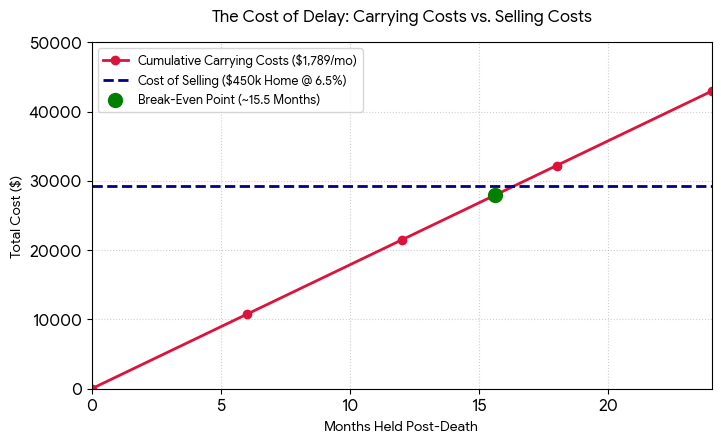
Cumulative costs based on $2,020/month illustrative carrying costs for a $450,000 Hill Country home: property tax at Kendall County illustrative combined local rate [1], insurance with vacancy endorsement per TDI guidance [4], HOA dues at $150/mo, minimal utilities at $200/mo, and maintenance at $500/mo. Selling cost assumes 6.5% total (commission plus closing). Actual figures vary by property, county, and market conditions.
Case Example: The Kendall County Estate
Illustrative hypothetical. This example combines common issues and does not describe a specific client or predict an outcome.
Consider a realistic scenario: a $450,000 home in Kendall County, no mortgage, standard Hill Country HOA community. The executor takes 18 months to make a decision and complete the sale.
Holding costs (18 months)
- Property taxes$12,564
- Insurance (vacancy)$8,496
- HOA dues$2,700
- Utilities (minimal)$3,600
- Maintenance & repairs$9,000
- Deferred repairs (at sale)$12,000
- Total holding cost$48,360
Selling at month 0
- Sale price$450,000
- Selling costs (6.5%)−$29,250
- Net proceeds$420,750
Net difference:
Holding cost $48,360 vs. Selling cost $29,250
Estimated cost of delay: $48,360 in holding costs and deferred repairs before considering lost investment income or market movement.
Because selling costs usually apply whether the property sells now or later, the true incremental cost of waiting is the estate's 18-month carrying cost plus any additional deterioration or deferred repairs. In this example, the 18-month carrying cost is $36,360, and deferred repairs add another $12,000, bringing the estimated cost of waiting to $48,360 before accounting for lost investment income or market risk. The $29,250 selling cost is not avoided by waiting; it is only postponed.
Illustrative scenario for a $450,000 Kendall County home. Property taxes use illustrative combined local tax rate [1]; insurance reflects vacancy endorsement per TDI guidance [4]; HOA, utilities, and maintenance at typical Hill Country rates. Selling cost assumes 6.5% total. Actual results vary by property specifics and market conditions.
The better question is not when carrying costs equal selling costs. Selling costs usually apply whenever the property sells. The better question is: how much would the property need to appreciate, or how much income would it need to generate, to justify holding it? On a $450,000 home with $24,240 in annual carrying costs, the property would need to gain about 5.4% in one year just to offset carrying costs before repairs, opportunity cost, and market risk.
The practical takeaway is not that every estate should sell immediately. It is that every estate should have a plan — and that plan should account for the real monthly cost of inaction. A well-prepared sale that happens quickly is almost always better financially than an unplanned sale that happens eventually.
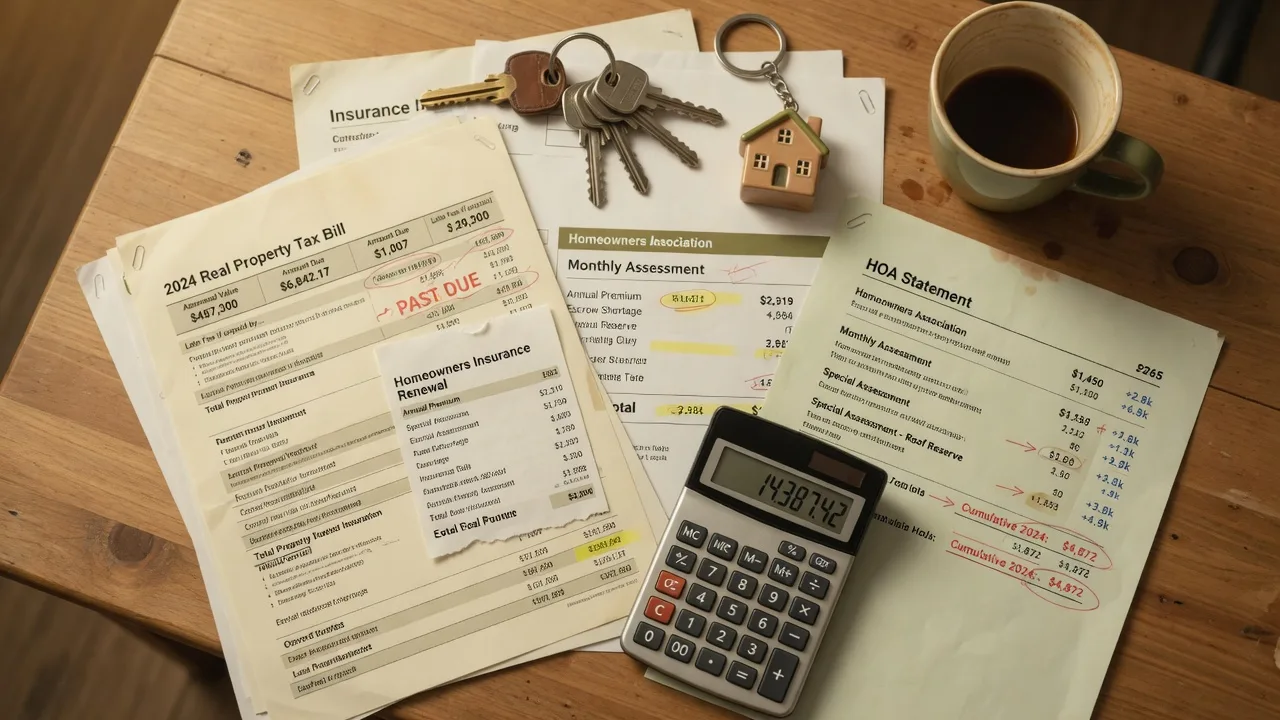
The Full Picture: Monthly Carrying Cost Breakdown
Typical Monthly Costs — $450K Hill Country Home (No Mortgage)
That is $24,240 per year — or $48,480 over a typical 24-month probate.
Monthly cost components for a $450,000 Hill Country home: property tax at Kendall County illustrative combined local rate [1], insurance with vacancy endorsement [4], HOA dues at $150/mo (typical for Hill Country communities [7]), minimal utilities $200/mo, and maintenance/landscaping $500/mo. Figures are illustrative estimates — actual costs vary by property, county, and service providers.
13. First 30 Days After Death: What the Executor Should Do With the House
Everything discussed in this article — the carrying costs, the appreciation math, the insurance gaps, the title complications — becomes easier to manage if the executor takes the right steps in the first month. The first 30 days are not about making permanent decisions. They are about establishing control, documenting condition, and preventing the kind of early neglect that compounds into expensive problems down the road.
Here is a practical, step-by-step checklist for the first month after the homeowner's death. Think of this as the foundation for everything that follows — whether the estate sells in three months or eighteen.
The First 30 Days: Executor Action Items
Secure the property and change locks if appropriate.
Collect all keys, garage remotes, and alarm codes. If there is any concern about who has access — ex-partners, estranged family members, former caregivers, tenants — rekey the locks immediately. Document who is authorized to enter the property and who is not. A house with uncontrolled access is far more likely to suffer missing items, unauthorized occupancy, and insurance complications.
Photograph the home's condition — interior and exterior.
Walk through every room and take dated photographs of walls, floors, ceilings, appliances, fixtures, and any existing damage. Photograph the exterior from multiple angles, including the roofline, foundation, landscaping, driveway, and fencing. These photos serve as baseline documentation for insurance purposes, condition disclosures, and any future disputes about the property's state at the time of death. Do not skip the less visible areas — under sinks, inside the garage, attic spaces, and the HVAC closet.
Confirm existing homeowner's insurance coverage and notify the carrier.
Call the insurance agent or carrier immediately. Confirm whether the current policy remains effective after the homeowner's death. Coverage depends on the policy, but the Texas Department of Insurance warns that most companies stop coverage if a house is vacant for 60 days or more, although liability coverage may continue. Ask what endorsements or policy changes are needed. Get the answer in writing. Failure to notify the carrier of a change in occupancy status can void coverage at the worst possible time.
Identify all mortgage, HOA, and utility accounts.
Gather statements for every account tied to the property. This includes the mortgage servicer (name, account number, payment amount, due date), the HOA management company (account number, dues amount, payment frequency), and all utility providers (electric, gas, water, sewer, trash, internet, pest control, lawn service, pool service, security monitoring). Create a single reference list with account numbers, contact information, and payment history.
Set up lawn care, seasonal cleanup, and exterior maintenance.
If the property is in an HOA community, a neglected yard can generate daily fines of $50 to $200 or more. Even without an HOA, local code enforcement can issue citations for overgrown vegetation. Arrange a lawn service contract immediately. If the property is in an area with freeze risk, ensure irrigation is winterized and exposed pipes are protected. Do not wait until the first citation arrives.
Set HVAC to a conservative maintenance temperature.
Set the HVAC to a conservative maintenance range, such as approximately 78°F in summer and 65°F in winter, unless the insurance carrier, HVAC contractor, or property manager recommends otherwise. This prevents pipe damage during rare freeze events, inhibits mold growth caused by humidity swings, and protects hardwood floors, cabinetry, and paint from heat-related warping. An HVAC system running at a moderate setpoint costs $75 to $150 per month in electricity — a fraction of the damage that results from turning it off entirely.
Arrange weekly or biweekly inspection visits.
A vacant property needs eyes on it regularly. Assign someone — a trusted family member, a neighbor, a property manager, or a professional inspection service — to walk through the property at least every two weeks. The purpose is to catch problems early: water leaks, roof damage after storms, HVAC failures, pest intrusion, signs of forced entry, or landscaping issues. An undetected water leak that runs for two weeks in a vacant home can easily cause a five-figure estate expense if the property is uninsured, underinsured, or not inspected regularly.
Gather all relevant financial statements.
Collect the most recent property tax statement, mortgage statement, HOA statement (including any resale or transfer requirements), insurance declarations page, and utility bills for the last 3 to 6 months. These documents are the raw data for calculating carrying costs, preparing the property for sale, and responding to questions from the estate attorney, title company, or potential buyers. Start a simple tracking log — even a spreadsheet — showing what arrived, when it arrived, and what action was taken.
None of these steps requires the executor to make permanent decisions about selling, keeping, or renovating the property. They are operational basics — the equivalent of stabilizing a patient before beginning treatment. But every one of them directly affects the estate's bottom line. A missed insurance notification can void a policy. A skipped lawn visit can trigger HOA fines. An ignored water leak can destroy a room. The first 30 days set the trajectory for every month that follows.
If the executor is overwhelmed — which is entirely understandable — the single most important step is confirming insurance coverage: call the insurance company. A coverage lapse on an estate's most valuable asset is the one mistake that can cause catastrophic, unrecoverable financial damage. Everything else can be delegated or caught up. Insurance cannot.
14. Sample Carrying-Cost Worksheet
Understanding carrying costs in the abstract is useful. Calculating them for your specific property is essential. The worksheet below gives executors a practical tool for building a realistic monthly and projected holding-cost estimate. Pull the actual numbers from the property's statements, insurance policy, HOA records, and utility bills — and fill in the blanks.
| Expense Category | Annual Amount | Monthly Estimate |
|---|---|---|
| Property tax bill | $__________ | Divide annual by 12 |
| Homeowner's insurance premium | $__________ | Include vacancy endorsement |
| Mortgage payment (P+I) | $__________ | $__________ |
| HOA dues | $__________ | $__________ |
| Electric | $__________ | $__________ |
| Gas | $__________ | $__________ |
| Water / sewer | $__________ | $__________ |
| Trash service | $__________ | $__________ |
| Internet / cable | $__________ | $__________ |
| Lawn / landscaping service | $__________ | $__________ |
| Pool service | $__________ | $__________ |
| Pest control | $__________ | $__________ |
| Inspection visits | $__________ | Est. cost × frequency |
| Security monitoring | $__________ | $__________ |
| Repair reserve (monthly set-aside) | N/A | $__________ |
| Estimated Total Monthly Carrying Cost | $__________ | |
| Projected Holding Period Number of months until sale: | ________ months | |
| Total Projected Holding Cost | Monthly × Months = $__________ |
How to Use This Worksheet
Start with the known numbers: property tax bill, insurance premium, mortgage payment, and HOA dues. These come from actual statements. For utilities, pull the most recent 3 months of bills and use the average — but remember that a vacant home's utility profile may differ from an occupied one, particularly for water and electricity. For lawn care, pest control, and inspection visits, get actual quotes from service providers. For the repair reserve, a common rule of thumb is 1% to 2% of the property's value per year, divided by 12.
Once you have a total monthly figure, multiply it by the expected number of months until the property is sold and closed. That product is your estate's total projected holding cost — the amount of equity that will be consumed by carrying costs during the holding period. If that number is larger than you expected, you are in good company. Most families underestimate their carrying costs by 30% to 50% because they omit expenses they do not think about — insurance adjustments, maintenance reserves, and the compounding effect of small monthly amounts over many months.
15. Required Appreciation to Justify Waiting
One of the most common reasons families hold an estate property is the belief that the market will improve and the home will be worth more if they wait. That reasoning is understandable — but it has a specific mathematical threshold that most families never calculate. For waiting to make financial sense, the property must appreciate enough to offset the carrying costs that accumulate during the holding period — plus repairs, opportunity cost, and market risk. If it does not, holding is costing the estate money in real terms.
The table below shows the minimum annual appreciation rate a property must achieve just to break even on carrying costs — at three common Hill Country price points:
| Home Value | Monthly Carrying Cost | Annual Carrying Cost | Min. Annual Appreciation to Break Even |
|---|---|---|---|
| $300,000 | $1,200 | $14,400 | 4.8% |
| $450,000 | $2,020 | $24,240 | 5.4% |
| $750,000 | $2,750 | $33,000 | 4.4% |
Illustrative break-even analysis. Monthly carrying costs include property taxes (based on illustrative combined local tax rates [1]), insurance with vacancy endorsement per TDI guidance [4], HOA dues, minimal utilities, and maintenance. Minimum annual appreciation = annual carrying cost ÷ home value. Actual break-even varies by property, county, exemptions, and market conditions.
These numbers represent the minimum appreciation required to cover carrying costs alone — before accounting for repairs, opportunity cost, market risk, or selling costs. The property must gain 4.4% to 5.4% in a single year just to tread water. If the property is unlikely to appreciate at that rate — and recent Hill Country market data shows mixed conditions with longer days on market and flat-to-modest appreciation in several segments — holding is costing the estate money.
Consider what this means in practice. A $450,000 home carrying $2,020 per month in costs needs to gain approximately $6,060 in value every quarter just to keep pace. Over a 12-month holding period, the property needs to be worth at least $474,240 at the end of the year to have broken even. If the market appreciates at 2% instead of 5.4%, the estate is underwater by roughly $15,240 — even though the home's nominal value went up. The family sees a higher list price but has less actual equity.
This is the key insight: appreciation and equity are not the same thing. A property can appreciate and still leave the estate with less money if the carrying costs exceed the appreciation. The question is not "Will the market go up?" The question is "Will the market go up fast enough to offset what we are spending every month to hold this property?" For most estate properties in most market conditions, the answer is no.
16. When Holding May Be Rational
The carrying-cost math strongly favors acting sooner rather than later — but there are situations where a short-term hold is both justified and financially defensible. The key distinction is that a rational hold is driven by a specific, time-limited constraint with a known resolution path, not by indecision, emotion, or a hope that conditions will improve.
Here are the circumstances under which holding an estate property for a defined period may make sense:
Title defect that must be resolved before sale.
If a title search reveals an unreleased lien, a boundary encroachment, or a chain-of-title problem, the property cannot sell with clear title until the defect is cured. This may take 60 to 120 days, depending on the nature of the issue and the responsiveness of the parties involved. Holding during this period is operationally necessary.
Letters testamentary or letters of administration not yet issued.
Without court-issued letters, the executor or administrator generally cannot sign listing agreements, transfer deeds, or conduct other legal transactions on behalf of the estate. This is a procedural delay, not a strategic choice — and the carrying costs still apply. The estate should be preparing for sale during this time, even if it cannot execute one yet.
Dependent administration requiring court approval for the sale.
When the estate is under dependent administration, the executor must obtain a court order before listing or selling property. This adds time — typically several weeks to a few months — but the delay is legally required. The estate should minimize costs during this period and work with counsel to expedite the court filings.
A short-term repair that prevents a significant market discount.
Some repairs have an outsized return on investment. A roof replacement that costs $12,000 to $15,000 but prevents a $30,000 price reduction may justify a 30-to-60-day hold. The math must be specific: the cost of the repair plus the additional carrying costs during the repair period must be less than the market discount the repair avoids. If the numbers do not support it, sell as-is.
Pending heir buyout negotiation.
If one heir wants to purchase the property from the estate, a short holding period may be justified while the buyout is negotiated, appraised, and documented. This should have a clear timeline and should not be used as an indefinite delay.
Surviving spouse or minor child occupancy rights under Texas law.
Texas law provides homestead rights to a surviving spouse and minor children that may affect the timing and process of a sale. A surviving spouse with a life estate or a minor child residing in the home may have occupancy rights that must be addressed before the property can be marketed. The estate attorney should advise on the specific legal requirements.
A very specific market-timing reason backed by current data.
In rare cases, there may be a data-driven reason to wait — a major employer announcing a relocation to the area, a planned infrastructure project that will increase property values, or a seasonal market pattern supported by actual transaction data. The key word is "data." A vague sense that "the market is going to pick up" is not a strategy — it is a guess with the heirs' equity on the line.
"Grief" or "we'll deal with it later" is not a financial plan. The carrying costs continue regardless of the family's emotional readiness. A rational hold acknowledges the carrying-cost math and sets a defined timeline with a specific resolution goal. An irrational hold defers the decision indefinitely while the estate's equity erodes month by month. The distinction matters — because the estate pays the same amount every month whether the family has a plan or not.
17. Executor Authority to Sell — The Legal Framework
Before an estate property can be listed, someone needs the legal authority to sign the listing agreement, accept offers, and transfer the deed. In Texas, that authority depends on the type of administration the estate is under, what the will says, and whether all parties are in agreement. Understanding this framework helps executors and families set realistic timelines and avoid costly missteps.
Independent Administration
This is the most common form of probate in Texas when a will is present. Under independent administration, the executor (or administrator, in some cases) has broad authority to manage, maintain, and sell estate property without ongoing court supervision. The executor can hire contractors, pay bills, negotiate with buyers, sign listing agreements, and execute deeds — all without seeking court approval for each transaction. This is the fastest and least expensive path to selling an estate property, and it is the standard assumed in most of this article's carrying-cost analysis. Independent administration is authorized under the Texas Estates Code, Chapter 401 [6].
Dependent Administration
When there is no will, when heirs disagree, or when the court determines that additional oversight is needed, the court may order dependent administration. Under dependent administration, many significant actions may require prior court approval or attorney involvement, including listing the property, accepting offers, authorizing major repairs, and resolving disputed expenses. Each step may require a court motion or attorney guidance, which adds time (typically four to eight weeks per hearing), attorney fees ($200 to $400 per hour for billable time), and carrying costs that continue to accrue while the estate waits for authorization. Dependent administration is governed by Texas Estates Code, Chapter 356 [13].
Will-Based Power of Sale
Some wills include a specific power of sale clause that grants the executor explicit authority to sell real property without additional court approval. This provision streamlines the process and can reduce both the timeline and the attorney fees associated with the sale. If the will contains this language, the executor should have the estate attorney confirm it early in the process — before making commitments to timelines, contractors, or buyers.
Heir Consent Issues
Even with independent authority, disputes among heirs can delay or complicate a sale. If co-heirs disagree about the listing price, the timing, or whether to sell at all, the executor may face a practical impasse. Options include mediation, a family settlement agreement drafted by the estate attorney, or — as a last resort — a partition action filed in district court to force a sale [12]. The key point for carrying-cost purposes: every month the family spends in disagreement is a month the estate spends paying taxes, insurance, maintenance, and HOA dues. Resolving heir consent issues early is one of the highest-value actions an executor can take.
For a summary of the differences between independent and dependent administration in Texas, see the TexasLawHelp resource on independent vs. dependent administration.
18. Documents to Collect Before Talking to a Real Estate Professional
One of the most practical steps an executor can take — and one that most families do not know about — is gathering the estate's property-related documents before meeting with a real estate agent, attorney, or title company. Having these documents organized accelerates every subsequent step: pricing the property, clearing title, preparing disclosures, and getting the listing underway.
Document Checklist for Estate Property Sales
Certified death certificate
Order multiple certified copies — you will need them for the court, the title company, the mortgage servicer, the insurance carrier, and utility transfers.
Original will or certified copy
The original will must be filed with the probate court. A certified copy or the attorney's file copy can be used for other purposes.
Letters testamentary or letters of administration
Once issued by the court, these documents establish the executor's or administrator's legal authority to act on behalf of the estate.
Most recent mortgage statement
Shows the remaining balance, monthly payment, interest rate, and servicer contact information.
Current property tax statement
Shows the assessed value, tax rate, exemptions, and any delinquent amounts.
HOA statement and resale package (if applicable)
Includes current dues balance, transfer fees, resale certificate requirements, and any outstanding assessments.
Insurance declarations page
Shows current coverage amounts, policy limits, deductible, and any endorsements. Essential for understanding the property's insurance status.
Current survey (if available)
The most recent survey can clarify boundary lines, easements, encroachments, and building setback compliance. If no survey exists, one may need to be ordered.
Deed to the property
Establishes how title is held and confirms the chain of ownership. This is the foundational document for any title work.
Original title policy (if available)
May provide coverage for certain title defects and can expedite the reissue process when the property is sold.
Repair records or contractor estimates
Documentation of past repairs, maintenance history, and any pending contractor estimates helps with pricing and disclosures.
Recent utility bills
Helps estimate carrying costs and provides a record of continuous service.
List of known liens or judgments
Any known debts, tax liens, contractor liens, HOA liens, or court judgments attached to the property should be disclosed early to avoid surprises during title work.
This list may seem long, but most of these items are already in the family's possession — in a file cabinet, a drawer, or an email inbox. The act of gathering them into one organized folder is itself a form of progress. It converts scattered information into a coherent record, and it signals to the estate attorney, real estate agent, and title company that the executor is organized and ready to move forward. That impression matters — it can affect how quickly professionals prioritize the estate's work.
19. Title Problems That Add Carrying Costs
Title issues are one of the most underappreciated sources of carrying-cost escalation in estate properties. A title defect does not just delay the sale — it forces the estate to continue paying taxes, insurance, maintenance, and HOA dues while the problem is investigated, negotiated, and resolved. In some cases, resolving a title issue can take months, and the carrying costs during that period can easily exceed the cost of the original problem.
Here are the most common title problems that add carrying costs in estate properties:
Unpaid property taxes creating tax liens.
If the estate fails to pay property taxes on time, the county can place a tax lien on the property. Under Texas Tax Code Chapter 32, property-tax liens are given strong priority over many other property interests, including many creditor and lienholder claims. Delinquency penalties, interest, and tax-sale procedures are addressed separately in Texas Tax Code Chapter 33 [3]. The estate must satisfy the lien — including penalties, interest, and attorney fees — before the property can be sold with clear title.
Unreleased liens from prior owners or contractors.
A contractor who performed work on the property and was not paid may have filed a mechanic's lien. A prior owner's debt may have resulted in a judgment lien that was never released. These liens surface during the title search and must be resolved before closing — often requiring legal research to confirm they are valid, negotiation to settle them, and recording a release.
Reverse mortgage payoff obligations.
If the property has a reverse mortgage, the full loan balance becomes due upon the borrower's death. The estate must either satisfy the balance, arrange for a short sale, or negotiate with the lender. This is discussed in more detail in the section below on reverse mortgages.
Medicaid estate recovery claims.
If the decedent received Medicaid benefits, the state of Texas may file an estate recovery claim against the property. These claims can delay or complicate a sale and must be resolved through the Medicaid Estate Recovery Program before title can transfer cleanly.
Missing probate authority preventing sale.
If the executor or administrator has not yet been appointed, or if letters testamentary have not been issued, there is no one with legal authority to sign a listing agreement or deed. This is a procedural title issue, not a defect — but it still delays the sale and extends the carrying-cost period.
Heirship disputes or unknown heirs.
If there are competing claims to the estate, missing heirs, or disputes about who is entitled to the property, the title cannot be cleared until all claims are resolved. This may require an heirship proceeding, an affidavit of heirship, or court intervention — each of which adds time and legal cost.
HOA transfer fees and outstanding assessments.
HOAs often require a resale certificate and may charge transfer fees. If there are outstanding assessments, special assessments, or pending violations, these must be resolved before the title company will issue a policy. The HOA can also place a lien that must be cleared.
Old judgments attached to the property.
A judgment against a prior owner — or even the decedent — can attach to the property as a lien. These may be years old and difficult to locate without a thorough title search. Resolving them requires legal research, potential negotiation with judgment creditors, and recording releases.
Deceased co-owner issues.
If the property was held as tenants in common, the deceased co-owner's interest must pass through their estate before it can be sold. If the property was held as joint tenants and the survivorship documentation is unclear, a court proceeding may be required to establish the surviving owner's interest. Each of these scenarios adds time, legal fees, and carrying costs.
The common thread in all of these scenarios is delay. A title problem that takes 90 days to resolve costs the estate 90 days of carrying costs — on a $450,000 home, that is roughly $4,600 to $5,300 in additional expenses before a single dollar of the problem itself is resolved. This is why it is critical to order a title search and begin addressing any issues as early as possible — ideally before the property is listed. The cost of early title investigation is almost always less than the carrying costs it prevents.
20. Reverse Mortgages in Estate Properties
Many estate properties — particularly those owned by homeowners age 62 or older — carry a reverse mortgage. These loans are common in the Hill Country and San Antonio metro area, and they create a specific, time-sensitive set of challenges for executors and families. Understanding how reverse mortgages work after the borrower's death is critical to protecting the estate's equity.
A reverse mortgage allows homeowners aged 62 and older to borrow against the equity in their home without making monthly payments. The loan becomes due and payable when the last surviving borrower dies, permanently leaves the home, or fails to maintain the property or pay required taxes and insurance. At that point, the full loan balance — principal, accrued interest, mortgage insurance premiums, and servicing fees — becomes due.
What Happens When a Reverse Mortgage Borrower Dies
The lender issues a due-and-payable notice.
Per the Consumer Financial Protection Bureau (CFPB) [16], heirs generally receive a due-and-payable notice from the reverse mortgage servicer. This notice outlines the loan balance and the options available to the heirs.
Heirs typically have 30 days to respond.
Heirs typically have 30 days to respond with a formal letter of intent outlining their plans. Extensions may be available, often in 90-day increments, but they depend on the loan type, servicer requirements, HUD rules for HECMs, and the estate's continued communication and progress toward payoff or sale.
If the estate cannot satisfy the reverse mortgage, the lender can foreclose.
If the heirs do not act within the required timeframe and the lender forecloses, the estate loses control over the sale process. A foreclosure auction may produce less than a properly marketed sale, which can reduce or eliminate remaining equity. If the sale produces surplus proceeds after the debt, foreclosure costs, and superior claims are paid, those funds may still be recoverable by the estate or other entitled parties.
The critical takeaway for executors is speed. When a reverse mortgage is involved, every day of delay narrows the window for protecting the estate's equity. The executor should immediately identify the reverse mortgage servicer, confirm the outstanding balance, and determine whether the estate can satisfy the loan — either through sale of the property, refinancing, or funds from the estate. If the home is worth significantly more than the reverse mortgage balance, a sale can still generate meaningful proceeds for the estate. But the timeline is compressed, and the carrying costs continue to accrue during that window.
If the property is worth less than the reverse mortgage balance — meaning the loan exceeds the home's market value — the heirs may be able to negotiate a short sale or take advantage of federal protections that limit a borrower's (and heirs') liability for a deficiency balance on a federally insured reverse mortgage. The specifics depend on the type of reverse mortgage, the lender, and the loan terms. Consult the estate attorney and the reverse mortgage servicer immediately.
Practical note: Reverse mortgage balances grow over time because interest is added to the loan balance rather than paid monthly. A home that had $100,000 in equity when the reverse mortgage was taken out may have a much smaller equity cushion — or none at all — by the time the borrower dies. The executor should request a current loan balance statement from the servicer as soon as possible to understand the estate's actual financial position.
Frequently Asked Questions
What if the family cannot agree to sell?
Family disagreement is one of the most common reasons estate properties sit too long. If heirs cannot reach consensus, the executor has several options: mediation (often the fastest and least expensive), a family settlement agreement drafted by the estate attorney, or — as a last resort — a partition action filed in district court to force a sale [12]. The important thing to understand is that while the family debates, the carrying costs accumulate against all heirs equally. Every month of delay reduces the net value available for distribution. Some families find it helpful to calculate the monthly cost — roughly $2,020 or more depending on the property — and frame the conversation around protecting everyone's share.
Can the property be rented during probate to offset costs?
In most cases, yes — the executor generally has authority to lease estate property, especially under independent administration [5]. However, renting changes the property's insurance requirements, affects its condition, may complicate a future sale if tenants are in place, and requires proper documentation and accounting. Under a lease, the property is no longer "vacant" for insurance purposes, which may help maintain coverage. But the tenant must be properly screened, the lease must be documented, and the rental income must be accounted for in the estate's records. Discuss this option with the estate attorney and a property management professional before signing any lease.
What if the property is underwater or has little equity?
If the mortgage balance exceeds the property's market value, the carrying-cost calculation becomes even more urgent. The estate is paying to hold an asset that is worth less than the debt against it. In that situation, the estate may benefit from a short sale (selling for less than the mortgage balance with lender approval), a deed in lieu of foreclosure, or simply listing the property and negotiating with the lender on any deficiency. A real estate professional experienced with estate properties and a real estate attorney can help evaluate the options. The key point is that underwater properties do not become less underwater by sitting — the mortgage payments and carrying costs continue to erode whatever equity remains.
How do I calculate the total carrying costs for our property?
Start with the known costs and add the likely ones. Pull the most recent property tax statement and divide by 12 for a monthly estimate — property taxes are assessed annually, not billed monthly. Contact the insurance agent for the current premium and ask about the vacancy endorsement cost. Coverage depends on the policy, but the Texas Department of Insurance warns that most companies stop coverage if a house is vacant for 60 days or more, although liability coverage may continue. Get the current HOA statement. Add $150 to $300 for minimum utilities, but decide carefully with the insurance agent, property manager, and plumber which services should remain active. Add $300 to $500 for basic maintenance. If there is a mortgage, include the full payment. Add 10% to 15% as a contingency for unexpected repairs. Sum all of these and multiply by the expected holding period in months. This gives a realistic estimate of the estate's total carrying cost. If the number is uncomfortable, that is useful information — it means the family has a financial incentive to move toward a decision.
Do property taxes keep accruing during probate even if no one is living there?
Yes. Texas property taxes accrue annually regardless of occupancy, probate status, or the estate's readiness to pay [3]. Under Texas Tax Code § 31.02, property taxes are due on receipt of the tax bill and generally become delinquent if not paid before February 1 of the year following the tax year. Once delinquent, penalties and interest are governed by Texas Tax Code Chapter 33 [3]. The county can initiate foreclosure proceedings after taxes become delinquent. The estate is responsible for paying property taxes, and the executor has a fiduciary duty to ensure they are paid on time. Failure to pay property taxes can result in a tax sale, which could result in the loss of the property entirely.
Will the homestead exemption reduce our property taxes during probate?
It depends. Probate homestead rights and property-tax homestead exemptions are related but not identical. A surviving spouse, qualifying heir, or owner-occupant may be able to qualify for or continue a residence homestead exemption, but eligibility depends on ownership, occupancy, documentation, and appraisal-district approval. An heir occupying inherited property as a principal residence may need to file inherited-residence homestead documentation with the appraisal district [2]. The exemption is most at risk when no qualifying person occupies the property. Texas law requires school districts to provide a $140,000 residence homestead exemption for a qualifying principal residence. Homeowners age 65 or older or disabled may receive an additional $60,000 school-district exemption. Counties that collect farm-to-market or flood-control taxes must provide a $3,000 residence homestead exemption, and other local taxing units may offer optional exemptions. Losing the $140,000 school-district homestead exemption can add meaningful annual taxes, but the amount should be calculated using the applicable school-district tax rate. Other local exemptions, if available, must be analyzed separately. New owners or heirs who move into the home can apply for their own exemption with the local appraisal district.
What happens if the estate runs out of money to pay carrying costs?
This is more common than many people realize, especially early in probate before assets are liquidated. If the estate lacks sufficient cash to cover carrying costs, the executor can petition the probate court for authorization to sell assets, borrow against the estate's property, or arrange advances against the eventual sale proceeds. In some cases, heirs may agree to advance funds personally with the expectation of reimbursement from the estate. The important thing is to address the shortfall proactively — not to let bills pile up while hoping for a resolution. Unpaid property taxes lead to penalties and potential tax sales. Unpaid insurance leads to coverage gaps. Unpaid HOA dues lead to liens. Each of these consequences is more expensive to resolve than to prevent.
At what point do carrying costs exceed the benefit of waiting for a better market?
The better question is not when carrying costs equal selling costs. Selling costs usually apply whenever the property sells. The better question is: how much would the property need to appreciate, or how much income would it need to generate, to justify holding it? On a $450,000 home with $24,240 in annual carrying costs, the property would need to gain about 5.4% in one year just to offset carrying costs before repairs, opportunity cost, and market risk.
If the estate home has a mortgage, the combined monthly cost is significantly higher. Using the base carrying cost from the breakdown table ($2,020 per month) and adding the example mortgage payment from Section 5 ($1,896 per month for a $300,000 loan at 6.5%), the total monthly carrying cost rises to approximately $3,916. For mortgaged properties, the financial case for acting promptly is even stronger.
If there is no specific, time-limited reason to wait — such as completing a probate milestone, resolving a title issue, or finishing necessary repairs — the financial evidence favors acting sooner rather than later.
Understand the numbers before they become a problem
Every estate situation is different, but the carrying-cost math is universal. If you are managing an estate property and want help calculating the actual monthly cost of holding — or exploring what a well-timed sale might look like — a conversation with an experienced probate real estate professional can help put the numbers in context.
Bill Ross — Hill Country Homesteads Group, brokered by KW Boerne
Disclaimer: This article is for educational purposes only and does not constitute legal, tax, insurance, or financial advice. Property tax rates, insurance premiums, HOA dues, and carrying costs vary by individual property and circumstances. All figures are illustrative estimates based on publicly available Hill Country market data as of the publication date. Consult a qualified Texas estate attorney, CPA, insurance agent, and other licensed professionals for guidance specific to your situation.
Understanding probate house carrying costs Texas is essential for executors who want to protect the estate's value and maximize the heirs' inheritance.
Sources
- County Appraisal Districts — Bexar County (bcad.org), Kendall County (kendallad.org), Comal County (comalad.org), and Bandera County (banderaproptax.org); Texas Comptroller County Property Tax Directory (comptroller.texas.gov) — County appraisal districts and county tax offices — Bexar, Kendall, Comal, and Bandera; Texas Comptroller County Property Tax Directory — local taxing-unit rate schedules. Used to identify local taxing jurisdictions and rate sources. Illustrative tax estimates in this article are not guarantees and vary by property location, school district, city, special district, exemptions, and appraisal value.
- Texas Comptroller — Property Tax Exemptions; see also Texas Tax Code § 11.13 — Residence homestead exemption amounts ($140,000 school-district exemption; additional $60,000 for age 65+ or disabled; $3,000 county exemption for farm-to-market/flood-control taxing units)
- Texas Tax Code Chapter 32 — Tax Liens and Personal Liability; Texas Tax Code Chapter 33 — Delinquency — Texas Legislature (Chapter 32: property-tax lien priority over other interests; Chapter 33: delinquency penalties, interest, and tax-sale procedures)
- Home Insurance Guide — Texas Department of Insurance — Vacancy and unoccupied property coverage rules. Most insurers limit or eliminate some coverage if a home is vacant for 60 days or more, though they usually do not stop liability coverage.
- Texas Estates Code, Chapter 351 — Duties of Executor or Administrator — Texas Legislature (§ 351.101 prudent management standard for executor/administrator; duty to keep buildings in good repair).
- Texas Estates Code, Chapter 401 — Independent Executor: Powers and Duties — Texas Legislature (independent administration; executor authority to manage, maintain, and sell estate property without ongoing court supervision).
- Texas Property Code, Chapter 209 — Texas Residential Property Owners Protection Act — Texas Legislature (HOA assessment liens, foreclosure limitations)
- Foreclosure in Texas — Texas State Law Library — Overview of non-judicial and judicial foreclosure processes; see also Texas Property Code § 51.002
- Kendall County, TX Housing Market Data & San Antonio, TX Housing Market Data — Redfin, 2026 market data (Kendall County: median sale price ~$550K, down 6.5% year-over-year; median days on market 129; February 2026 reading. San Antonio: median sale price ~$265K, down 1.9% year-over-year; median days on market ~58; three months ending August 2026)
- IRS Publication 551 — Basis of Assets — Internal Revenue Service (step-up in basis rules, capital gains on inherited property)
- IRS Topic No. 515 / Publication 547 — Casualty, Disaster, and Theft Losses — Internal Revenue Service (casualty-loss rules; personal casualty loss deduction generally eliminated for most taxpayers under the Tax Cuts and Jobs Act except in federally declared disaster areas)
- Texas Property Code, Chapter 23 — Partition — Texas Legislature; see also Chapter 23A — Uniform Partition of Heirs’ Property Act
- Texas Estates Code, Chapter 356 — Dependent Administration of Estates — Texas Legislature (court supervision requirements, executor powers under dependent administration)
- Texas Estates Code, Chapter 102 — Probate Assets: Decedent’s Homestead — Texas Legislature (surviving spouse and minor child homestead rights during probate, prohibition on partition of homestead)
- CFPB — What Is a Successor in Interest? — Consumer Financial Protection Bureau (rights of heirs and executors to communicate with mortgage servicers; successor-in-interest notification requirements).
- CFPB — With a reverse mortgage loan, can my heirs keep or sell my home after I die? — Consumer Financial Protection Bureau (reverse mortgage due-on-death rules; heir options for satisfying, refinancing, or selling the home; federal protections limiting deficiency liability on HECM reverse mortgages).
Legal Disclaimer: The information provided in this article is for general informational and educational purposes only. It does not constitute legal, tax, insurance, financial, or professional advice. Every estate, probate proceeding, and real property transaction is unique, and the laws governing Texas probate, insurance, property taxation, and HOA obligations are subject to change. The author and Hill Country Homesteads Group are not law firms, insurance agencies, or CPA firms and do not provide legal, insurance, or tax representation. Readers should consult a licensed Texas probate attorney, insurance agent, CPA, or other qualified professional for advice specific to their individual circumstances. Reliance on any information in this article is solely at your own risk.