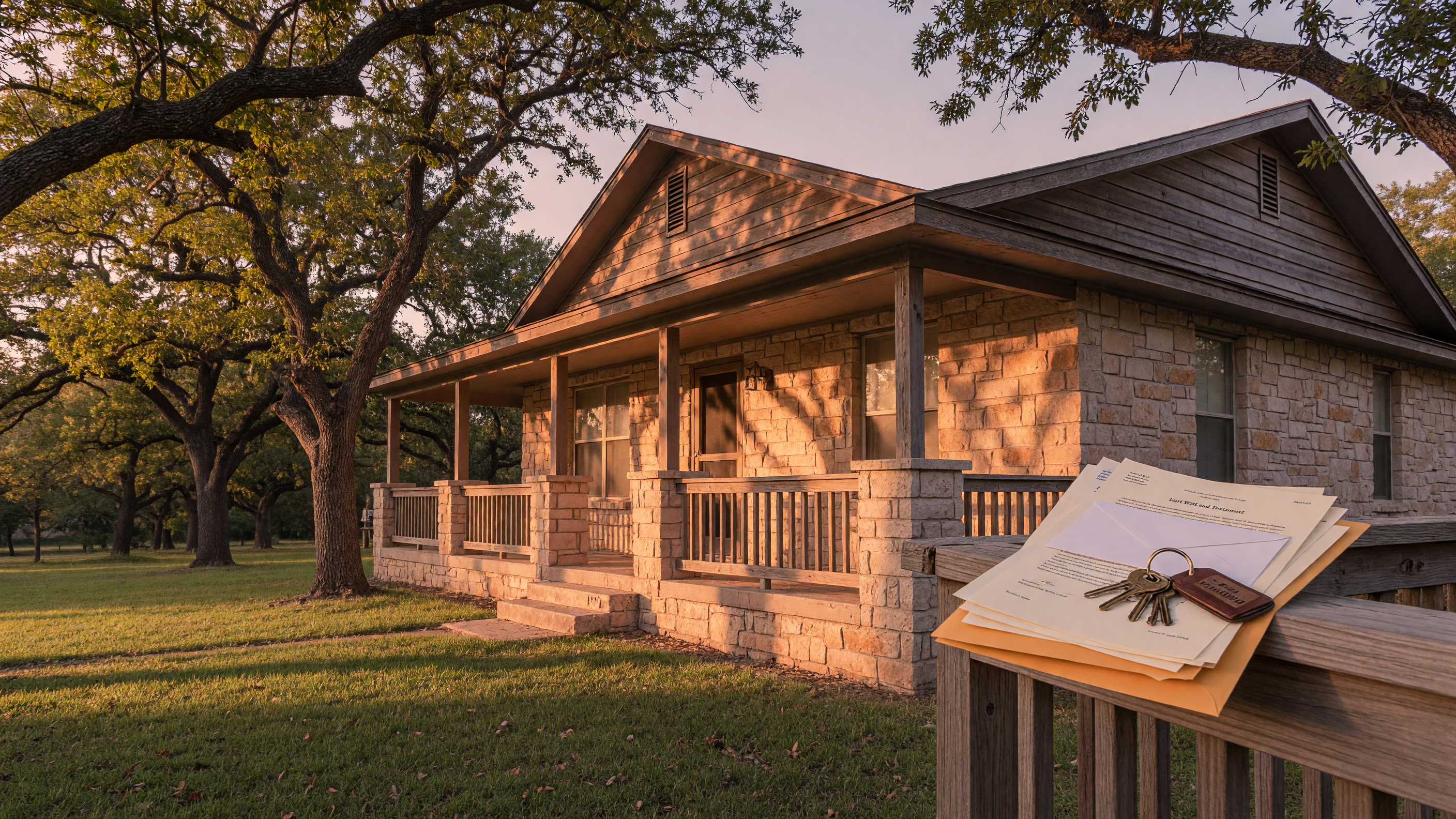

The house sits there. Everyone in the family has an opinion about what it's worth, and those opinions rarely match. One heir remembers summer barbecues on the back patio and thinks it's priceless. Another just wants the check cleared and the estate closed. A third read Zillow once and is now convinced the property is worth thirty percent more than any agent will tell them.
This is one of the most common friction points in probate sales. The house isn't just an asset. It's a repository of memory, identity, and sometimes decades of family history. Pricing it becomes the stage where all of that gets negotiated.
Here's how to work through it without destroying relationships or leaving money on the table.
This article provides general information about Texas probate and real estate practices and is not legal or tax advice. Every estate is unique. Consult a licensed Texas probate attorney for guidance specific to your situation.
Start With the Executor's Fiduciary Duty
In Texas, the executor or administrator has a legal obligation — codified in Texas Estates Code § 351.101 — to act in the best interest of all heirs and creditors. That means the pricing decision isn't a democracy. It's a fiduciary responsibility. The executor must establish a defensible, market-based price that protects everyone's financial interest.
An important caveat: the scope of the executor's authority depends entirely on the type of administration. This distinction is the single biggest variable in how a pricing dispute plays out.
Texas law strongly favors Independent Administration when a properly drafted will names an independent executor. In that scenario — which is by far the most common in Texas — the executor receives broad powers under Texas Estates Code § 401.001 et seq. to manage and sell estate property with minimal court oversight after the initial Letters Testamentary are issued. The executor can set the list price, negotiate contracts, and close a sale without returning to court for approval at each step. If a pricing disagreement arises among heirs, the independent executor has the legal authority to make the call — backed by professional valuations and proper documentation — and move forward.
Dependent Administration — typically used when there is no will, when the heirs cannot agree on an independent executor, or when the will is silent on the matter — operates very differently. Under a dependent administration, the executor must petition the court and obtain the judge's approval of the sale price and terms before a contract can close. Every major action requires a hearing. This makes the process slower, more expensive, and more adversarial — but court oversight also acts as the ultimate antidote to family pricing disputes. The judge, not the executor alone, signs off on the deal. For families locked in disagreement, a dependent administration shifts the burden of the pricing decision from the executor to the court. For executors operating under independent authority, the responsibility — and the documentation burden — stays squarely on them. (Read more about dependent administration.)
This isn't about being authoritarian. It's about being accountable. If the executor prices too high based on one heir's emotional attachment, the house sits and the estate bleeds carrying costs. If they price too low to close fast, they've breached their duty to maximize value. Either way, heirs have recourse — though not necessarily an immediate one. In an Independent Administration, disgruntled heirs generally cannot block a sale mid-transaction. Instead, they typically challenge the executor's actions later, during the Final Accounting phase, when the court reviews how the estate was managed, or by filing a separate lawsuit for breach of fiduciary duty. The risk is real, but it surfaces after the fact — which is exactly why thorough documentation matters so much.
The executor needs documentation that shows the price was set using objective, professional standards, not family politics.
Get at Least Two Independent Valuations
The first step to de-escalating disagreement is to take subjective opinions off the table and replace them with professional data. That means getting:
A Comparative Market Analysis from a licensed agent who works the neighborhood. This looks at recent sales of comparable properties and adjusts for condition, location, and market trends. It's not an appraisal, but it's grounded in actual transaction data.
A formal appraisal from a certified appraiser. This costs four hundred to six hundred dollars, but it's the gold standard. It gives you a documented, defensible opinion of value that holds up in court.
If the two numbers are close, you have your answer. If they diverge significantly, you have a conversation to have backed by professional judgment rather than family emotion.
Getting both is advisable when disagreement is likely. The cost is small relative to the estate's value, and it removes the "but my neighbor said" problem.
Acknowledge the Emotional Component Directly
The heirs who think the house is worth more than market value aren't being irrational. They're attaching a memory premium. The kitchen where Mom made Sunday dinners. The bedroom where Dad told bedtime stories. The tree in the backyard that Grandpa planted fifty years ago.
Those memories have real value, just not market value. No buyer is going to pay extra because your family loved the house. The market doesn't care.
The best approach is to acknowledge this directly. Say something like: "I know this house means more than any number can capture. That's real. But the buyer won't know those stories, and the price has to reflect what someone who's never set foot inside will pay."
This isn't dismissive. It's honest. It gives the emotionally attached heir permission to grieve the loss of the house while still engaging with the financial reality.
Use a Pricing Strategy, Not a Single Number
Sometimes the disagreement isn't about the value itself but about the strategy. One heir wants to list high and negotiate down. Another wants to price competitively and sell fast. A third wants to hold and rent.
These are strategy questions, not valuation questions. The executor can address them by laying out the tradeoffs:
- List high and negotiate down works in a seller's market with low inventory. It risks the house sitting for sixty-plus days. Then you'll need a price reduction. Stigma accumulates, and buyers assume something's wrong.
- Price at or slightly below market value to generate multiple offers. This works in balanced or hot markets. It's faster and cleaner, but the final price may be lower than the high-list strategy would have achieved.
- Hold and rent only makes sense if all heirs are aligned on being landlords or if one heir wants to buy out the others. Otherwise, it creates ongoing friction.
Presenting these as options with clear tradeoffs lets each heir see the logic and pick a path. It shifts the conversation from "you're wrong" to "which outcome do we want."
A Note on Current Market Conditions for Probate Properties
Probate and estate listings in Texas Hill Country markets tend to require more patient pricing discipline than conventional sales. Buyers often expect condition discounts on inherited homes — deferred maintenance, dated interiors, or personal property still in place — and they know they have negotiating leverage when a property has been on the market for a while. This means probate listings typically stay on the market slightly longer than standard listings in the same area.
Setting realistic days-on-market expectations up front helps the family understand that pricing accurately isn't the same as pricing for a quick flip. A well-priced inherited home in the Hill Country will sell — but it may take longer than a move-in-ready listing. Families that understand this dynamic from the start are less likely to second-guess the pricing decision after three weeks of showing activity without an offer.
The Tax and Financial Cost of a Pricing Dispute
Delay isn't free, and the family pays for every month the pricing dispute continues. The financial consequences go well beyond the emotional toll.
Stepped-up basis and capital gains. Under IRC § 1014, inherited property receives a "stepped-up" cost basis equal to its fair market value on the date of the decedent's death. For most heirs, this is a significant tax advantage. If the home was purchased decades ago for a fraction of its current value, the stepped-up basis can minimize or even eliminate capital gains tax when the property is sold near that value within a reasonable timeframe. This tax benefit is one of the strongest financial arguments for pricing accurately and selling reasonably promptly — not just an emotionally simpler outcome, but a financially rational one. (Read more about stepped-up basis.) The longer the property sits, the further the market may drift from the date-of-death valuation, potentially eroding the tax advantage.
Property tax carry. Texas has no cap on annual assessment increases for non-homestead property. A vacant inherited home continues to accrue property taxes at the full assessed rate, and the bill doesn't pause while the family argues about the list price. Depending on the county and the property's assessed value, this alone can represent several hundred dollars per month in unavoidable expense.
Quantified carrying costs of delay. Consider what it actually costs to hold a Texas Hill Country estate home vacant while a pricing disagreement plays out. A realistic monthly budget for a vacant inherited property includes: insurance (often significantly higher for vacant properties — many insurers require a vacancy endorsement or a separate vacant-property policy), property taxes, utilities maintained to protect HVAC systems and plumbing, lawn care and landscaping, HOA dues if applicable, periodic security checks, and the opportunity cost of tied-up equity. Even a modest $400,000 estate home can easily cost $3,000 to $5,000 per month to hold once every line item is accounted for. Over six months of disagreement, that's $18,000 to $30,000 in carrying costs — money that comes directly out of what the heirs will eventually receive.
When families understand that every month of dispute costs real dollars from their eventual inheritance, the motivation to reach a resolution tends to sharpen considerably. Presenting a simple monthly cost breakdown to the family early in the process is one of the most effective tools for breaking pricing deadlocks.
Consider a Buyout If One Heir Wants to Keep It
If one heir wants to keep the house and the others want to sell, the cleanest path is a buyout. The heir who wants the house gets it at the appraised value, and the others get their share in cash. The executor can facilitate this by:
- Getting the appraisal.
- Having the buying heir secure financing or use cash.
- Distributing the other heirs' shares from the estate.
This only works if the buying heir can actually afford it. If they can't get financing or don't have the cash, the house has to be sold. The executor can't force a sale below market value to accommodate one heir's desire to keep it.
Document Everything
Whatever price the executor sets, document why. Keep the CMA, the appraisal, the emails with the heirs explaining the decision, and any notes about market conditions. If an heir later challenges the price in court, the executor needs to show they acted reasonably and with professional input.
Documentation also protects the executor from personal liability. If you can show you relied on licensed professionals and acted transparently, the court will almost always defer to your judgment.
Bring in a Mediator If You're Stuck
If the family is genuinely deadlocked, and the executor can't move forward without risking a legal challenge, bring in a mediator. This doesn't have to be expensive. Many probate attorneys offer mediation services, and the cost can be paid from the estate.
A mediator's job is to help the family find a path forward that everyone can live with, even if it's not perfect. Sometimes that means a phased approach: list at one price, reduce after thirty days if there's no activity. Sometimes it means agreeing to disagree but moving forward anyway.
The key is to get unstuck before the estate starts hemorrhaging money in taxes, insurance, maintenance, and opportunity cost.
The Nuclear Option: Partition Lawsuits
When every other strategy has failed — when heirs simply refuse to agree, the executor lacks independent authority, or the estate is intestate (no will) and the heirs have inherited the property as tenants-in-common — any co-owner can file a partition lawsuit to force a sale of the property through the court.
Under Texas Property Code § 23.001 et seq. and Texas Rule of Civil Procedure 752 et seq., a partition action asks a judge to divide the property — either partition in kind (a physical division of the land, which is rare for a single-family residence on a standard lot) or partition by sale (a court-ordered auction or forced sale with proceeds distributed among the co-owners). The court will grant it. Texas law does not require co-owners to remain tied to a property against their will. But the process is brutal on the estate's finances.
Partition lawsuits are one of the fastest ways to drain an estate's equity. Once litigation begins, the estate can easily lose 15% to 30% of the property's value to the combined effect of legal fees (which all parties pay their own counsel for), court costs, a court-appointed receiver or special commissioner's fees, and a forced sale that rarely achieves full market value. Even in a relatively cooperative case, attorney fees alone can consume tens of thousands of dollars from each side before the property ever reaches a buyer. The litigation can take months or even years to resolve. During that time, the property continues to accumulate carrying costs: taxes, insurance, maintenance, and deterioration.
The net result is that everyone ends up with less money, relationships are destroyed beyond repair, and the estate's most valuable asset has been liquidated under the worst possible conditions. Partition is the last resort nobody wants — and the strongest argument for using the strategies outlined above. A buyout, a mediated pricing agreement, or even a straightforward market-based sale with clear documentation will almost always produce a better outcome for every heir involved.
Practical Tools for Moving Forward
A Family Communication Script
When the executor needs to communicate pricing decisions to the family, clear and neutral language prevents escalation. Here is sample language an executor can use in an initial email or meeting to set expectations:
"We've had two professional valuations completed. Here's the range they establish. Our role as heirs is to decide which pricing strategy serves the estate best — not to set the price ourselves. The valuations give us a factual foundation, and from there we need to agree on a strategy that balances speed, certainty, and value for everyone."
This framing keeps the conversation focused on process rather than personal opinions. It positions the executor as a facilitator of professional guidance rather than someone imposing a number.
A Documentation Checklist for Pricing Disputes
If a pricing disagreement persists, thorough documentation protects both the executor and the heirs. Keep a running record of:
- Date and source of each valuation — who produced it, when, and what methodology was used.
- Comparable sales used — which recent transactions informed the valuation and why they were selected.
- Condition adjustments — what repairs, deferred maintenance, or property conditions were factored into the price.
- Strategy discussed — which pricing approaches were presented, the tradeoffs of each, and the rationale for the one selected.
- Heirs consulted — who was contacted, when, and what feedback was provided.
- Final price and rationale — the list price chosen, the professional basis supporting it, and why it was determined to serve the estate's best interest.
- Communications sent — copies of all written correspondence to heirs regarding pricing decisions.
This kind of record-keeping is precisely what courts look for if an executor's decisions are later challenged. It also demonstrates to the family that the process was transparent and professional.
How One Family Resolved a Pricing Disagreement
Illustrative hypothetical. This example combines common issues and does not describe a specific client or predict an outcome.
Consider a scenario that illustrates how these tools work together in practice. An executor was managing the sale of a family home in a Texas Hill Country community. Three heirs were involved. One believed the home was worth significantly more than comparable sales suggested, based on sentimental value. Another wanted the lowest possible price to ensure a fast sale. The third was neutral and simply wanted the estate closed.
The executor obtained two independent valuations — a CMA from a local agent and a formal appraisal from a certified appraiser. The two valuations established a range of approximately $420,000 to $445,000. The executor shared both reports with all three heirs and proposed a phased pricing strategy: list at $445,000, with pre-planned price reductions of 3% at 30-day and 60-day intervals if no offers were received. This gave the heir who wanted a higher price a chance to test the market at the top of the range, while giving the heir who wanted speed the assurance that the price would move toward market if necessary.
The home received an offer at $435,000 after thirty-eight days on market — within the professionally established range and before the second price reduction was triggered. All three heirs accepted the outcome because the process had been transparent, the valuations were objective, and the phased strategy gave everyone a stake in the process rather than a single number to fight over. The executor documented every step. The estate closed without dispute.
The Bottom Line
Pricing an inherited house when the family disagrees isn't really about the number. It's about trust, fairness, and the feeling that everyone was heard. The executor's job is to make a defensible decision based on professional input, to communicate it clearly, and to move the estate forward.
The house will sell. The price will be what the market decides. What matters is that the process was fair, documented, and respectful of everyone involved. That's how you preserve relationships while closing the estate.
Need Help Navigating This Conversation?
If your family is facing a pricing disagreement on an inherited property, a confidential conversation can help. Bill Ross works with executors and families across the Texas Hill Country to set defensible, market-based pricing that respects everyone's interests.
Legal Disclaimer: The information provided in this article is for general informational and educational purposes only. It does not constitute legal, tax, or financial advice. Every estate and real property transaction is unique. The author and Hill Country Homesteads Group are not a law firm and do not provide legal advice. Readers should consult a licensed Texas probate attorney, CPA, or other qualified professional for advice specific to their individual circumstances.
Resources and References
The following resources provide additional context on Texas probate law, estate administration, and the tax treatment of inherited property:
- Texas Estates Code — Full text of the Texas Estates Code, including provisions on fiduciary duty (§ 351.101), independent administration (§ 401.001 et seq.), and probate procedures. Available via statutes.capitol.texas.gov.
- Texas Property Code, Chapter 23 — Provisions governing partition of property among co-owners.
- Texas Law Help — Plain-language probate resources and guides for Texas residents. A useful starting point for executors and heirs unfamiliar with the probate process.
- IRS Publication 551: Basis of Assets — Explains how the stepped-up basis under IRC § 1014 applies to inherited property, including rules for fair market value on the date of death.