

If a family member received Medicaid long-term care benefits in Texas, you may have heard the term "Medicaid Estate Recovery" or "MERP." It is a program that allows the state to seek repayment from the deceased recipient's estate for certain Medicaid benefits paid after the recipient turned 55. The most common target is the family home. But MERP is not a blanket claim against everything the family owns, and there are exemptions, waivers, and protections that many families do not realize they have.
This article explains how MERP works in Texas, when it may apply, what protections exist, and what executors and families should do when they receive a notice.
This article provides general educational information about the Medicaid Estate Recovery Program in Texas. It is not legal advice. MERP rules are complex and change over time. Consult a licensed Texas probate attorney for advice specific to your situation. Bill Ross is a licensed Texas real estate agent, not an attorney.
What MERP Is, and What It Is Not
Congress made Medicaid estate recovery mandatory for all states in 1993 [18], but how aggressively each state enforces it varies. In Texas, recovery is limited to assets included in the decedent's probate estate, and MERP cannot reach property that passes through a valid nonprobate transfer [1].
How Texas MERP Works in Practice
The program is administered by the Texas Health and Human Services Commission (HHSC). As of August 17, 2026, HHSC identifies Health Management Systems, Inc. (HMS), a Gainwell Technologies company, as its MERP contractor. HHSC has announced that MERP operations will transition to Stellarware Corporation effective September 1, 2026. Because contact information and submission instructions may change during that transition, families should follow the instructions on the notice they receive and confirm current information on the HHSC MERP website.
Texas implemented MERP on March 1, 2005. Whether recovery applies depends on the recipient's age, the type and timing of Medicaid services received, the property included in the probate estate, and any applicable exclusion, cost-effectiveness rule, deduction, or hardship waiver.
2026 Rulemaking Activity
In March 2026, HHSC proposed substantial amendments to the Texas MERP regulations. Among other changes, the proposal would extend MERP's claim-filing period after actual notice of death from 70 to 120 calendar days, extend the period for sending a Notice of Intent from 30 to 60 calendar days, and increase the cost-effectiveness thresholds from a recoverable estate value of $10,000 to $15,000 and recoverable Medicaid costs of $3,000 to $5,000.
As of this article's August 17, 2026 verification date, those figures appeared in proposed amendments, while the currently published Texas Administrative Code and HHSC consumer guidance continued to state the existing 70-day, 30-day, $10,000, and $3,000 rules. Families and executors should verify the rule in effect when their case arises rather than relying on a pending proposal.
What MERP Can and Cannot Reach
Under current Texas MERP rules, recovery is limited to property included in the deceased recipient's probate estate. Property that passes outside the probate estate — such as property transferred under a valid survivorship agreement or properly implemented nonprobate transfer — generally falls outside the current Texas MERP definition of 'estate.' Whether a particular asset is probate or nonprobate depends on its title, beneficiary designation, governing document, and surrounding facts. Families should not assume that the absence of a full estate administration by itself resolves MERP.
A Transfer on Death Deed, enhanced life-estate deed, survivorship agreement, beneficiary designation, or trust must be legally valid and properly implemented to produce the intended nonprobate result. Title companies and probate courts may also request an Authorization and MERP Certification even when a family believes the property passed outside a conventional administration. The certification is widely used in Texas title practice, but it is not a substitute for legal analysis of ownership and creditor rights.
This distinction matters most when it comes to the family home. Under the current Texas rule, MERP does not seek a claim if the recipient is survived by a spouse, a child under age 21, a child of any age who is blind or disabled under the applicable federal standard, or a qualifying unmarried adult child who resided continuously in the recipient's homestead for at least one year before death. The surviving-spouse and qualifying-child protections are not conditioned on the home being the only estate asset. Texas law protects certain family situations from full recovery, and understanding those protections is the first step in defending the estate.
When MERP May Apply
MERP may apply when a person received covered Medicaid long-term-care services at age 55 or older and initially applied for those covered long-term-care services on or after March 1, 2005. Under the currently published rule, a person is treated as age 55 beginning on the first day of the month following the month in which the person turns 55.
What Services May Be Recoverable
Under the current Texas rules, recoverable services include:
- Nursing-facility services;
- Intermediate-care-facility services for individuals with intellectual disabilities or related conditions, including applicable state-supported-living-center services;
- Covered Home and Community-Based Services under Section 1915(c) of the Social Security Act;
- Community Attendant Services covered under Section 1929(b); and
- Related hospital and prescription-drug services.
MERP does not recover every Medicaid payment the recipient ever received. Routine medical care unrelated to the covered long-term-care services is not recoverable. Medicare benefits are not Medicaid payments, and services received before the applicable age and program dates are outside the Texas MERP claim. Because related hospital and prescription-drug costs can be included, the article should not state categorically that all "acute care" is excluded [3][4][11].
The Notice of Intent and the 60-Day Response Deadline
Under the currently published rule, MERP is to provide a Notice of Intent to File a Claim within 30 days after MERP is notified of the recipient's death. The notice includes a program overview, a questionnaire concerning possible claim exclusions, and information about requesting an undue-hardship waiver.
A hardship-waiver request and all required supporting documents must be submitted within 60 days of the date of the Notice of Intent. A request for allowable home-maintenance or care-cost deductions must be made in writing within 60 days after receipt of the notice. These deadlines should be treated as firm. A late or incomplete hardship application may not be reviewed, so the recipient's representative or heirs should not assume that missing the deadline merely makes the process more complicated [7][9][12].
MERP Timeline
- MERP receives death notification
- Notice of Intent provided
- Questionnaire, waiver, and deduction documents submitted
- MERP evaluates claim bars, waiver, deductions, and amount
- Claim filed, declined, waived, reduced, or resolved
What to Do During the First 10 Days After Receiving a MERP Notice
- Save the notice, envelope, and all enclosures; record both the notice date and receipt date.
- Do not distribute estate funds or home-sale proceeds.
- Send the notice to the estate's Texas probate or elder-law attorney.
- Confirm whether the recipient actually received covered services after the applicable age and date requirements.
- Identify every possible surviving-family protection.
- Work with the probate attorney to identify the property potentially included in the recoverable estate and compare its documented value with the current cost-effectiveness rules.
- Gather receipts for home maintenance, taxes, utilities, insurance, repairs, lawn care, and qualifying care expenses.
- Determine whether any heir may qualify for a general or homestead hardship waiver.
- Notify the title company immediately if the property is listed, under contract, or expected to be sold.
- Submit complete forms and supporting documents before the applicable deadline, using the delivery method stated in the current notice, and retain proof of submission.
Exemptions That Stop a MERP Claim
Not every estate is subject to MERP. Texas law provides several exemptions that can prevent or limit a claim [1][6].
Surviving-Family Circumstances That Prevent a Claim
MERP cannot file a claim if any of the following apply at the time of the recipient's death:
- Surviving spouse: If the Medicaid recipient had a surviving spouse, MERP cannot file a claim against the estate [1][6].
- Child under 21: If there is a surviving child under 21 years of age, MERP cannot file [1][6].
- Blind or disabled child: If there is a surviving child of any age who is blind or disabled as defined by 42 U.S.C. §1382c, MERP cannot file [1][6].
- Unmarried adult child residing in the home: If an unmarried adult child lived continuously in the recipient's homestead for at least one year immediately before the recipient's death, MERP cannot file [1][6].
When Recovery Is Not Cost-Effective
Under the currently published version of 1 TAC §373.215, MERP will not file a claim if any one of the following applies:
- The value of the recoverable estate is $10,000 or less;
- The recoverable amount of Medicaid costs is $3,000 or less; or
- The cost involved in selling the property would be equal to or greater than the property's value.
These are cost-effectiveness rules, not hardship waivers. A pending 2026 proposal would increase the first two thresholds to $15,000 and $5,000, respectively, but proposed figures should not be presented as current law unless the amendment has been adopted and has taken effect [10].
Homestead Undue-Hardship Waiver
A qualifying heir may request a waiver for the inherited homestead. Under the current rule, HHSC will exempt the homestead when the required conditions are established. The rule uses the tax-appraisal-district value for the relevant tax year. If that value exceeds $100,000, the first $100,000 is exempt and the excess may remain subject to recovery.
The property must pass to one or more siblings or direct descendants, such as children or grandchildren, who satisfy the income requirement. The 300-percent-of-the-federal-poverty-level test uses gross family income without exclusions or deductions. HHSC considers adult heirs separately. If only some heirs qualify, only the percentage corresponding to the qualifying heirs' ownership shares is exempt [7].
This waiver requires a request from the qualifying heir together with the required supporting documentation.
What May and May Not Keep the Home Outside MERP
- If the home is included in the probate estate, a will does not by itself prevent a MERP claim. A claim may still be barred or limited by the recipient's eligibility history, surviving-family protections, cost-effectiveness rules, deductions, or a hardship waiver.
- A properly executed and recorded Transfer on Death Deed (TODD) may keep the home out of probate and therefore out of MERP [14].
- A properly prepared enhanced life-estate or "Lady Bird" deed may also accomplish a nonprobate transfer at death, but it is a different legal instrument from a TODD.
- Trust ownership may also avoid MERP, depending on how the trust is structured and funded.
| Exemption Type | Requirement | Documentation Needed |
|---|---|---|
| Surviving spouse | Spouse alive at time of death | Decedent's death certificate and proof of marriage; additional evidence may be required for an informal or common-law marriage. |
| Child under 21 | Surviving child under age 21 | Decedent's death certificate, child's birth certificate, and current proof of the child's age. |
| Blind or disabled child | Any age, blind or disabled as defined by 42 U.S.C. §1382c | Social Security blindness or disability determination, or other documentation acceptable to MERP under the applicable federal standard |
| Recovery not cost-effective: estate value | Value of recoverable estate is $10,000 or less | Inventory or affidavit in lieu when applicable; deeds; account statements; tax-appraisal records; lien information; and other documents establishing the value of the recoverable estate. |
| Recovery not cost-effective: Medicaid costs | Recoverable Medicaid costs are $3,000 or less | HHSC benefit summary, Medicaid payment records |
| Recovery not cost-effective: sale expense | Cost of selling the property would equal or exceed the property's value | Written seller net sheet, title charges, commissions, necessary transaction expenses, valuation evidence, and other documentation requested by MERP. |
| Homestead hardship | Qualifying sibling or direct descendant inherits a share of the homestead and satisfies the gross-family-income test below 300% of the applicable federal poverty level. The first $100,000 of tax-appraisal-district value may be exempt; protection is proportional when only some heirs qualify. | Tax-appraisal-district value for the relevant year; proof of heirship and ownership share; income documentation for each applicant; completed hardship-waiver application and required supporting documents. |
MERP Decision Path
- Did the recipient receive covered long-term-care services at age 55 or older, and did the recipient initially apply for those services on or after March 1, 2005?
- Is there a surviving spouse, child under age 21, child blind or disabled as defined by 42 U.S.C. §1382c, or qualifying unmarried adult child who resided continuously in the homestead for at least one year before death?
If yes, current Texas rules prevent a MERP claim. - Is the recoverable estate $10,000 or less, are recoverable Medicaid costs $3,000 or less, or would the cost of selling the property equal or exceed its value?
If any answer is yes, recovery is not cost-effective under the currently published rule. - Does a documented general or homestead hardship ground apply?
- Are documented maintenance or qualifying care-cost deductions available?
- If recovery proceeds, the allowed claim is classified as Class 7 under Texas Estates Code §355.102.
Current published rule as of August 17, 2026; verify before use.
Surviving Spouse and Disabled-Child Protections
The surviving-spouse exemption is one of the most important MERP protections. If the Medicaid recipient's spouse is alive at the time of death, MERP cannot file a claim against the estate [1][6]. This protection applies regardless of whether the spouse is living in the home. This is a regulatory circumstance that prevents a claim rather than an undue-hardship waiver. Nevertheless, the family should promptly return the requested questionnaire and provide proof of the marriage and the spouse's survival so MERP can document that the protection applies.
The disabled-child exemption applies to any child, regardless of age, who is blind or disabled as defined by 42 U.S.C. §1382c [1][6]. This protection requires documentation of the disability, so families should gather medical records and Social Security disability determinations before or immediately after death.
For adult children living in the home, Texas law protects an unmarried adult child who lived continuously in the home for at least one year immediately before the recipient's death. This requires documentation of continuous occupancy for that full one-year period [1][6].
Hardship Waivers
If no exemption applies, families can request an undue-hardship waiver. This is a separate process from the exemptions and requires demonstrating that MERP recovery would cause undue hardship to the heirs or legatees [7].
Grounds for Hardship
Texas Administrative Code Section 373.209 lists several grounds for hardship waivers [7]:
- The estate property has been the site of a family business, farm, or ranch for at least 12 months before the recipient's death, is the primary income-producing asset of the heirs, produces 50% or more of their livelihood, and recovery would cause the heirs to lose that primary income source
- The heirs would become eligible for public or medical assistance if MERP recovers the claim
- Allowing a survivor to keep the estate would let that person get off public or medical assistance
- The Medicaid recipient received the underlying medical assistance because they were the victim of a crime
- Other compelling reasons, evaluated case by case
- Separately, the homestead itself may qualify for the hardship waiver described above (the first $100,000 of applicable tax-appraisal-district value, subject to the qualifying-heir, income, documentation, and proportional-share requirements) [7]
The 60-Day Deadline
Hardship waiver applications must be submitted within 60 days of the Notice of Intent to File a Claim [7][12]. HHSC will make a determination within 40 days of receiving the complete application [7]. If MERP denies the waiver, the applicant may request an informal review. Under 1 TAC §373.211, MERP must receive the review request within 60 days after the applicant receives notice of the denial. The review is not a hearing. The denial letter should provide the current submission address and instructions [8].
Circumstances That Do Not Establish Hardship by Themselves
Under the currently published rule, undue hardship does not exist solely because:
- Recovery would merely prevent heirs from receiving an anticipated inheritance
- The hardship was created by estate planning methods that sheltered assets contrary to Medicaid law [7]

Allowable Deductions for Home Maintenance and Costs of Care
Under 1 TAC §373.213, the estate representative, heirs, or legatees may request a reduction of the MERP claim for documented, necessary, and reasonable expenses in two categories:
- Expenses and taxes incurred to maintain the recipient's home, including real-estate taxes, utility bills, homeowners insurance, repairs, ordinary maintenance, and lawn care; and
- Direct payments for the recipient's care, including personal-attendant care, when the care enabled the recipient to remain at home and delayed institutionalization.
The person requesting the deduction must provide receipts or other sufficient supporting documentation. The request must be made in writing within 60 days after receipt of the Notice of Intent to File a Claim. HHSC determines whether an expense is necessary, reasonable, documented, and allowable.
Approved deductions reduce the recoverable claim and, depending on the documented amount, may substantially reduce it [9].
Claim Notices and the Claim Process
The Notice of Intent
After MERP is notified of the recipient's death, the currently published rule directs MERP to provide a Notice of Intent within 30 days. The notice begins the applicable 60-day period for submitting a hardship-waiver request and supporting documents. The deduction rule separately requires a written deduction request within 60 days after receipt of the notice.
What Happens After the Notice
After reviewing the available information, MERP may present or file a probate claim if the recipient and estate fall within the program, no surviving-family claim bar applies, recovery is cost-effective, and no waiver prevents recovery. The claim is classified as a Class 7 claim under Texas Estates Code §355.102 [5][13]. Subject to the program-date requirements, allowable deductions, and the value available for recovery, the claim amount is based on covered Medicaid long-term-care services provided after the recipient reached the age used by the MERP rules.
MERP's Claim-Filing Rule
Under the currently published version of 1 TAC §373.205(b), a MERP claim is to be filed within 70 days after MERP has actual notice of the death of a recipient who was at least 55 and received covered long-term-care services. HHSC proposed changing that period to 120 calendar days in 2026, but the proposed period should not be described as current law unless the amendment has been adopted and has taken effect.
A separate 120-day creditor deadline can arise when a Texas personal representative sends an unsecured creditor the permissive notice authorized by Texas Estates Code §308.054. If the creditor does not present its claim before the 121st day after receiving a compliant notice, Texas Estates Code §355.060 bars the claim. That probate-creditor procedure is not the same as MERP's regulatory deadline following actual notice of death. An executor should consult a Texas probate attorney before attempting to use a permissive creditor notice.
Claim Priority
MERP claims are Class 7 claims under the Texas Estates Code [13]. Claims against a Texas estate are paid in this order, and MERP is paid only after Classes 1 through 6 are satisfied:
- Class 1: Funeral expenses and costs of last illness (capped at $15,000 each)
- Class 2: Expenses of estate administration
- Class 3: Secured claims, such as a mortgage or tax lien, paid from the proceeds of the property securing the debt
- Class 4: Confirmed child support arrearages
- Class 5: Taxes, penalties, and interest owed to state and local taxing authorities
- Class 6: Costs of confinement owed to the Texas Department of Criminal Justice
- Class 7: MERP claims under §355.102
- Class 8: Other claims not included in Classes 1 through 7
If the estate has insufficient assets to pay all claims in order, MERP may receive nothing or only a partial payment [13].
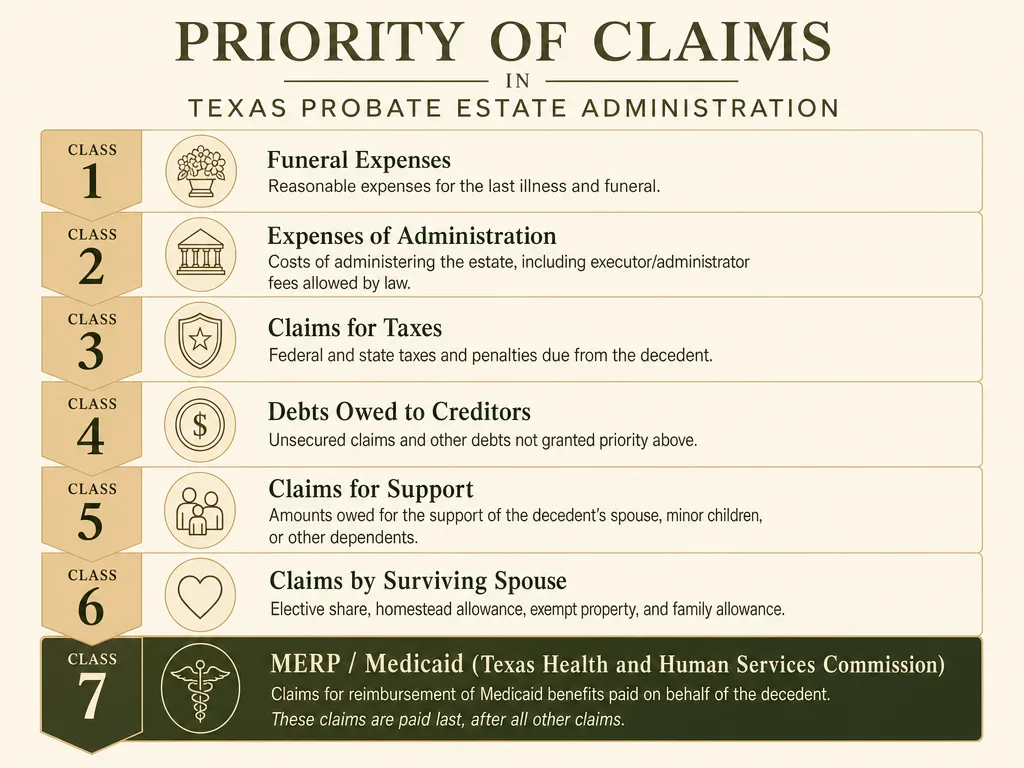
The correct claim priority hierarchy under Texas Estates Code §355.102 is:
- Class 1: Funeral expenses and expenses of last illness, subject to the statutory $15,000 limit for each category
- Class 2: Estate-administration expenses and expenses of preserving, safekeeping, and managing the estate
- Class 3: Qualifying secured claims, including qualifying tax liens, to the extent payable from the property securing the debt
- Class 4: Qualifying delinquent child-support and child-support-arrearage claims
- Class 5: Taxes, penalties, and interest identified in Texas Estates Code §355.102(f)
- Class 6: Costs of confinement established by the Texas Department of Criminal Justice
- Class 7: Claims for repayment of state medical-assistance payments, including applicable MERP claims
- Class 8: Other claims not included in Classes 1 through 7
How MERP Affects Title and Closing
The MERP Certification
When an estate-owned property is sold, title companies often require an Authorization and MERP Certification form. This form is used to obtain information about whether MERP has or expects to assert a claim against the decedent's estate. It should not be described as evidence that MERP recorded a lien against the property.
If MERP has a claim, the title company will typically require the claim to be satisfied or resolved before issuing a title policy. This can delay or prevent closing.
This certification is commonly requested in Texas title and probate practice; however, it is not a universal statutory prerequisite to every sale. The title company and its underwriter determine what evidence they require before insuring a particular transaction.
What Executors Should Know
- A MERP claim is made against the decedent's estate, and a person is not personally liable merely because that person is an heir. However, premature distribution of estate property can create liability issues for the personal representative and may permit a creditor to pursue recipients to the extent allowed by law and up to the value of property received. The representative should not distribute sale proceeds while a potentially valid MERP claim remains unresolved.
- MERP generally asserts its recovery right through the probate-claims process, but the absence of an open administration should not be treated as a permanent defense. A creditor may have procedural options to seek an administration, and probate courts or title underwriters may require MERP documentation in small-estate, heirship, muniment-of-title, or sale proceedings.
- If the property is sold before MERP files its claim, the proceeds may be held in escrow pending resolution.
Can a Closing Proceed With an Unresolved Claim?
In some transactions, the title company and its underwriter may consider an escrow holdback or another written arrangement while a claim is being resolved. Approval is discretionary, and the required amount, documents, indemnities, and release conditions vary. Executors should not promise a buyer that a holdback will be available. The probate attorney and title company should address the issue before the property is placed under contract or, at the latest, immediately after a possible MERP claim is discovered.
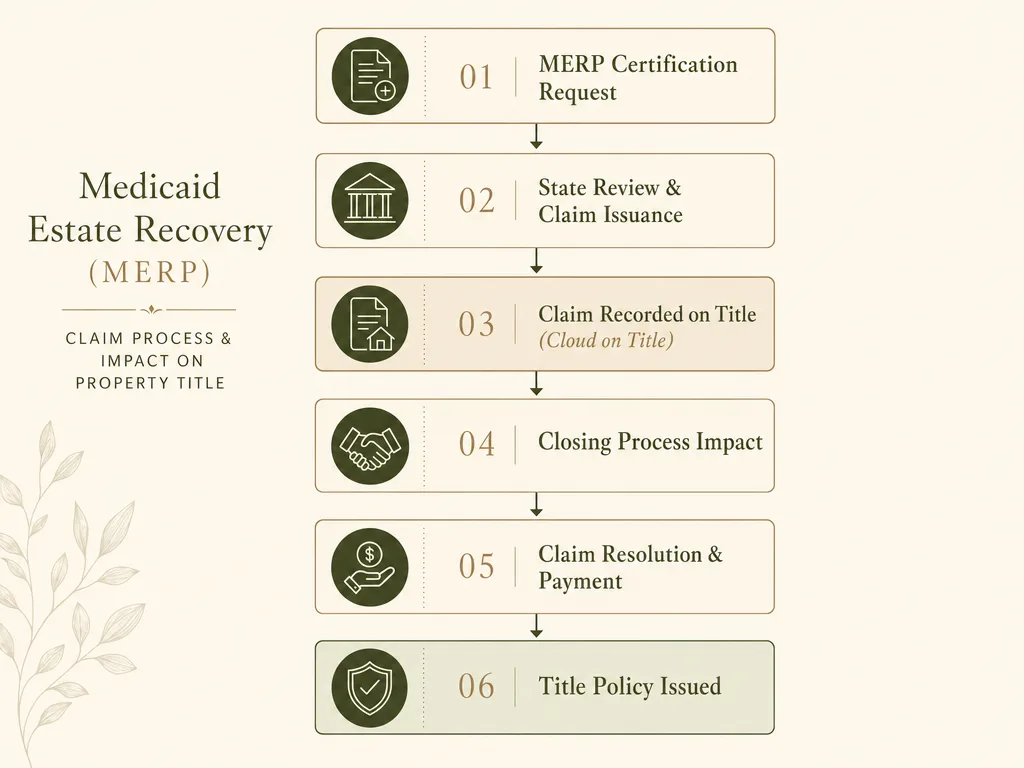
The MERP closing process generally involves these steps:
- Identify probate property and possible covered services
- Request MERP information or certification if required
- Evaluate claim bars, cost-effectiveness rules, waivers, and deductions
- Resolve any valid estate claim and title requirements
- Title underwriter establishes closing conditions
- Close after underwriting requirements are satisfied
What Executors Should Not Assume
- Do not assume the claim is the final word. The notice is not a judgment, but the response deadlines are short.
- Do not assume a Medicaid beneficiary must lose the family home. Under current Texas MERP rules, property transferred through a legally valid nonprobate arrangement generally falls outside the probate-estate definition used by MERP. Whether a TODD, Lady Bird deed, trust, survivorship agreement, or beneficiary designation produces that result depends on the document, title, recording, funding, and surrounding facts. The homestead undue-hardship waiver may also protect all or part of the property when its requirements are satisfied.
- Do not assume you have forever to act. The hardship-waiver deadline runs from the date of the notice; the deduction rule refers to 60 days after receipt. Follow the deadline stated in the notice and obtain advice promptly if the dates are unclear.
- Do not assume you must accept the first claim amount. The claim amount may be amended. Compare the claimed dates and services with the recipient's records and submit all allowable, documented deductions.
- Do not assume an executor must handle this alone. A Texas probate or elder-law attorney should evaluate legal rights and deadlines. The title company determines insurability and closing requirements. A real estate agent can coordinate property preparation, valuation, marketing, and closing logistics but cannot give legal advice or decide the validity of a MERP claim.
Documentation to Gather
If you receive a MERP Notice of Intent, gather the following documents:
- The complete Notice of Intent, including the envelope and every enclosure
- Proof of the date the notice was received
- The will, trust, TODD, Lady Bird deed, survivorship agreement, and beneficiary designations, as applicable
- The current deed and prior deeds affecting the property
- The tax-appraisal-district value for the relevant year
- Available Medicaid eligibility, enrollment, and service records; if the family does not possess them, ask the attorney whether and how to request an itemization or supporting records
- Evidence of the recipient's age at the time benefits were received
- Documentation of any surviving spouse, child under age 21, or blind or disabled child
- Medical records and Social Security disability determinations (if claiming the disabled-child exemption)
- Utility bills, voter registration, driver's-license records, tax returns, or other proof of a qualifying adult child's continuous residence
- Income records for each heir seeking a homestead hardship waiver
- Property deed, mortgage documents, and current property valuation
- Estate financial records (bank accounts, investments, other assets)
- Receipts, canceled checks, invoices, bank statements, and proof of payment for taxes, utilities, insurance, repairs, maintenance, lawn care, and qualifying care expenses
- The itemized MERP claim showing service dates and amounts
- Correspondence with HHSC, the MERP contractor identified in the current notice, the probate attorney, and the title company
- Any written MERP release, waiver determination, claim satisfaction, or certification
- Hardship waiver application and supporting documentation (if applicable)

The Attorney's Role
A probate attorney can help families:
- Evaluate whether exemptions apply
- Prepare and submit hardship waiver applications
- Respond to MERP claims within deadlines
- Negotiate claim amounts
- Advise on property transfer strategies (transfer-on-death deeds, trusts)
- Represent the estate in probate court if the claim is disputed
Legal fees vary with the estate and dispute. Ask the attorney for a written explanation of the anticipated work and fee arrangement so the representative can compare that cost with the amount and property at issue.
Preventive Planning
The best time to address MERP is before a claim is filed, ideally before the Medicaid recipient needs long-term care. Options include:
- Transfer on Death Deed (TODD): A statutory Texas deed that names a beneficiary to receive the property at the owner's death. To be effective, it must comply with Texas Estates Code Chapter 114 and be recorded in the appropriate county before the transferor's death.
- Enhanced life-estate or "Lady Bird" deed: A different type of deed through which the owner generally retains broad lifetime control while creating a nonprobate transfer at death. It is not the same instrument as a TODD and should be prepared or reviewed by a qualified Texas attorney.
- Trust planning: Property actually titled in a properly drafted and funded trust may avoid probate, but trust assets can have Medicaid-eligibility, tax, creditor, homestead, and title consequences. A revocable trust should not be described as guaranteed MERP protection.
- Important: Do not transfer or give away a home solely to avoid MERP without obtaining individualized legal and tax advice. A transfer for less than fair market value can trigger Medicaid's transfer-of-assets rules and a penalty period when it occurs within the applicable look-back period. It can also create capital-gains, property-tax, creditor, control, and title consequences.

Respond Using the Official Notice and Forms
Do not rely on a generic response letter or an address copied from an older article. The proper response depends on whether the family is documenting a circumstance that prevents a claim, requesting an undue-hardship waiver, seeking allowable deductions, disputing the services or amount claimed, or using a formal probate-creditor procedure.
Use the forms, address, submission method, and deadline stated in the current MERP notice. A hardship-waiver request generally requires the official application and supporting documents within 60 days of the date of the Notice of Intent. A deduction request must be made in writing within 60 days after receipt of the notice. Because probate creditor notices involve separate statutes and legal requirements, an executor should obtain advice from a Texas probate attorney before sending one.
Questions to Ask the Title Company
Title requirements vary by transaction and underwriter. When inherited property may involve MERP, ask the title company:
- Which deed or probate document controls ownership?
- Does the title underwriter require an Authorization and MERP Certification?
- What proof of death, heirship, beneficiary status, or probate authority is required?
- Does the commitment identify liens, mortgages, judgments, taxes, or other creditor issues?
- If a TODD or Lady Bird deed is involved, what affidavits or recorded documents are required to establish the beneficiary's title?
- If an estate representative is selling, what evidence of authority to sell is required?
- Must a possible MERP claim be resolved before funding?
- Would the underwriter consider an escrow holdback, and if so, what written conditions would apply?
- What documents will be required before the title policy can be issued?
The title company determines its underwriting requirements. A Texas probate or real-estate attorney should resolve questions about ownership, creditor rights, deed validity, and the representative's authority to sell.
Frequently Asked Questions
Can Medicaid take my house while I am alive?
Texas MERP is an after-death recovery program; it does not itself take the recipient's home while the recipient is alive. Medicaid eligibility is a separate issue. A home may be excluded as an eligibility resource when applicable conditions are met, including rules concerning the principal residence, intent to return, certain relatives residing there, and the home-equity limit. Families should not assume that every residence is excluded in every Medicaid eligibility situation.
What if my parent received Medicaid but never entered a nursing home?
MERP is not limited to nursing-home residents. Covered services can include qualifying home- and community-based services, Community Attendant Services, intermediate-care-facility services, and related hospital and prescription-drug services [3][4][11]. If the recipient received only routine or acute Medicaid services unrelated to a covered long-term-care program, those services generally fall outside the current Texas MERP definition of a recoverable claim. Confirm the program and service dates rather than relying solely on whether the recipient lived in a nursing home.
Can I sell the house before MERP files a claim?
Do not attempt to defeat a potential estate creditor by selling or distributing estate property before the claim has been evaluated. A title company may require an Authorization and MERP Certification, and the personal representative has fiduciary duties concerning estate debts and sale proceeds. Obtain advice from the estate's probate attorney and disclose the issue to the title company before proceeding.
What if I cannot afford to pay the MERP claim?
MERP cannot require heirs to pay from their own funds. The claim is against the estate's assets only. If the estate has insufficient assets, MERP may receive nothing. If the claim would cause undue hardship, you may request a hardship waiver [7].
How long does the MERP process take?
The rules establish deadlines for particular steps, but they do not establish one universal deadline for completing every MERP matter. Under the currently published rule, MERP is to file its claim within 70 days after it has actual notice of the death. Hardship-waiver applicants generally have 60 days from the date of the Notice of Intent to submit the request and supporting documents, and MERP is to decide a complete waiver request within 40 days. Title, probate, valuation, deduction, and claim disputes can extend the overall process.
Is there a time limit on MERP claims?
Several different deadlines may apply. The currently published MERP rule uses a 70-day period after MERP receives actual notice of death. Separately, a personal representative may use the permissive-notice procedure in Texas Estates Code §308.054, which can bar an unsecured claim if it is not presented before the 121st day after receipt of a compliant notice. General limitations and different probate procedures may also matter. Because the trigger and form of notice are legally significant, an executor should have a Texas probate attorney evaluate any potentially late claim.
Does MERP apply if the recipient stopped receiving long-term-care services before death?
Potentially, yes. A recipient does not have to be receiving covered services on the date of death. If the person previously received recoverable long-term-care services after satisfying the applicable age and program-date requirements, MERP may still evaluate a claim for those services [2].
Related Reading
Sources
- HHSC, Your Guide to the Medicaid Estate Recovery Program. hhs.texas.gov
- HHSC, MERP FAQs. hhs.texas.gov
- 1 TAC §373.103, Applicability and covered services. law.cornell.edu
- 1 TAC §373.105, Definitions, including "estate" and "claim". law.cornell.edu
- 1 TAC §373.205, Claim contents and current filing period. law.cornell.edu
- 1 TAC §373.207, Surviving-family exclusions. law.cornell.edu
- 1 TAC §373.209, Hardship waivers. law.cornell.edu
- 1 TAC §373.211, Review of waiver denial. law.cornell.edu
- 1 TAC §373.213, Deductions. law.cornell.edu
- 1 TAC §373.215, Current cost-effectiveness thresholds. law.cornell.edu
- 1 TAC §373.217, Claim amount. law.cornell.edu
- 1 TAC §373.307, Notice of Intent. law.cornell.edu
- Texas Estates Code §308.054, Permissive Notice to Unsecured Creditor; and §§355.001, 355.060, and 355.102, Presentment, Claim Bar, and Claim Classification. Source for §308.054: statutes.capitol.texas.gov Source for §§355.001, 355.060, and 355.102: statutes.capitol.texas.gov
- Texas Estates Code, Chapter 114, Transfer on Death Deeds. statutes.capitol.texas.gov
- HHSC Form 5006, Application for Hardship Waiver. hhs.texas.gov
- 2026 Proposed MERP Amendments, Texas Register. sos.state.tx.us
- Bexar County, How to Address Medicaid for Muniments and Determination of Heirship. bexar.org (Note: this is Bexar County court practice guidance, not a statewide rule)
- 42 U.S.C. §1396p(b) — Medicaid estate-recovery requirements. law.cornell.edu
This article provides general information about the Medicaid Estate Recovery Program in Texas. It does not constitute legal advice. MERP rules are complex and change over time. Consult a licensed Texas probate attorney for advice specific to your situation. Bill Ross is a licensed Texas real estate agent, not an attorney.
Last source-checked: August 17, 2026. Verification included the current text of 1 TAC Chapter 373, Texas Estates Code Chapters 308 and 355, current HHSC MERP guidance, and the status of pending 2026 rule amendments. Because HHSC has announced a contractor transition effective September 1, 2026, verification of contractor names, addresses, telephone numbers, email addresses, form links, and submission instructions should be repeated after that date.