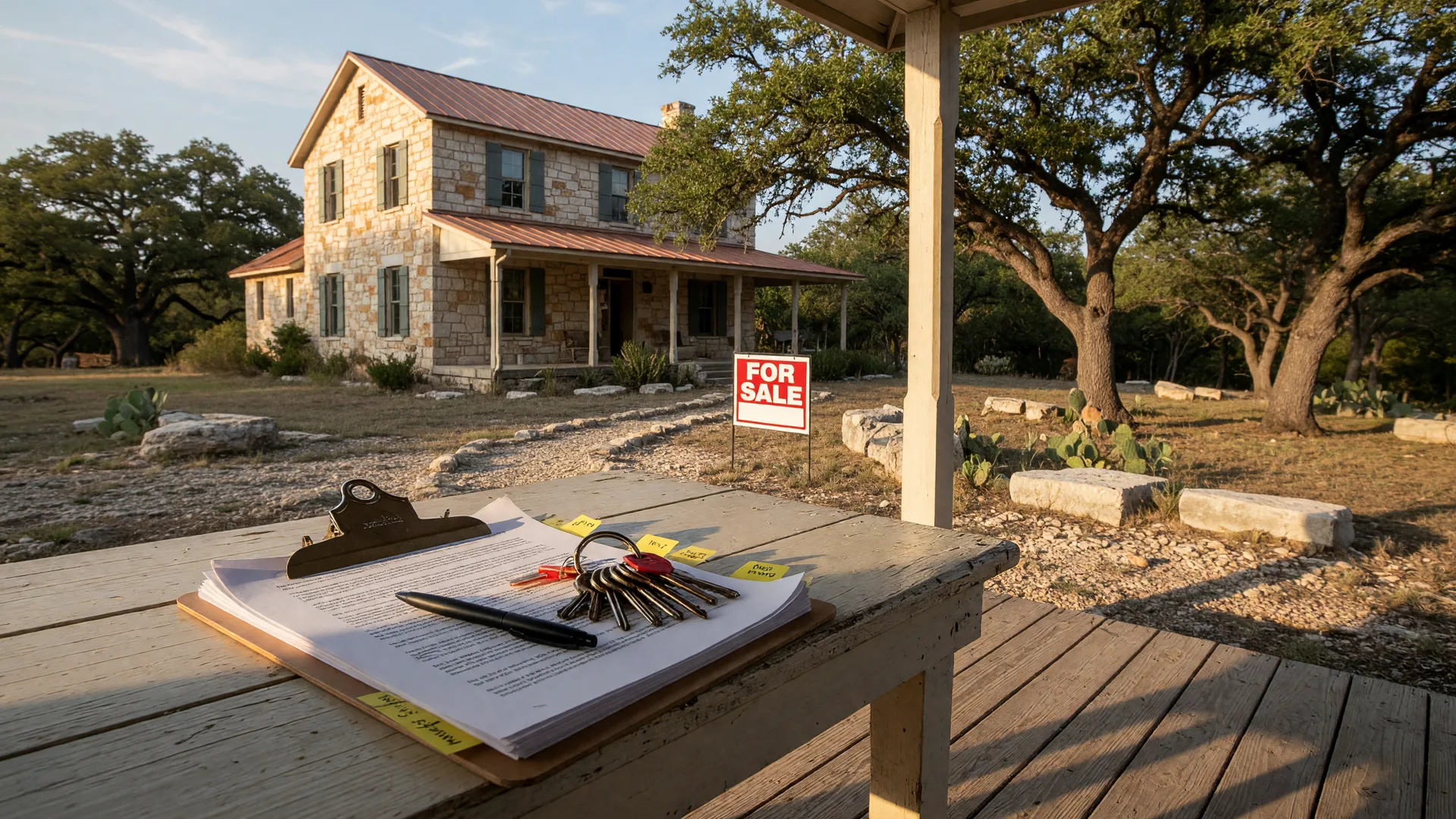

Many estates contain a valuable house but almost no liquid money. The bank accounts are empty, the retirement accounts passed outside the estate, and the only significant asset is the real estate. Meanwhile, the mortgage payment is due, the insurance premium is coming up, the property taxes will not wait, and the house needs at least basic maintenance to prevent further deterioration.
If you are the executor facing this situation, you are not powerless — but you need to act strategically and document everything. This guide explains several common options available to a Texas executor when the estate is asset-rich but cash-poor, along with the legal, title, insurance and practical questions that should be resolved before acting.
This article provides general educational information about Texas probate real estate. It is not legal, tax, title, accounting, appraisal, lending, insurance, or investment advice and does not create an attorney-client, broker-client, fiduciary, or other professional relationship. Consult the appropriate licensed professionals before acting on any of the options described here.
1. Understand Your Authority as Executor
Before signing a listing agreement, purchase contract, deed, lease or loan document, confirm both your appointment and the scope of your authority. That authority comes from the admitted will, the court's appointment order, the type of administration and the Texas Estates Code — not from the Letters alone.
Independent administration. Unless the will limits the power, Texas Estates Code Section 402.052 gives an independent executor or independent administrator the same power to sell estate property, for the same legally authorized purposes, that a personal representative has in a supervised administration, but without routine court approval. Therefore, the absence of an express "Power of Sale" clause does not automatically mean that every heir or beneficiary must sign the deed. A title underwriter may nevertheless require evidence that the proposed sale is authorized and serves a permitted estate purpose, and may request consents, joinders or additional court documentation depending on the will, the title history, homestead rights and the reason for the sale. When the representative is relying on statutory sale authority rather than an express power of sale in the will, ask the probate attorney and title company whether the recorded affidavit described by Texas Estates Code Section 402.053(a)(3) is appropriate. That affidavit addresses a sale that is necessary or advisable for one of the purposes listed in Section 356.251(1). It is a title-protection mechanism for a qualifying good-faith purchaser; it does not eliminate the representative's fiduciary duties or cure a sale made for an unauthorized purpose.
Dependent administration. A dependent executor or administrator operates under court supervision. Unless an exception applies, such as a will that authorizes the executor to sell under Texas Estates Code Section 356.002, a real-property sale generally follows the applicable Chapter 356 process: an application and verified exhibit; citation and an opportunity to oppose; any required hearing; an order of sale; a contract for private sale or a public auction as ordered; a sworn report of sale; and court action approving or disapproving the sale. Bond and deed requirements may also apply. An appraisal may be useful or required in a particular case, but it is not one of the universal Chapter 356 sale steps. Do not market or contract to sell the property until the probate attorney confirms the required sequence, any exception and the contract contingencies.
Letters Testamentary are issued to a qualified executor under a will; Letters of Administration are issued to a qualified administrator. They prove the representative's appointment and qualification. Texas Estates Code Section 306.005 does not require the Letters to state the full scope of authority or whether the administration is independent. Review the court order and admitted will with the probate attorney, and have the proposed title company confirm its underwriting requirements before listing the property.
2. Confirm That the House Is an Estate Asset — and Whether Homestead Rights Apply
Before deciding how to fund or sell the property, ask the probate attorney and title company to confirm who owns it and whether it is subject to administration. Review the deed and title history for community-property ownership, survivorship language, a transfer on death deed, an enhanced life-estate or "Lady Bird" deed, a trust, divorce orders, liens and other ownership interests. A house that passed outside probate may not be an asset the executor can pledge or sell.
Texas probate-homestead protections can also change the analysis. If the decedent was survived by a spouse or minor child, Texas Estates Code Section 102.004 generally protects the homestead from estate debts other than the constitutionally and statutorily permitted categories, such as purchase-money debt and taxes on the homestead. A surviving spouse may also have a right to occupy the homestead. Do not assume the house can be sold to pay general unsecured debts merely because it is the estate's largest apparent asset. Resolve title, homestead, occupancy and exempt-property issues before borrowing against, listing or emptying the house.
3. First 72 Hours: Stabilize, Verify and Calendar
- Prevent unauthorized access; photograph or video every room, exterior elevation, meter and major system.
- Locate the will, deed, insurance declarations, mortgage and reverse-mortgage statements, tax bills, HOA notices, leases and utility accounts.
- Confirm whether anyone is lawfully occupying the property; do not change locks on an occupant or remove belongings without legal advice.
- Notify the probate attorney of any foreclosure notice, tax suit, insurance cancellation, active leak, fire, freeze damage, code notice or vulnerable occupant.
- Create a deadline calendar for insurance vacancy, mortgage, tax, HOA, court, creditor-notice and contract dates.
- Do not sign a listing, sale, cleanout, repair, loan or lease agreement until authority and payment source are confirmed.
4. Triage Urgent Carrying Costs Without Violating Payment-Priority Rules
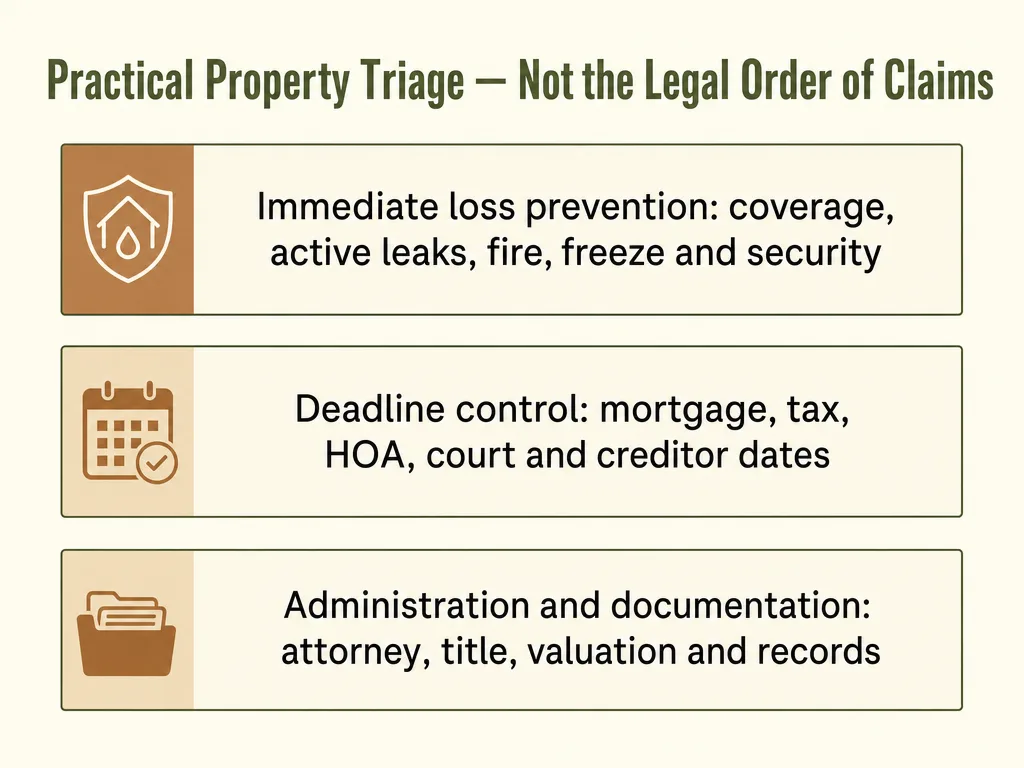
The tiers below describe practical urgency for protecting the house; they are not the legal order for paying estate claims. Texas Estates Code Sections 355.102 and 355.103 establish claim classifications and payment priorities, Section 355.104 addresses proceeds from property securing debt, and federal claims can carry separate priority rules. When cash is insufficient, do not choose whom to pay based solely on this checklist — have the probate attorney approve a written payment plan.
Immediate Property-Preservation Issues
- Home insurance: Notify the carrier or agent promptly of the owner's death and provide the documents it requests. Ask for written confirmation of the named insured, permitted occupancy, vacancy or unoccupancy restrictions, covered causes of loss, required inspections and whether an estate, dwelling-vacant or other endorsement or replacement policy is needed. Whether the existing policy can continue, must be endorsed or must be replaced depends on the policy language and the carrier's requirements; the deceased owner's name remaining on the declarations page does not by itself establish whether a future claim will be covered. The Texas Department of Insurance warns that most companies stop coverage after a house has been vacant for 60 days, although liability coverage usually continues. Obtain the carrier's instructions in writing before that point and keep the required coverage in force through closing.
- Property taxes: Confirm the current balance, delinquency status, exemptions, deferrals and payment options with both the appraisal district and the tax office. Delinquent Texas property taxes accrue statutory penalty and interest and may also incur collection charges; a tax lien can obstruct a sale and ultimately support foreclosure. The statutory charges increase according to monthly penalty-and-interest schedules; they are calculated under those schedules rather than as ordinary compound interest. Property-tax status after death is fact-specific. Texas currently requires school districts to provide a $140,000 general residence-homestead exemption to qualifying owners and an additional $60,000 exemption for qualifying owners who are age 65 or older or disabled. The age-65-or-older or disability benefit also includes a school-tax ceiling; it is not a freeze on the property's appraised value. A qualifying surviving spouse or heir-property owner may be able to retain or obtain exemptions, and special survivor rules may apply to disabled-veteran exemptions. The exemptions do not necessarily disappear merely because probate closes or title changes, but continued eligibility depends on the new owner, occupancy and the requirements for the particular exemption. Ask the appraisal district to confirm the current and anticipated treatment in writing, and use the actual tax statement and a reasonable reserve in the estate's cash-flow plan.
- Mortgage payments: The debt and lien do not disappear at death. If the property is to be retained or sold before foreclosure, the required payments generally must remain current unless the servicer agrees in writing to another arrangement. Contact the servicer promptly, report the death, ask for its successor-in-interest process, and request a written list of required documents and any available forbearance or loss-mitigation options. Do not promise that the lender will "work with" the executor. Federal law restricts enforcement of a due-on-sale clause for certain death-related transfers to relatives, but it does not excuse missed payments. At an ordinary third-party sale, the existing loan is normally paid off through closing. A buyer assumes the loan only when the loan documents and applicable program permit assumption and the lender's requirements are satisfied.
- Reverse mortgage (HECM): Treat this as a separate, urgent track. A HECM generally becomes due after the death of the last borrower and any applicable eligible non-borrowing-spouse protections must be evaluated. CFPB guidance states that heirs who receive a due-and-payable notice generally have 30 days to buy, sell or turn over the home. An extension of as much as six months may be available when the estate or heirs are actively selling the property or arranging repayment, but it is not automatic; obtain the servicer's extension requirements in writing. If the HECM balance exceeds the home's value, CFPB guidance states that heirs generally may satisfy the loan by selling the home for at least 95 percent of its appraised value. Contact the servicer immediately and involve a probate attorney or HUD-approved housing counselor.
- HOA dues: If applicable, HOA liens can attach to the property and create additional complications.
Condition and Security Issues to Address Promptly
- Basic maintenance: Mow the lawn, winterize pipes, secure the property, change locks if needed. A neglected house loses value fast.
- Utilities: Keep the electricity or other climate-control service needed to prevent damage and permit inspections. Decide whether water and gas should remain on, be shut off or be professionally winterized based on the season, the property systems, the insurer's requirements and the risk of leaks or freeze damage.
- Security: If the house is vacant, consider a security system or regular check-ins. Vacant houses attract problems.
Administration Costs to Budget and Document
- Attorney fees: Your probate attorney is essential. Do not try to save money by skipping legal counsel.
- Court costs and filing fees
- Appraisal and inspection costs if needed for sale
5. Options for Getting Cash Into the Estate
When the estate account has little or no cash, first identify funds already payable to the estate before creating new debt or selling a major asset. Ask the attorney or CPA about final wages, tax refunds, insurance or utility refunds, uncashed checks, claims owed to the decedent, rental income, recoverable deposits and other receivables. Do not treat retirement accounts, life-insurance proceeds or other beneficiary-designated assets as estate cash unless the estate is actually the beneficiary or counsel confirms that a specific law makes them reachable.
Option 1: Sell Nonexempt Personal Property
Selling estate-owned, nonexempt personal property can provide interim cash, but it is not automatically the fastest or simplest option in every administration. Before selling vehicles, furniture, tools, collectibles or other items, determine whether each item is probate property, specifically devised by the will, encumbered, claimed as exempt property or required to be set aside for a surviving spouse or child. Confirm the representative's authority; a dependent administration may require court approval. Inventory valuable items, use a defensible valuation or competitive sale method, retain sale records and deposit the net proceeds into the estate account.
Option 2: Executor Expense Advance
An executor may use personal funds for an urgent, necessary estate expense, but should not assume that every payment will be reimbursable or immediately repay himself or herself without review. Texas Estates Code Section 352.051 ties reimbursement to necessary and reasonable expenses incurred in preserving, safekeeping and managing the estate and to satisfactory proof. Before advancing a material amount, obtain the probate attorney's written guidance, keep the vendor invoice and proof of payment, record the purpose, and avoid blending the advance with executor compensation. In an independent administration, routine estate payments may be made without advance court approval, but they remain subject to the will, fiduciary duties, accounting and later challenge.
Option 3: Beneficiary Loan or Expense Advance to the Estate
A beneficiary can fund a specific estate expense or make a documented loan to the estate, but the parties should not create their own "repayment priority." Statutory priorities, secured claims, the will and court orders cannot be displaced by a private agreement. Have the probate attorney document whether the transaction is an expense advance or loan, the permitted use, interest if any, maturity, security if any, repayment source, required approvals and treatment if the estate is insolvent. The beneficiary should be able to lose or delay repayment without jeopardizing personal finances.
Option 4: Estate-Secured Loan
Texas Estates Code Section 402.054 recognizes that an independent executor may borrow money without routine court supervision for purposes and within the scope otherwise authorized by the Estates Code, unless the will limits that authority. This is not an unrestricted power to encumber the house. The loan must serve a proper estate purpose and satisfy fiduciary duties. Before proceeding, obtain attorney and title-company confirmation of authority; compare the interest rate, points, legal fees, appraisal costs, prepayment terms and lien priority against the expected benefit; and document why borrowing produces a better expected net result than selling or another option. A dependent representative should assume that court authorization is required unless counsel confirms otherwise.
Option 5: As-Is Sale
An as-is sale can avoid repair spending, but "as-is" describes the property-condition allocation in the contract — not the marketing method, buyer type or closing speed. An estate home can be exposed to the open market and sold as-is to a financed or cash buyer. Financing may be limited when condition problems affect lender requirements. The executor should compare expected net proceeds, execution risk and time rather than assume that an off-market cash offer is the only or fastest solution. Sale proceeds do not become distributable automatically: liens and closing charges are handled at closing, and remaining estate funds must be used for valid allowances, expenses and claims in the legally required order before distribution.
An Inheritance Advance Is Not Estate Financing
An inheritance advance pays an individual heir, not the estate. It does not solve the estate's liquidity shortage unless the heir separately advances those funds to the estate. Terms and effective costs vary, the heir's net inheritance is reduced, and the heir should obtain independent legal and financial review before assigning any interest.
A Family Allowance Is an Estate Obligation, Not a Source of Estate Cash
A Texas family allowance is an estate allowance based on the amount necessary to maintain an eligible surviving spouse, minor children and adult incapacitated children for one year after the decedent's death. It is not necessarily paid in monthly installments for exactly one year; the required procedure and payment method depend on the administration and any applicable order. Eligibility and amount depend on the statutory requirements, including whether the surviving spouse or child has adequate property of his or her own and, for an adult incapacitated child, whether the decedent was supporting that child at death. The procedure differs between independent and dependent administration and can begin before the inventory is approved. Under Texas Estates Code Section 353.104, the family allowance is paid ahead of all other debts of or charges against the estate except Class 1 claims. It does not bring new money into the estate. Ask the probate attorney to identify eligible family members, the required procedure, amount, payment method and reserve before paying lower-priority obligations or making distributions.
Build a 90-Day Estate-House Cash Forecast
List the opening estate cash; funds expected and their dates; mortgage or reverse-mortgage requirements; insurance; property taxes; HOA charges; electricity, water and gas; lawn, pool and pest service; security; urgent repairs; attorney, court, appraisal and title costs; and a contingency reserve. Calculate the weekly cash shortfall and the date on which coverage, foreclosure, tax, condition or contract risk becomes unacceptable. That date — not family pressure — should drive the decision calendar.
| Funding path | How it creates estate cash | Critical safeguard | Best fit |
|---|---|---|---|
| Sell nonexempt personal property | Converts estate-owned items to cash | Confirm ownership, exemptions, specific gifts, value and sale authority | Modest interim needs |
| Executor expense advance | Executor pays an approved estate expense personally | Confirm necessity and reimbursement treatment; retain proof | Small urgent preservation expense |
| Beneficiary loan or advance | Beneficiary supplies funds under attorney-prepared terms | Private terms cannot override statutory priorities | Cooperative family with documented capacity |
| Estate-secured loan | Estate borrows against authorized collateral | Confirm authority; compare all financing costs and lien risks | Larger need when expected benefit exceeds cost |
| As-is sale | Converts the house to net sale proceeds without estate-funded repairs | Verify authority, title, homestead rights, price support and net proceeds | Sale is authorized and continued carrying risk is unattractive |
Could the Estate Lease the House Temporarily?
An independent executor may have authority to lease estate property under Texas Estates Code Section 402.054, but rent is not free liquidity. Leasing can require repairs, landlord insurance, deposits, accounting, property management and compliance with landlord-tenant law, and an occupant can complicate a later sale. Consider it only when the sale is not imminent and the attorney, insurer and financial analysis support the plan.

6. Sell As-Is — What the Executor Needs to Know
Selling the house as-is is often the most practical option when the estate has no cash for repairs, staging, or carrying costs. Here is how the process works and what you need to understand.
The Process
- Confirm the representative's appointment and sale authority by reviewing the applicable Letters Testamentary or Letters of Administration, the admitted will and the court's appointment order with the probate attorney and proposed title company.
- Get an appraisal or market analysis to understand the property's current value.
- List the property with a probate-experienced agent or sell directly to a buyer.
- Identify every disclosure and notice that applies. A transfer by a fiduciary in the course of administering a decedent's estate is generally exempt from the statutory Seller's Disclosure Notice under Texas Property Code Section 5.008(e)(5). That exemption does not permit fraud, misrepresentation or concealment, and it does not eliminate other potentially applicable federal, state, local, title or contractual notices. For example, the federal Lead-Based Paint Disclosure Rule generally applies to the sale of most pre-1978 housing even when the Texas statutory Seller's Disclosure Notice is not required. It can require disclosure of known lead information and available records, delivery of the EPA pamphlet, prescribed contract language and an opportunity for the buyer to conduct a lead inspection or risk assessment, subject to the rule's exemptions. Have the attorney, title company and agent create a property-specific disclosure checklist.
- Close only after the probate attorney and title company have confirmed that the required authority, court approval and closing documents are in place. At closing, the title or escrow agent will disburse the authorized mortgage and lien payoffs, tax prorations and transaction charges shown on the settlement statement, then deposit the net sale proceeds into the estate account unless a court order or other legally effective instruction requires different treatment.
- Do not treat the net proceeds as immediately distributable. Retain the reserves counsel recommends and pay valid allowances, administration expenses and claims under the rules applicable to the estate, including the statutory priority, classification and secured-claim rules.
What "As-Is" Really Means
- The contract allocates agreed condition and repair risk; the exact contract language controls.
- The estate does not promise to make repairs unless the contract says otherwise.
- The buyer may still inspect, negotiate or terminate if the contract provides those rights.
- "As-is" does not cure title defects, eliminate required notices or protect fraud, misrepresentation or concealment.
- "As-is," "cash offer" and "off-market sale" are not synonyms.
Compare Net Proceeds, Not a Generic Discount
There is no standard percentage discount for an as-is estate sale. Value depends on the property's current condition, location, title, occupancy, financing eligibility, buyer pool, marketing exposure and market conditions. The executor should compare documented expected net proceeds:
As-is expected net = expected as-is sale price minus liens and payoff amounts, negotiated seller expenses, concessions, commissions or brokerage compensation, closing costs and carrying costs through the expected closing date.
Repair-and-list expected net = expected repaired sale price minus liens and payoff amounts, repair and cleanout costs, contingency for overruns, negotiated seller expenses, concessions, commissions or brokerage compensation, closing costs and carrying costs during repairs and marketing.
Obtain a current comparative market analysis and written net sheets for the realistic alternatives. When value is disputed, the sale is to an insider, the condition is unusual or the estate is insolvent, ask counsel whether an independent appraisal and written repair estimates are appropriate. Document the assumptions, offers received and reason the selected option best serves the estate. The best fiduciary decision is not automatically the highest gross offer; price, contingencies, proof of funds, closing certainty, time and risk all affect the expected net result.
Preserve Date-of-Death Value and Tax Records
Inherited property generally receives an income-tax basis tied to fair market value at the decedent's date of death, subject to exceptions and any valid alternate-valuation election. A prompt sale may therefore produce little taxable gain, but that result is not automatic. Preserve a supportable date-of-death value, closing documents, capital-improvement records and selling expenses. Ask the estate's CPA who is treated as the seller, whether Form 1041 or another return is required, how gain or loss will be reported and whether a formal retrospective appraisal is appropriate. Do not substitute a listing CMA for tax advice.
Open-Market As-Is Listing Versus Direct Cash Offer
An open-market as-is listing provides broader price discovery but may take longer and may attract buyers who need financing. A direct cash offer may reduce financing risk and shorten some steps, but it can sacrifice market exposure and still remains subject to title, authority, inspection and contract risk. Before accepting a direct offer, verify proof of funds, buyer identity, assignment rights, option and earnest-money terms, closing date, fees, title requirements and the estate’s expected net. Obtain enough market evidence to explain the decision to beneficiaries or a court.
For more on the as-is strategy in estate sales, see Can a Probate House Be Sold As-Is? and Fix Up or Sell As-Is? A Guide for Estate Executors in Texas.
For additional considerations when a tenant is in place, read Selling an Inherited Texas House With a Tenant in Place.
And if an heir is living in the property and reluctant to leave, see What If an Heir Is Living in the Estate House and Refuses to Leave?
7. Protecting the Property While It Is Listed
- Maintain insurance until closing.
- Keep the electricity or other service needed for climate control, security, inspections and showing access. Follow the insurer's written requirements, and decide whether water and gas should remain on, be shut off or be professionally winterized based on the property systems, season and risk of leaks or freeze damage.
- Secure the property — change locks, add a security system if vacant.
- Maintain the exterior — mow, trim, keep it presentable.
- Document the property's condition with dated photographs.
- Do not make major improvements unless the cost is clearly justified by the expected return.
- Give the insurer the listing and occupancy status and obtain written confirmation that showing activity and vacancy remain covered.
- Remove medications, firearms, financial records, identity documents, valuables and mail before showings; inventory and store estate property under controlled access.
- Use a sign-in, electronic lockbox or other showing record appropriate for a vacant estate property.
- Inspect after storms, freezes, extended outages and contractor visits, and record each inspection.
For additional guidance on property condition, see the Hill Country Homesteads home inspection checklist.
8. Tracking Every Dollar
- Open a dedicated estate bank account after the representative has authority to do so.
- Deposit estate funds into the estate account; do not commingle them with personal funds.
- When estate funds are used, pay estate expenses from the estate account. If an attorney-approved executor or beneficiary advance is paid outside the account, record the source, date, purpose, proof of payment and reimbursement or loan treatment separately.
- Keep every receipt, invoice, and statement.
- Retain bank statements, canceled checks or transaction confirmations, loan documents, appraisals or CMAs, repair estimates, offers, net sheets and the closing disclosure or settlement statement.
- Maintain a spreadsheet tracking:
- Date of each expense
- Amount
- Purpose
- Payee
- Whether it was paid from estate funds, an executor advance, or a beneficiary loan or advance
- A court or interested person may require or request an accounting, depending on the administration type and circumstances.
- Complete records help substantiate expenses and respond to an accounting demand under Texas Estates Code Section 404.001.
For a deeper discussion of reimbursement rules, see Can an Executor Reimburse Themselves for Estate House Expenses?

Note: Under Texas Estates Code Section 404.001, after 15 months have elapsed from the date the clerk first issued Letters to any personal representative, an interested person may demand a sworn written accounting from an independent executor. The independent executor generally has 60 days after receiving the demand to comply. In a supervised administration, Texas Estates Code Sections 359.001 and 359.002 generally require the first annual account no later than 60 days after the first anniversary of the date the representative qualifies and receives Letters, and another annual account no later than 60 days after each later anniversary until the estate is closed, unless the court authorizes an extension. Keep complete records from day one rather than waiting for a formal demand.
9. Avoiding Unauthorized Agreements
- Do not enter an insider or below-market transaction merely because beneficiaries agree or a court might later approve it. Before contracting, obtain attorney guidance on self-dealing and fiduciary rules, an independent value opinion, full written disclosure of the relationship and the consents or court process appropriate to the administration.
- Do not permit rent-free or below-market occupancy without attorney-approved written terms addressing authority, duration, utilities, insurance, maintenance, access, liability, move-out and any charge against the occupant’s distribution.
- Do not sign any contract that commits the estate to expenses you cannot fund.
- Do not make a preliminary or final distribution until known claims, taxes, allowances and expenses have been resolved or adequate reserves are documented and the probate attorney confirms the distribution is authorized. Partial distributions can be appropriate in some estates, but they are not a do-it-yourself decision when liquidity is tight.
- If you are unsure about your authority, ask your attorney before acting.
- Insolvent-estate alert: If known or reasonably possible debts exceed available assets, stop nonessential payments and all distributions until the probate attorney establishes the payment plan. Texas Estates Code Sections 355.102 and 355.103 govern state claim priorities, but federal claims may receive separate priority under 31 U.S.C. Section 3713 and can create personal liability for a representative who pays other debts first when the federal statute applies. Secured claims, exempt property, family allowances and sale proceeds require separate analysis.
For a closer look at the rules governing insider transactions, see Can an Executor Buy the Estate House or Sell to a Family Member?
10. When Authority or Time Is Unclear
Do not assume that a probate court can give informal advance approval for any act, override a restriction in the will or cure an unauthorized contract after it is signed. In a dependent administration, the attorney can seek the application and order required for a sale, loan or expenditure. In an independent administration, the attorney should determine whether the will and statutory authority are sufficient, whether targeted court relief is available and whether a title company or lender will require additional documentation.
If no permanent representative has qualified and immediate action is needed to prevent foreclosure, lapse of coverage or material property loss, ask counsel whether a temporary administration or another limited court remedy is available. A temporary administrator has only the powers stated in the court order. Request an expedited hearing when warranted, but do not promise that a court “can act quickly”; timing depends on the court, notice requirements and evidence.
Stop and Call the Probate Attorney Before Paying or Signing If
- the house may be a protected probate homestead;
- a spouse, heir, tenant or other occupant objects or refuses access;
- the will specifically gives the house to someone or limits sale or borrowing;
- the proposed buyer, lender, contractor or agent is related to the executor;
- debts may exceed assets or a federal, tax or Medicaid claim may exist;
- foreclosure, tax sale, lapse of insurance or major physical damage is imminent;
- the title company questions authority or requests heir signatures;
- anyone proposes assigning anticipated sale proceeds, taking an advance against them, diverting net proceeds outside the estate account or using earnest money as though it were distributable estate cash.
11. Frequently Asked Questions
Can I sell the house without all heirs agreeing?
Possibly, but the answer does not turn solely on unanimous heir consent. Unless limited by the will, Texas Estates Code Section 402.052 gives an independent executor or independent administrator statutory sale authority for the same purposes permitted in supervised administration without routine court approval. A dependent representative ordinarily needs the Chapter 356 court process. The will, purpose of sale, title ownership, homestead and occupancy rights, specific devises and title-underwriter requirements can change what signatures or orders are needed. Have the probate attorney and proposed title company approve the authority path before listing or contracting.
What if there is a mortgage on the house?
The lien and debt do not disappear at death. Contact the servicer, establish the executor or successor-in-interest contact, request the payoff and account status, and keep required payments current or obtain a written alternative while the property is retained. At a typical third-party sale, the mortgage is paid from closing proceeds. A buyer does not automatically assume the loan; an assumption is possible only when the loan documents and applicable program permit it and the lender’s requirements are satisfied. Qualifying death-related transfers to relatives may receive federal due-on-sale protection, but payment default can still lead to foreclosure. Handle reverse mortgages under their separate rules.
Can I borrow money against the house to pay expenses?
An independent executor may have authority under Texas Estates Code Section 402.054 to borrow for an authorized estate purpose without routine court approval, unless the will limits that authority. The statute does not create unrestricted borrowing power. Confirm title, homestead rights, estate purpose, fiduciary benefit, lien priority and lender requirements with the attorney and title company, and compare all financing costs with the expected benefit. A dependent representative should obtain the court authority counsel identifies before borrowing.
How do I get reimbursed for expenses I paid out of pocket?
Texas Estates Code Section 352.051 provides for necessary and reasonable preservation, safekeeping and management expenses on satisfactory proof. In an independent administration, routine reimbursement may not require advance court approval, but the expense can still be challenged and the will or circumstances can alter the result. Keep the invoice, receipt, proof of personal payment, date, estate purpose and written approval for material advances. Do not combine reimbursement with executor compensation, interest or a personal loan without attorney-prepared documentation.
What if the house needs major repairs but there is no money?
Possible paths include an authorized as-is sale, limited work needed to preserve the property, a properly documented executor or beneficiary advance, or borrowing if the representative has authority. An independent executor may have borrowing authority under Texas Estates Code Section 402.054 unless the will limits that authority. A dependent representative generally must follow the court process identified by counsel. An ordinary request to borrow or fund repairs is not automatically an emergency court matter. A probate attorney should determine whether the facts support a specific expedited or temporary remedy. Do not authorize major repairs until the representative's authority and the source and treatment of payment are documented.
How long does the executor have to sell the house?
Texas law does not impose one universal deadline for every estate-home sale. Timing depends on the will, administration type, reason for sale, title, homestead and occupancy rights, creditor and tax issues, property condition and the executor’s fiduciary duty to avoid unnecessary loss or delay. Creditor-notice deadlines govern claims administration; they do not themselves create a deadline to sell the house. Foreclosure notices, reverse-mortgage notices, insurance restrictions, tax proceedings, court orders and contract dates can create case-specific deadlines, so build the timeline with the probate attorney.
Can I use the estate's money to pay for my own travel to the property?
Necessary and reasonable travel incurred to preserve, safeguard or manage the estate may be reimbursable on satisfactory proof under Texas Estates Code Section 352.051; it is not automatically reimbursable. Before incurring material or unusual travel, obtain the probate attorney's guidance. Record the date, estate purpose, destination, mileage or transportation cost, lodging and other receipts, and separate any personal portion. Do not charge personal travel to the estate.
What happens if I sell the house for less than it is worth?
Good faith alone is not an automatic safe harbor. The representative must have authority, comply with the will and applicable court process, act prudently and loyally, and obtain a result that can be defended under the property’s actual condition and transaction terms. Preserve the appraisal or CMA, repair evidence, marketing history, offers, buyer qualifications, net sheets and written reason for selecting the offer. An insider, below-market or weakly marketed sale requires attorney guidance before a contract is signed.
What if the house is underwater or the estate may be insolvent?
Negative equity in the house and insolvency of the estate are different. The house is underwater if its liens and expected sale costs exceed its expected sale proceeds. The estate may be insolvent if assets legally available for claims are insufficient to pay valid obligations and allowances. One condition does not automatically establish the other. Stop distributions and obtain the probate attorney's written payment plan before choosing which claims to pay or signing short-sale terms. Secured claims, exempt property, homestead rights, statutory priorities and federal claims require separate analysis.
Sources
- Texas Estates Code, Chapter 306 — Granting and Issuance of Letters: https://statutes.capitol.texas.gov/Docs/ES/htm/ES.306.htm
- Texas Estates Code, Chapter 402 — Administration; Power of Sale; Other Actions: https://statutes.capitol.texas.gov/Docs/ES/htm/ES.402.htm
- Texas Estates Code, Chapter 356 — Sale of Estate Property: https://statutes.capitol.texas.gov/Docs/ES/htm/ES.356.htm
- Texas Estates Code, Chapter 102 — Probate Assets and Homestead Protections: https://statutes.capitol.texas.gov/Docs/ES/htm/ES.102.htm
- Texas Estates Code, Chapters 353 and 403 — Exempt Property, Family Allowance and Independent Administration: https://statutes.capitol.texas.gov/Docs/ES/htm/ES.353.htm and https://statutes.capitol.texas.gov/Docs/ES/htm/ES.403.htm
- Texas Estates Code, Chapters 308 and 355 — Creditor Notices, Claims and Payment Priorities: https://statutes.capitol.texas.gov/Docs/ES/htm/ES.308.htm and https://statutes.capitol.texas.gov/Docs/ES/htm/ES.355.htm
- Texas Estates Code, Chapters 352 and 404 — Expenses, Compensation and Accounting: https://statutes.capitol.texas.gov/Docs/ES/htm/ES.352.htm and https://statutes.capitol.texas.gov/Docs/ES/htm/ES.404.htm
- Texas Estates Code, Chapter 359 — Annual Account and Other Exhibits and Reports: https://statutes.capitol.texas.gov/Docs/ES/htm/ES.359.htm
- Texas Estates Code, Chapter 452 — Temporary Administration of Estates: https://statutes.capitol.texas.gov/Docs/ES/htm/ES.452.htm
- U.S. Environmental Protection Agency — Lead-Based Paint Disclosure Rule: https://www.epa.gov/lead/lead-based-paint-disclosure-rule-section-1018-title-x
- Texas Property Code, Section 5.008 — Seller's Disclosure of Property Condition: https://statutes.capitol.texas.gov/Docs/PR/htm/PR.5.htm
- Texas Department of Insurance — Home Insurance Guide: https://www.tdi.texas.gov/pubs/consumer/cb025.html
- Texas Comptroller — Property Tax Exemptions; Paying Property Taxes: https://comptroller.texas.gov/taxes/property-tax/exemptions/ and https://comptroller.texas.gov/taxes/property-tax/pay/
- CFPB — Inherited Mortgages and Successors in Interest: https://www.consumerfinance.gov/ask-cfpb/i-recently-inherited-a-house-the-mortgage-lender-said-its-required-to-determine-my-ability-to-repay-before-it-will-let-me-take-over-the-mortgage-loan-is-this-true-en-1939/
- CFPB — Reverse Mortgages After Death: https://www.consumerfinance.gov/ask-cfpb/with-a-reverse-mortgage-loan-can-my-heirs-keep-or-sell-my-home-after-i-die-en-242/
- 31 U.S.C. Section 3713 — Priority of Government Claims: https://www.govinfo.gov/link/uscode/31/3713
- Internal Revenue Service — Publication 559; Gifts and Inheritances: https://www.irs.gov/publications/p559 and https://www.irs.gov/faqs/interest-dividends-other-types-of-income/gifts-inheritances/gifts-inheritances
- 12 U.S.C. Section 1701j-3(d)(5) — Due-on-sale exception for a transfer to a relative resulting from the borrower’s death: https://www.govinfo.gov/link/uscode/12/1701j-3
Related Reading
Can an Executor Buy the Estate House or Sell to a Family Member?
Self-dealing rules, court-approval paths, and safeguards for insider transactions.
Can an Executor Reimburse Themselves for Estate House Expenses?
Documentation rules, independent reimbursement limits, and estate account requirements.
What Happens When the Estate Owes More Than the House Is Worth?
Insolvent estates, creditor priority, and executor options.
Selling an Inherited Texas House With a Tenant in Place
Leases, security deposits, and selling with occupancy in place.
What If an Heir Is Living in the Estate House and Refuses to Leave?
Occupancy rights, eviction limits, and executor options.
Can a Probate House Be Sold As-Is?
Legal authority, disclosure rules, pricing, and buyer types.
Need a Property-Sale Plan for the Estate House?
If you are an executor deciding how to handle an estate house, Bill Ross can provide a current market analysis, realistic sale-timeline estimate and side-by-side net sheets for an as-is listing and other practical sale options. He can coordinate the real-estate work with your probate attorney and title company. Questions about legal authority, creditor priority, taxes, homestead rights and court approval should be answered by the appropriate licensed professional.