

Quick Navigation Guide
If you have been named executor of a Texas estate that includes a house, you are about to face one of the most consequential financial decisions of the entire probate process: what do you actually do with the property?
The house is usually the largest asset in the estate. The wrong decision can cost heirs tens of thousands of dollars. But the right one is rarely obvious, because it depends on the property's condition, the estate's cash position, the local market, the probate timeline, and the family's ability to agree on a path forward.
In this article, I will walk through the four main options — sell as-is, clean out and sell, repair and sell, or wait — with the real costs, timelines, and trade-offs for each. I will also include a comparison table, real-world scenarios, and practical guidance on how Texas probate law and fiduciary duties shape the decision.
This is not legal advice. It is the kind of practical, plainspoken guidance I wish every executor had before they start making calls. Let's dig in.
Educational Notice
This article is for educational and informational purposes only and does not constitute legal, tax, financial, or real estate advice. Probate laws, executor duties, and real estate procedures vary by county and individual circumstance. Always consult a qualified Texas probate attorney, CPA, and licensed real estate professional before making decisions about estate property. The costs, timelines, and scenarios described are illustrative and based on general market data; individual situations vary.
The 60-Second Answer
Do not begin with repairs. First confirm authority, occupancy rights, insurance, title, estate liquidity, and the property's actual condition. Then obtain an open-market as-is valuation, identify any financing or insurance barriers, price only the work that could materially improve net proceeds, and compare all strategies after carrying costs and risk. For many estate homes, clean-out and limited preparation provide a practical middle ground. For others, an immediate sale in present condition is financially superior. Waiting should have a documented purpose, cost estimate, and deadline. If you need to sell inherited house as is Texas, this guide helps you decide whether a clean-out, targeted repairs, or an immediate as-is sale is the best path forward.
Before Choosing a Path: Determine Who Has the Right to Possess or Sell the Home
Before any estate home is listed or sold, the probate attorney must verify key legal factors:
- Administration and Power of Sale: Whether a personal representative is appointed and if the will grants sale authority.
- Property Character: Distinguishing between separate and community property to determine necessary signatures.
- Occupancy Rights: Surviving spouses or minor children have strong Texas constitutional protections (Article XVI, Section 52) regarding homestead occupancy that cannot be overridden by creditors.
- Transfers: Identifying specific devises or non-probate transfers like TODDs or right of survivorship agreements.
These legal thresholds, particularly the homestead protection, must be resolved before proceeding.
Notify the Insurer and Protect the Property
The representative should promptly notify the insurance carrier or agent of the owner's death and any change in occupancy. Ask in writing whether the current policy remains effective, whether the home is considered vacant or unoccupied, whether an endorsement or replacement policy is required, and whether coverage is limited for water damage, vandalism, theft, mold, or other losses.
Until the sale closes, maintain an appropriate level of utilities, secure doors and windows, change or control access codes, forward mail, inspect the property regularly, address active leaks and safety hazards, maintain the yard, and document each inspection. Do not begin substantial work until insurance coverage and contractor requirements have been confirmed.
The Executor's Moving and Safety Checklist

Stepping into an inherited property to begin an inventory or clean-out introduces hidden financial, logistical, and legal risks. Before family members or clean-out crews enter the home, the executor should execute this Texas-specific safety protocol:
- Secure Hazardous Items First (Firearms and Ammunition): Under Texas law, firearms must be accounted for immediately to prevent theft or liability. Locate, safely unload, and catalog all firearms. Transfer them to a secure off-site lockbox or a licensed third-party storage facility. Never leave weapons in a vacant house.
- Secure Financial Records and Sensitive Documents: Locate and shred or remove all bank statements, tax returns, stock certificates, social security cards, and checkbooks. This prevents identity theft and secures the necessary documents for the estate's accounting.
- Extract and Catalog High-Value Valuables: Secure jewelry, coins, cash, fine art, and small heirlooms immediately. Document their discovery with digital photographs and move them to a secure bank safe deposit box under the estate's name.
- Rekey Doors and Update Access Control: Change all physical door locks immediately and reset garage door codes. Family members who previously held keys do not have a legal right to enter or remove items once a personal representative is appointed. The executor must strictly control access to protect estate assets.
- Mitigate Weather and Climate Risks: Set the HVAC system to a baseline temperature (typically 78°F in a Texas summer to prevent toxic mold growth; 55°F in winter to prevent pipe bursts). Turn off the water supply at the main exterior meter if the home will sit vacant for more than 48 hours to eliminate the risk of catastrophic interior leaks.
The "Vacant" vs. "Unoccupied" Insurance Trap
Executors routinely confuse a home being "unoccupied" with it being "vacant." Standard Texas homeowners insurance policies contain a strict 30-day or 60-day vacancy clause. If the home is completely empty of personal belongings (vacant) for more than 30 consecutive days, the policy automatically voids or severely limits coverage for fire, theft, and water damage.
If you are staging an estate clean-out, leave basic furniture (a kitchen table, a couple of chairs, a bed frame) inside the home until you are ready to list it. This simple logistical step can maintain the home's "unoccupied" status rather than triggering a "vacant" status, protecting the estate from catastrophic uncovered losses while you transition to a specialized vacant home policy.
The Four Paths for an Inherited Property
For an estate property that is expected to be sold, four common preparation strategies are available: sell it in its present condition, clean it out and sell it, make targeted repairs before selling, or delay the sale. These are not the only possible outcomes. Depending on the will, the administration, the beneficiaries' goals, and the property's economics, the estate may instead distribute the property in kind, complete an heir buyout, retain it as a rental, or pursue another court-approved resolution.
Sell As-Is
List the property on the open market in its current condition with no repairs, no clean-out, and no preparation beyond basic preservation. Expect a discounted price but a fast, simple transaction with minimal estate capital at risk.
Clean Out and Sell
Remove all personal property, debris, and clutter. Conduct an estate sale for valuables, donate what has value to charity, and dispose of the rest. Then sell the house in its cleaned-but-unrenovated condition. This is the middle ground that many estates overlook.
Repair and Sell
Invest in targeted repairs — paint, flooring, fixtures, basic landscaping — to improve the property's market position. This takes more time and capital but can yield a higher sale price if the numbers work.
Wait and Hold
Delay the sale for months or years, either to wait for better market conditions, to resolve title or legal issues, or because heirs cannot agree. This is almost never a neutral decision — carrying costs and deterioration eat into the estate's value every month.
Option One: Sell As-Is
Selling an inherited property as-is means listing it on the open market in its current condition, with no obligation to make repairs or improvements. The buyer accepts the property with all known and unknown defects. This is the most common path for probate properties in Texas, and for good reason — it is fast, simple, and requires the least capital outlay from the estate.
What "As-Is" Means in Texas
Under the TREC One to Four Family Residential Contract, a buyer may agree to accept the property in its present condition. That generally means the seller is not promising to make repairs merely because defects are discovered. It does not necessarily eliminate the buyer's inspection rights, option-period termination rights, financing or appraisal conditions, or any repair obligations separately negotiated in the contract.
An as-is provision also does not protect a seller who commits fraud, makes a material misrepresentation, or actively conceals a known defect. Federal lead-based-paint disclosure requirements may also apply to most residential properties built before 1978.
Per Texas Property Code § 5.008(e)(5), court-appointed fiduciaries (executors/administrators) are exempt from providing the statutory Seller's Disclosure Notice. However, this exemption is narrow:
- Capacity Requirement: The exemption only applies to court-appointed representatives, not heirs selling after an Affidavit of Heirship or TODD.
- Liability for Fraud: Fiduciaries are still liable for fraudulent, active concealment of known, serious latent defects.
- Lead-Based Paint: Pre-1978 properties still require federal lead-based paint disclosures regardless of fiduciary status.
Who Buys As-Is Properties
As-is properties in Texas attract several types of buyers:
- Cash investors and flippers who buy at a discount, make repairs, and resell for a profit
- Buyers looking for a project who want to customize a home to their own tastes
- Land-value buyers who plan to demolish the existing structure and build new
- Owner-occupants with cash reserves who are willing to take on deferred maintenance
Pricing and Discounts
As-is properties typically sell for 15% to 30% below the market value of a comparable home in good condition [4]. Cash investors often use the 70% rule: they calculate the after-repair value (ARV) of the home, multiply by 70%, and subtract the estimated repair costs. The result is the maximum offer they can make while still covering their own holding costs, closing costs, and profit margin [5].
For example, a home that would be worth $350,000 after repairs might draw investor offers based on the 70% rule. If repairs are estimated at $25,000, the investor's formula (70% of $350,000 minus $25,000) produces an offer of roughly $220,000. This represents roughly 63% of the fully repaired value. This structural discount accounts for the investor's immediate cash deployment, holding costs, and market risk — a trade-off the family must weigh against the cost of doing the work themselves.
Pros and Cons
Pros
- Fastest path to close
- No estate cash needed for repairs
- Minimal executor time and stress
- Simple, clean transaction
- No contractor management needed
Cons
- Lowest sale price of any option
- Can attract lowball investor offers
- May leave money on the table if the home needs only cosmetic work
- Buyer pool is limited to investors and cash buyers
Option Two: Clean Out and Sell
This is the option that most estates overlook — and it is often the right one. Before you decide whether to renovate or sell as-is, the house needs to be emptied of its contents. That alone can change the economics of the entire decision.

The Cost of Professional Clean-Out
Professional clean-out services in Texas typically cost $1,000 to $5,000 for a standard home, though severe hoarding situations can run $10,000 or more [6]. The cost depends on the volume of contents, whether hazardous materials are present, and whether the property is a single-story or multi-story home. Hourly rates range from $25 to $80 per worker, and most companies charge by the truckload or by the square foot.
For comparison, a standard 1,500–2,000 square foot home with a normal accumulation of furniture and personal effects typically costs $1,500 to $3,500 to clear out. A hoarding situation — which is more common in estate properties than most people realize — can run $5,000 to $15,000 depending on severity [6].
Estate Sale Potential
Before you haul everything to the dump, consider whether an estate sale could recover some of the clean-out cost. Estate sale companies typically charge 25% to 50% of gross sales as their commission [7]. They handle pricing, setup, advertising, and staffing the sale. For a home with antiques, collectibles, quality furniture, or valuable household items, an estate sale can net $2,000 to $10,000 or more — sometimes enough to offset the clean-out cost entirely.
The key is to have an estate sale professional assess the contents before the clean-out crew arrives. They can tell you relatively quickly whether the contents have meaningful sale value or whether the items are primarily donation-grade or trash.
Donation and Tax Implications
- Stepped-Up Basis: Inherited items receive a "step-up" to their fair market value at the time of death (IRC § 1014), meaning liquidation rarely causes capital gains tax.
- Charitable Deductions: Donations to 501(c)(3) charities require either a will directive for estate deductions (Form 1041) or, if distributed first, individual deductions (Form 1040).
- Substantiation: Donations over $500 require Form 8283; items over $5,000 necessitate a qualified appraisal.
Why Clean-Out Changes the Math
A clean property sells for more than a cluttered one, even when no repairs are made. Contractors can bid accurately when they can see the walls and floors. Buyers can imagine themselves living in the home when they are not distracted by someone else's furniture and personal effects. And a clean house photographs better, shows better, and signals that the estate is being professionally managed.
The clean-out-first approach also gives you a clear picture of the property's actual condition. What looked like a wall that needed painting might just be a smudge that wipes off. What looked like a stained carpet might simply need a professional cleaning. Clean the house, then decide what else needs to happen.
Option Three: Repair and Sell
For some estates, investing in targeted repairs makes clear financial sense, focusing on buyer objections and structural compliance rather than full renovations. When hiring contractors in Texas, verify credentials, as trades like electrical, plumbing, and HVAC require state licenses from the TDLR or TSBPE. Always request a Certificate of Insurance (COI) naming the estate as an additional insured to minimize liability.
For some estates, investing in targeted repairs makes clear financial sense. The key word is targeted. A full-scale renovation is rarely the right move for an estate sale. But selective, strategic repairs — particularly those that address buyer objections and financing barriers — can produce a meaningful return on investment.
What Repairs Usually Pay Off for Estate Properties
According to the National Association of Realtors' 2025 Remodeling Impact Report, the projects that recover the highest percentage of their cost at resale are exterior replacements and small cosmetic updates — not major renovations [10]. For estate properties, the most cost-effective repairs typically fall into three categories:
The 70% Rule and Other Evaluation Frameworks
The 70% rule, mentioned earlier, is an investor's tool — not an executor's. But the logic behind it is useful for any seller: the cost of repairs, plus the risk of cost overruns, plus the carrying costs during the repair period, plus a reasonable margin for the buyer's risk, means that the net gain from repairs is almost always less than the gross repair cost suggests.
A better framework for executors is a net-proceeds comparison. Calculate the estimated sale price after repairs, subtract all costs (repairs, carrying costs, selling expenses, contingency reserve), and compare that to the estimated net proceeds from an as-is sale. If the difference is less than 10% of the sale price, the simpler path usually wins — because the intangibles (time, stress, family dynamics, probate deadlines) tilt the scales.
When Repairs Do Not Make Sense
Major structural issues — foundation repair ($8,000–$25,000+), roof replacement ($15,000–$35,000), HVAC replacement ($8,000–$15,000), whole-house repiping ($4,000–$12,000) — rarely produce a positive net return for an estate sale [11]. The cost is high, the timeline is long, and the market may not reward the improvement with a proportional price increase.
Functional obsolescence — a two-bedroom floor plan in a four-bedroom market, a bathroom accessible only through a bedroom, a kitchen that is closed off from the living area — is even harder to fix profitably. These are design deficiencies, not deferred maintenance, and correcting them usually costs more than the value they add.
Option Four: Wait and Hold
Waiting is almost never a neutral decision. Every month a property sits unsold, the estate bleeds value through carrying costs, deterioration, and market risk. Sometimes waiting is unavoidable — title issues, court delays, or family disputes can force a delay. But voluntarily choosing to wait in hopes of a better market is usually a mistake.
The Real Cost of Waiting
For a typical Texas estate property in the $350,000–$450,000 range, monthly carrying costs look roughly like this [12]:
Based on 2025–2026 Texas Hill Country market data for a typical $350,000–$450,000 property [12].
Over six months, that is $6,000 to $12,900 in pure carrying costs — money that comes directly out of the estate's value before a single dollar is distributed to heirs. And that does not account for the deterioration that occurs when a home sits vacant. A property that was in decent condition at the time of death can look significantly worse after a year of deferred maintenance.
When Waiting Makes Sense
There are legitimate reasons to delay an estate sale. These include:
- Title issues that need to be resolved before the property can be marketed
- Court delays in dependent administration where the sale requires court approval
- Probate litigation that directly affects the executor's authority to sell
- Medicaid Estate Recovery (MERP) claim resolution before closing
- Heir buyout negotiations where one heir plans to purchase the others' shares
In these cases, waiting is not a choice — it is a necessity. But even then, the executor should work to minimize the delay. Every month the property sits costs the estate real money.
Market Timing Risk
Waiting for a "better market" is a gamble. Interest rates, inventory levels, and buyer demand shift in ways that even professional economists struggle to predict. A property that would sell for $350,000 today might sell for $375,000 in a year — but by then, the estate will have spent $12,000 to $24,000 in carrying costs, and the home's condition may have deteriorated. The net gain is often zero or negative [13].
For a detailed breakdown of how waiting costs estate families money, see Why Waiting Too Long to Deal With an Estate House Can Cost the Family Money.
Comparison Table: As-Is vs. Clean-Out vs. Minor Repairs vs. Full Renovation
The following table compares the four main strategic options across the factors that matter most to executors and heirs. Use it as a starting point for your own analysis, but remember that every property and every estate is different.
The Fiduciary Net-Proceeds Formula
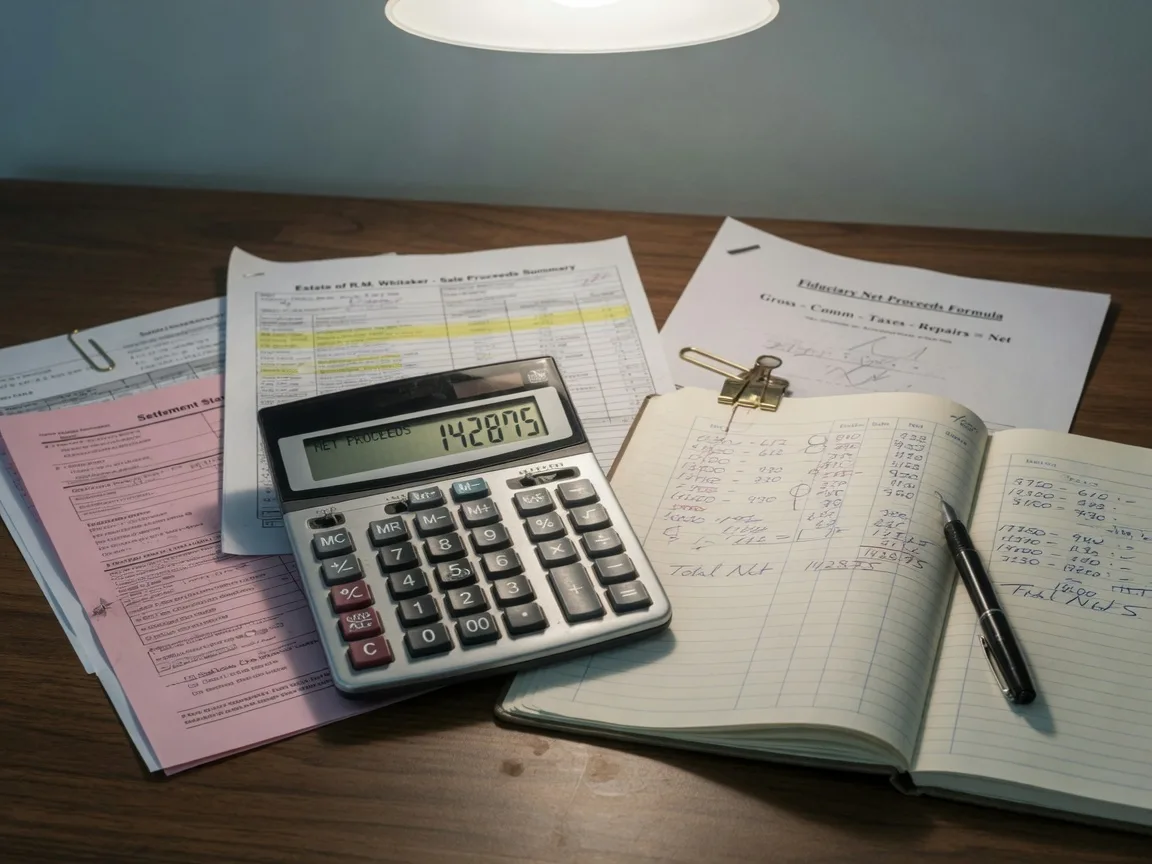
To fulfill your Texas fiduciary duty of prudence, avoid guessing which path yields the best result. Run every option through this standardized formula before making a commitment:
Net Proceeds = (Estimated Sale Price) − (Cost of Repairs/Clean-out) − (Monthly Carrying Costs × Est. Months on Market) − (Transaction Costs and Commissions)
A Practical Math Example
Imagine a typical Kendall County property with an After-Repair Value (ARV) of $400,000. It needs $35,000 in updates and has carrying costs of $1,500/month.
The Fiduciary Insight
While Path A boasts a top-line sale price that is $55,000 higher, the true net financial difference to the heirs is only $14,900. As an independent executor, you must document whether chasing that $14,900 is worth 4 months of market risk, contractor management liabilities, and potential family friction.
How the Probate Timeline Affects These Decisions
The probate timeline is not a suggestion — it is a legal framework with deadlines that directly affect the property sale decision. Understanding these constraints helps you choose a path that fits the estate's timeline rather than fighting against it.

Independent Administration (Most Texas Estates)
In an independent administration under Texas Estates Code Chapter 401, a properly qualified independent executor or independent administrator generally operates without court supervision when managing and selling real estate. However, the power of sale is not unconditional. An independent executor has an inherent power of sale without court intervention only if the will explicitly grants that power, or if a true estate debt exists that necessitates the sale to satisfy creditors. If the will is completely silent and there are no estate debts, an independent executor cannot sell real estate cleanly without either the unanimous joinder of all beneficiaries or a partition order. When the will is silent on sale authority and no debts require satisfaction, the appointment order may grant agreed sale authority under Texas Estates Code §401.006. Section 402.052 governs the manner of administration and the representative's powers, but it does not grant a blanket power over real property independent of the will's terms and the estate's financial needs.
The transaction timeline is heavily governed by the statutory creditor process under Chapter 308 and Chapter 403:
- Notice by Publication: Within one month of receiving Letters Testamentary, the representative must publish a general notice to creditors in a county newspaper.
- Notice to Secured Creditors: Within two months of receiving letters, the representative must send a certified or registered mail notice to all known secured creditors (such as mortgage lenders or lienholders).
- Notice to Unsecured Creditors: The representative may send a permissive, direct notice to general unsecured creditors, triggering a strict 4-month statute of limitations for them to present claims.
Critical Asset Warning: An independent executor must never immediately distribute real estate sale proceeds to heirs simply because the transaction closed. Under Texas Estates Code Chapter 355, proceeds must be held in the estate bank account until all statutory waiting periods clear, and all valid debts, family allowances, and estate tax liabilities are fully satisfied. Failing to maintain these financial reserves creates personal, joint, and several liability for the executor if a superior creditor claim emerges later.
Dependent Administration
In a dependent administration, the court retains strict supervision over the estate. To sell real estate, the dependent administrator must precisely execute a five-step statutory sequence required by Texas Estates Code Chapter 356:
- Application for Sale: The administrator must file a formal written application under oath describing the property, its condition, and the statutory necessity for the sale. Texas Estates Code § 356.251 dictates the mandatory baseline contents that must be included in this application, including a verified exhibit showing the estate's precise financial condition, outstanding claims, and remaining assets. The application must sit on the court's docket for at least 10 days to allow for public citation and potential objections.
- Order of Sale: The probate judge conducts a formal hearing under Texas Estates Code § 356.252 and, if satisfied, issues an official Order of Sale specifying whether the property must be sold via public auction or private contract, and setting the minimum terms.
- Public Notice of Sale: Unless the court specifically authorizes a private sale, the administrator must publish a public notice of the sale in a county newspaper as required by the court's order and applicable law before proceeding with the auction or marketing.
- Report of Sale: Once a buyer is secured under contract, the administrator must file a formal Report of Sale within 30 days detailing the buyer's name, the sale price, and the terms. This report must remain on the docket for a mandatory 5-day waiting period.
- Decree of Confirmation: The court reviews the report to ensure the sale price is fair and legally compliant. The judge then signs a Decree of Confirmation of Sale, which officially authorizes the administrator to sign the deed and transfer title at closing.
Impact on Selling Strategy: This rigid statutory process eliminates the estate's ability to act quickly. Contracts must always contain an explicit contingency clause making the sale strictly subject to Texas probate court approval. This multi-step process typically extends the closing timeline by 45 to 90 days compared to an independent administration.

Texas Property Tax Burden During Holding
Texas has some of the highest property tax rates in the nation, and these taxes continue to accrue daily against estate property. However, an executor should not assume that the decedent's death causes an immediate loss of all tax benefits:
- January 1st Rule: Texas appraisal districts establish property value and exemption status as of January 1st of each tax year. If the decedent qualified for a residence homestead or an over-65 tax ceiling on January 1st, that status generally remains locked for the remainder of that specific calendar year.
- Surviving Spouse Exemption: Under Texas Tax Code § 11.13, a surviving spouse who is 55 or older may continue to qualify for a residence homestead exemption on the property. The specific statutory mechanism for the survival of the over-65 school tax ceiling is governed by Texas Tax Code § 11.26(i), which allows a qualifying surviving spouse to retain the decedent's tax ceiling on their school-district taxes, provided they continue to occupy the property as their principal residence.
- The Vacancy Penalty: If the property sits vacant and is not occupied by a qualifying surviving spouse or minor child, the residence homestead exemption will completely expire on January 1st of the following tax year. This triggers an immediate reassessment to full market value and eliminates all caps, causing a sudden 20% to 50% spike in the estate's monthly carrying costs.
- Heir Property Rules: Under Texas Tax Code § 11.49, if one or more heirs inherit a fractional interest in the property and occupy it as their primary residence, they can apply to maintain a proportional homestead exemption on their share of the property. This allows the estate to preserve or reinstate the homestead tax cap and exemptions proportionally based on that heir's inherited share, preventing a massive tax spike while the estate settles.
Accounting Directive: Do not guess carrying costs using a general statewide average. The executor must pull the exact tax account records from the local county appraisal district (e.g., Kendall CAD, Bexar CAD, Comal CAD) to calculate the precise prorated tax burden based on current exemptions and local millage rates.
The Executor's Fiduciary Duties and How They Affect the Choice
As an executor, you are a fiduciary. That means you are legally required to act in the best interest of the beneficiaries and the estate — not in your own interest, and not in the interest of any single family member. Texas law holds executors to the highest standard of care recognized by law [17].
Key Duties That Apply to the Property Decision
- Duty of loyalty: You must put the beneficiaries' interests above your own. No self-dealing, no sweetheart deals to family members, no steering the property to a buyer who will benefit you personally [17].
- Duty of prudence: Under Texas Estates Code § 351.101, you must manage estate property as a prudent person would manage their own property. This includes taking reasonable care to preserve the property's value [18].
- Duty of impartiality: You must balance the interests of all beneficiaries fairly. If one heir wants to wait for a higher price and another needs cash now, you must weigh the interests of both — not favor one over the other.
- Duty to account: You must keep clear records of all financial decisions, including the sale strategy, the costs incurred, and the rationale for the chosen path. A well-documented file is your best defense if a beneficiary challenges your decisions.
How These Duties Affect the Strategy Choice
The fiduciary standard does not require you to maximize the sale price at all costs. It requires you to make a reasoned, informed, and documented decision that serves the estate's best interests. If you can show that you obtained professional valuations, compared multiple strategies, and chose a reasonable path based on the available data, you have met your duty — even if the outcome is not the highest possible price.
This is important because it means you do not have to take on unreasonable risk to chase a higher price. A $350,000 as-is sale that closes in 30 days with no risk of cost overruns may serve the estate better than a $400,000 renovation project that takes six months, costs $45,000 in repairs and carrying costs, and carries significant risk of delays and cost overruns. The net proceeds comparison tells the real story.
The Emotional Side of the Decision
No discussion of this topic would be complete without addressing the emotional dimension. The house is not just an asset — it is the place where someone lived, where memories were made, where holidays were celebrated. Deciding what to do with it can feel like a judgment on the person who lived there.
I have seen families spend six months and $30,000 renovating a house because they could not bear to sell it "in that condition" — only to net less than they would have from an as-is sale, after accounting for the costs and carrying charges. The renovation was driven by guilt and grief, not by financial analysis.
Research on decision-making during bereavement confirms that grief significantly affects executive function — the cognitive processes responsible for planning, evaluating options, and making sound judgments [19]. Bereaved individuals frequently experience "grief brain," characterized by difficulty concentrating, impaired working memory, and increased susceptibility to decision fatigue.
The practical takeaway: if you are the executor and you are in the early stages of grief, do not make major financial decisions alone. Bring in professionals — a real estate agent who understands probate, an estate attorney, a CPA — who can give you objective guidance. And give yourself permission to choose the path that is simplest and least stressful, not the one that feels like it honors the deceased the most. Honoring the deceased is what you did while they were alive. Now your job is to manage the estate wisely.
How the Title Company Affects the Sale
The title company plays a critical role in any estate sale, and the path you choose affects how the title process works. Here is what you need to know:
Confirming Authority to Sell
Before the title company can issue a title policy, it must confirm that the executor has legal authority to sell the property. This means reviewing the will, the court order appointing the executor (Letters Testamentary or Letters of Administration), and any Power of Sale provisions. If the will does not explicitly grant a Power of Sale, the title company may require all beneficiaries to sign the deed at closing — a requirement that can delay the sale if heirs are scattered or uncooperative [20].
The Protection of an Executor's Special Warranty Deed
Executors and administrators should strictly utilize an Executor's Special Warranty Deed — and never a standard General Warranty Deed — to close a transaction. A General Warranty Deed binds the estate to warrant and defend the entire historical chain of title stretching back to the original sovereign land grant. This exposes the estate, and potentially the fiduciary, to title defects created by completely unknown prior owners. Conversely, an Executor's Special Warranty Deed limits the title warranty strictly to the period during which the decedent or the executor held the property, providing standard protection appropriate for a Texas fiduciary sale.
Title Defects and Liens
Regardless of whether you sell as-is, repaired, or after a clean-out, the title company must resolve all title defects before closing. These can include unreleased mortgages, judgment liens, tax liens, HOA assessment liens, Medicaid Estate Recovery claims, and heirship disputes. The as-is condition of the house has nothing to do with the condition of the title — both must be addressed separately.
For a deeper dive into how title problems can derail a probate sale, see Title Problems That Commonly Derail Probate Home Sales in Texas.
The Hidden HOA Super-Lien Threat
Under Texas Property Code Chapter 209, HOAs have aggressive, non-judicial foreclosure rights. If the estate account is illiquid, these fees can rapidly lead to foreclosure, making it crucial to prioritize HOA dues or negotiate with the board early.
The Mandatory MERP Check
In Texas, if the deceased received Medicaid long-term care or nursing facility services after age 55, the state's Medicaid Estate Recovery Program (MERP) will file a claim against the estate's real property. Texas title companies cannot issue a clean title policy without a formal MERP release or authorization from the Texas Health and Human Services Commission (HHSC). If a claim exists, the title company is legally obligated to pay the state out of the seller's proceeds at closing. Always have your probate attorney request a MERP certification of "No Claim" early in the process to prevent an unexpected freeze on your funds on closing day.
Texas Title Insurance Checklist for Estates
Before a Texas title insurance underwriter will clear an estate property for closing, the executor or administrator must compile and submit a rigorous chain-of-authority packet. To prevent delays at closing, ensure your probate attorney has prepared and submitted the following statutory items to the title company:
- Certified Letters Testamentary or Administration: Provide the official court-stamped authorization. Title companies typically require letters issued within the last 60 days to verify that your fiduciary powers remain active and have not been revoked.
- The Decedent's Last Will and Testament: Submit a true, certified copy of the admitted will alongside the court order admitting it to probate. Underwriters review this to verify whether an express Power of Sale was granted.
- The Court-Approved Inventory or Affidavit in Lieu: Provide a copy of the Inventory, Appraisement, and List of Claims approved by the probate judge, or the Affidavit in Lieu of Inventory filed under Texas Estates Code § 309.056. The title company uses this to confirm that the real estate asset was properly identified and listed as part of the formal probate estate.
- Medicaid Estate Recovery Program (MERP) Release: If the decedent was age 55 or older, the title company will hold closing until you provide an official MERP Certification of No Claim or a formal Release of Claim from the Texas Health and Human Services Commission (HHSC).
- Federal and State Tax Clearances: While Texas does not have a state inheritance tax, if the gross estate exceeds the federal estate tax threshold, provide IRS Form 792 (Certificate discharging property from federal estate tax lien). For municipal debts, ensure a clean title search shows zero outstanding Texas workforce or state franchise tax liens against the decedent.
- Joinder of Heirs (If Required): If the decedent died intestate (without a will) or the will does not grant an express Power of Sale, the title company will require a Court Order Authorizing Sale, or they will mandate that every single legal heir sign the listing agreement and the final Special Warranty Deed at closing.
Real-World Scenarios
Illustrative hypothetical. The following scenarios combine common issues and do not describe a specific client or predict an outcome.
The following scenarios are based on the types of situations I see regularly in the Texas Hill Country. They are not specific to any one family, but they illustrate how the four paths play out in practice.
Scenario: The Foundation Issue
The situation: A 1970s home in Boerne with a known foundation issue, an original roof, outdated wiring, and no estate cash to make repairs. The executor is an out-of-state sibling who needs to resolve the estate quickly.
The path: Sell as-is to a cash investor. The home is worth $380,000 in good condition, but the foundation and roof issues mean most buyers cannot finance it. An investor offers $220,000 cash, closes in 30 days, and the estate nets approximately $200,000 after closing costs. The executor avoids the stress of managing contractors from out of state, and the estate avoids several months of carrying costs.
The outcome: The estate maximizes net proceeds by avoiding the risk and expense of repairs that would not have produced a dollar-for-dollar return.
Scenario: The Cluttered Estate
The situation: A 1,800-square-foot home in Fair Oaks Ranch with three generations of accumulated belongings. The house is structurally sound but filled with furniture, boxes, and personal effects. Heirs are overwhelmed by the prospect of sorting through it all.
The path: Hire an estate sale company to sell the valuables (netting $4,000 after commission), then a clean-out crew to remove the remaining contents ($2,500). The emptied house is professionally cleaned ($600) and listed at $325,000. It sells in 45 days for $315,000.
The outcome: The clean-out cost of $3,100 was more than offset by the estate sale proceeds, and the clean, showable home sold for roughly $30,000 more than the as-is estimate of $285,000. The total net gain from cleaning out was approximately $27,000.
Scenario: The Cosmetic Fixer
The situation: A 1990s home in San Antonio with dated wallpaper, worn carpet, and an overgrown yard — but solid structure, updated HVAC, and a newer roof. The estate has $25,000 in cash reserves.
The path: Invest $12,000 in paint, flooring, and landscaping. The home is listed at $320,000 and sells in 30 days for $310,000 (vs. an as-is estimate of $270,000). The estate nets an additional $28,000 after accounting for the repair costs and two months of carrying costs.
The outcome: Targeted cosmetic repairs produced a clear positive return because the underlying systems were sound. The key was that the repairs addressed cosmetic issues only — not structural or system problems.
Scenario: The Waiting Game
The situation: Three siblings inherit a home in Kendall County. One wants to wait for a better market, one wants to sell immediately, and the third cannot decide. The property sits vacant for 14 months while they argue. During that time, a pipe bursts, causing $18,000 in water damage. The carrying costs total $21,000. The property value drops by roughly $25,000 due to the damage and the stigma of the prolonged vacancy.
The path: Eventually, the siblings agree to sell as-is. The home sells for $285,000 — $65,000 less than the $350,000 it would have brought 14 months earlier in its original condition.
The outcome: The decision to wait cost the family an estimated $86,000 in combined carrying costs, damage, and value loss. The article Why Waiting Too Long to Deal With an Estate House Can Cost the Family Money covers this dynamic in detail.
A Practical Decision Framework
If you are the executor and you are trying to decide what to do with the property, here is a simple step-by-step process that will lead you to the right answer:
Get the authority question answered first
Confirm with the probate attorney that you have the legal authority to sell the property, and determine what documentation the title company will require. This shapes everything that follows.
Assess the property's condition honestly
Walk through the property with a real estate agent who knows the local market. Note the condition of the roof, HVAC, foundation, plumbing, electrical, and interior finishes. Get a pre-listing inspection if the condition is unclear.
Get a professional as-is market valuation
Have the agent prepare a Comparative Market Analysis based on recent sales of similar homes in similar condition. Ask specifically for data on as-is sales in the area.
Get contractor bids for recommended repairs
If the agent recommends repairs, get two to three written bids from licensed, insured contractors. Make sure the bids are itemized and include a realistic timeline.
Compare net proceeds across all scenarios
Build a simple spreadsheet comparing as-is, clean-out, and repair scenarios. Include estimated sale price, repair costs, carrying costs, and selling expenses. The option with the highest net proceeds wins — unless the timeline or family dynamics make a different path more practical.
Document the decision
Write a brief memo explaining why you chose the path you did, referencing the data you gathered. Share it with the beneficiaries and the probate attorney. This creates a clear record that protects you if the decision is later questioned.
Frequently Asked Questions
Do I have to disclose known problems if I sell the house as-is?
Yes. Texas Property Code § 5.008(e)(5) exempts executors from the standard Seller's Disclosure Notice form, but this exemption does not allow you to conceal known material defects. If you are aware of a foundation issue, a history of flooding, or any other material problem, you must disclose it. Failure to do so can create liability for fraud or misrepresentation, even in an as-is sale [3].
Can the estate deduct the cost of repairs from the sale proceeds?
Yes. The cost of necessary repairs, clean-out, and maintenance during the probate period are estate administration expenses that reduce the estate's net value before distribution to heirs. They are generally deductible on the estate's fiduciary income tax return (Form 1041) to the extent they are ordinary and necessary expenses of administering the estate. Consult a CPA for specific guidance on your situation [9].
What if the heirs disagree about whether to repair or sell as-is?
In independent administration, the executor generally has the authority to make the decision, even over the objections of some beneficiaries. However, the executor should document the reasoning and share the analysis with all heirs before proceeding. If the disagreement is severe, consider mediation or consulting the probate attorney about whether court guidance is needed. The article What If One Heir Wants to Keep the House and the Others Want Cash? covers this dynamic in detail.
How do I find a contractor I can trust for estate repairs?
Get two to three written, itemized bids from established, insured contractors. Verify trade licenses (electricians, plumbers, and HVAC contractors are licensed by the state of Texas; general contractors are not, but some municipalities require registration). Check references, ask about their experience with older homes, and get a detailed written scope of work with a payment schedule tied to completed milestones. The estate should never pay the full amount upfront.
Is it ever worth doing a full renovation on an estate property?
Rarely. Full renovations — kitchen remodels, bathroom overhauls, additions — require significant capital, take months to complete, carry substantial cost-overrun risk, and typically do not recover their full cost at resale. According to the 2025 Cost vs. Value Report, even mid-range kitchen remodels recover only about 70%–80% of their cost, and major additions recover far less [10]. For estate sales, the safe approach is to limit work to deferred maintenance and cosmetic improvements that clearly expand the buyer pool.
Texas-Specific Factors That Affect the Decision
Several factors make the Texas real estate market unique for estate sales. Executors should be aware of these when evaluating their options:
- High property tax burden: Texas has among the highest effective property tax rates in the country. The homestead exemption ends at death, meaning the estate — and eventually the buyer — will pay taxes at the full market rate. This is a significant carrying cost for any holding strategy [16].
- Insurance costs: Texas homeowners insurance is among the most expensive in the country, averaging $3,291–$3,899 per year for a standard policy [22]. Vacant properties require specialized policies at even higher premiums. This adds substantial cost to any waiting strategy.
- Market conditions: The Texas Hill Country market — particularly in Boerne, Fair Oaks Ranch, and San Antonio — has seen strong demand for move-in-ready homes. But the investor market for as-is properties is also active, meaning there is a ready buyer for almost any condition [23].
- Title company requirements: Texas title companies have specific requirements for probate sales, including documentation of the executor's authority and the type of deed used. Getting the title company involved early can prevent delays at closing [20].
- Medicaid Estate Recovery (MERP): If the decedent received Medicaid long-term care benefits, the state may file a claim against the estate. This claim must be resolved before the sale proceeds can be distributed, and it can affect the net proceeds significantly [24].
Making the Decision
There is no single right answer to the question "Should I repair, clean out, sell as-is, or wait?" The right answer depends on the property's condition, the estate's cash position, the probate timeline, the local market, and the family's ability to agree on a path forward.
What I can tell you from experience is this: the worst decision is usually not choosing the wrong path — it is not choosing at all. Every month a property sits without a plan, the estate loses value through carrying costs, deterioration, and market risk. Executors who act decisively, gather good data, and document their reasoning almost always serve the estate better than those who delay.
If you are navigating this decision and would like to talk through the options for a specific property, I am glad to help. My practice focuses on exactly this kind of situation — no pressure, no sales pitch, just practical guidance from someone who has been through it many times.
Sources
- TREC One-to-Four Family Residential Contract (Resale) — Texas Real Estate Commission
- Texas Property Code, Chapter 5 — Conveyances
- Texas Property Code § 5.008(e)(5) — Seller's Disclosure Notice Exemption for Executors
- How Much Do You Lose Selling a House As-Is in Texas? — VIP Real Estate
- The 70% Rule in Real Estate Investing — Lima One Capital
- How Much Does It Cost to Clean a Hoarder House in Texas? — Southern Hills Home Buyers
- Professional House Cleaning Costs in Texas — Angi
- IRS Publication 526 — Charitable Contributions
- IRS Publication 559 — Survivors, Executors, and Administrators
- 12 Remodeling Projects That Offer the Best Value at Resale — NAR Magazine
- Angi — Home Repair Cost Guide (general cost ranges)
- Texas Property Tax Rate Map — Texas Tax Protest
- Waiting to Buy a House: The Real Cost — NerdWallet
- Texas Estates Code, Chapter 402 — Independent Administration
- Texas Estates Code, Chapter 356 — Sale of Estate Property by Executor
- Texas Property Tax Rates Explained — XOA Tax
- Fiduciary Obligations of Texas Executors — Texas Probate Litigation
- Texas Estates Code § 351.101 — Duty of Care for Estate Property
- Grief and Decision-Making: The Impact of Bereavement on Executive Function — National Institutes of Health
- Can an Executor Sell a House Without Beneficiary Approval in Texas? — Themis Legal Group
- Texas Estates Code § 402.053 — Protection of Purchasers from Independent Executors
- Average Cost of Home Insurance in Texas — Policygenius
- San Antonio Board of Realtors — Market Data
- Texas Medicaid Estate Recovery Program — HHSC