Many families going through probate in Texas face an understandable question: can we handle this ourselves? The probate process can seem straightforward on paper, and the idea of saving money by avoiding attorney fees is tempting. When the estate includes a house, though, the decision to go it alone — what the legal system calls "pro se" representation — is where things usually start to unravel.
This article examines why pro se probate may work in narrow, simple situations, why it often breaks down when real property is involved, and what families should understand before making that choice.
This article provides general educational information about Texas probate real estate and is not legal, tax, financial, title, or insurance advice. Probate procedure, creditor claims, title requirements, disclosure obligations, and court practices vary by county and by case. A licensed Texas probate attorney should advise on legal authority and estate administration. A title company should confirm what will be required to insure a sale. A CPA, insurance professional, and other qualified advisors may also be needed depending on the estate.
Important distinction: this article uses "pro se probate" in the practical sense many families use it — trying to handle probate without hiring a lawyer. In Texas, however, true pro se representation is limited. A person can generally represent only themselves. When someone asks to serve as executor or administrator, they are usually acting for the estate, beneficiaries, heirs, and creditors. That fiduciary role is why many Texas probate courts require counsel for formal probate proceedings.
What "Pro Se" Means in Texas Probate
Texas allows a person to represent themselves in court when they are truly representing only their own interests. Probate is different. In most Texas probate cases, an executor or administrator is not acting only for themselves; they are acting in a fiduciary role for the estate, beneficiaries, heirs, and creditors. For that reason, many Texas probate courts require a licensed attorney when someone applies for letters testamentary, letters of administration, or a determination of heirship. Limited pro se options may exist in narrow situations, such as certain small estate affidavits, some muniment of title proceedings, or cases where the applicant is the only person whose interests are affected. Families should confirm the local court's requirements before assuming they can proceed without counsel.
While the Texas Estates Code does not explicitly require every executor or administrator to be a lawyer, Texas case law and local court policies place strict limits on whether a non-lawyer fiduciary may appear in court or file pleadings without counsel. A person may be eligible to serve as executor or administrator without being a lawyer, but once that person acts in a representative capacity for the estate, beneficiaries, heirs, or creditors, the court may require the fiduciary to be represented by licensed counsel.
Nonlawyer personal representatives cannot appear "pro se" (without an attorney) in court, as this constitutes the unauthorized practice of law in Texas. Executors represent the interests of beneficiaries and creditors, requiring legal counsel. The Texas Supreme Court's *Suday v. Suday* ruling was limited to a specific scenario, not a general right to proceed without a lawyer.
The practical point remains: the issue is not whether a non-lawyer can serve as executor. The issue is whether that person can act in court without counsel while representing interests beyond their own.
Why Families Choose Pro Se Probate
The reasons are practical and usually well-intentioned:
- Cost concerns. Attorney fees for probate administration can range from several thousand dollars to a percentage of the estate's value. For families managing an estate with limited liquid assets, the expense feels significant.
- Perceived simplicity. If the estate appears small and straightforward — one house, few debts, clear heirs — the family may believe the process is a matter of filling out forms and appearing in court.
- Timeline pressure. Families sometimes believe that handling probate themselves will be faster than working through an attorney's schedule.
- Family consensus. When all heirs agree and there are no disputes, the family may feel an attorney is unnecessary.
These are reasonable starting points. The problem is not the decision itself — it is the gap between what probate looks like on paper and what it actually requires when a house is part of the estate.
The Probate Process at a Glance
Before examining where pro se representation breaks down, it helps to understand the basic structure of Texas probate when real property is involved. Texas offers several probate pathways, and the correct one depends on the estate's circumstances.
Independent Administration
Independent administration may be authorized by the will or created by court order when heirs agree and statutory requirements are met, not merely for silent wills or intestate cases. Once the inventory and list of claims are approved, the representative manages property without constant court supervision. However, an independent executor's power to sell real estate without beneficiary consent depends on a "power of sale" in the will or if needed to pay debts.
Dependent Administration
- Typical timeline: 12+ months typical
- Court involvement: High; court approval required for most significant actions, including property sales
- Key requirements: More court appearances, more filings, and higher costs
- Best fit: Disputes, contested estates, or cases where the will does not authorize independent administration
Muniment of Title
- Typical timeline: Often faster than full administration
- Court involvement: Minimal; court admits the will to probate as a muniment of title, and no executor or administrator is appointed
- Key requirements: Valid will required; no unpaid estate debts other than debts secured by real property; no need for full administration
- Best fit: Simple testate estates where the main need is to establish title to real property and there are no disputes, creditor complications, or administration needs
Affidavit of Heirship
- Typical timeline: Recorded in property records; no fixed court timeline
- Court involvement: None; not a court proceeding
- Key requirements: Usually requires disinterested witnesses; does not appoint a representative; acceptance depends on the title company
- Best fit: Intestate real-estate situations where the title company will accept heirship evidence, but full probate authority is not being created
Small Estate Affidavit
- Typical timeline: Limited use; timeline depends on court review
- Court involvement: Court filing required; judge must approve the affidavit, but no personal representative is appointed
- Key requirements: Decedent must have died intestate; estate must meet statutory value and debt requirements; no administration may be pending or needed
- Best fit: Small intestate estates. Real-property use is narrow and generally limited to a qualifying homestead that is the only real property in the estate and is inherited by an eligible surviving spouse or minor child who was homesteading with the decedent.
Muniment of Title
A simplified court process that may be available when there is a valid will, no unpaid estate debts other than debts secured by real property, and no need for full administration. It can be useful for transferring real property, but it is not appropriate for every estate and may not work if there are disputes, creditor issues, or title complications.
Affidavit of Heirship
A recorded document used to establish heirship evidence in the real property records when someone dies without a will and leaves real estate. It is not a court order, does not appoint a personal representative, and does not itself give someone authority to act for the estate. It may help link the chain of title, but acceptance depends on the facts, the passage of time, and the title company's underwriting requirements.
Each pathway has its own rules, deadlines, and documentation requirements. Choosing the wrong one — or failing to complete the correct one properly — is where problems begin. The rules become even more restrictive when real property is involved, because the executor's actions affect not only the estate but also the rights of creditors, heirs, and future buyers.
County Court Policy Spotlight: Pro Se Rules Vary by County
The legal standards discussed in this article apply statewide, but the practical reality of filing pro se varies significantly by county. Several Texas counties publish specific local policies governing pro se applicants in probate proceedings.
Bexar County
The Bexar County Probate Courts publish pro se policy guidance explaining that a pro se applicant may represent only themselves and may not represent the interests of third parties, including probate estates, beneficiaries, or creditors. The policy states that individuals applying for letters testamentary, letters of administration, determinations of heirship, and guardianships generally must be represented by a licensed attorney. Bexar County also notes that limited pro se filings may be available for certain small estate affidavits and muniment of title matters.
Bexar County Probate CourtTravis County
Travis County Probate Court publishes local rules, forms, and procedural information for probate matters. Families considering any pro se filing should review the current Travis County Probate Court materials and confirm filing requirements directly with the court before relying on a general statewide explanation.
Travis County Probate CourtComal County
Comal County probate matters are handled through the Comal County Courts at Law and the County Clerk's office. Local filing practices, forms, hearing procedures, and e-filing requirements should be confirmed directly with the county before filing.
Comal County Court at LawThese county-specific policies are updated periodically. Always verify current requirements directly with the county court before filing.
Where Pro Se Representation Breaks Down: The House Problem
A house is not like a bank account or a brokerage statement. It is a physical asset with ongoing costs, legal encumbrances, disclosure obligations, title complexity, and emotional weight. These characteristics create specific challenges that pro se representatives consistently underestimate.
1. Title Clearance Is Not a Form — It Is a Process
The single most common place pro se probate breaks down is at the title company.
Under Texas law, estate property may vest immediately in devisees or heirs at death, subject to debts, administration, and other statutory limitations. That does not mean the property is ready to sell. The deed in the county records may still show the deceased person's name, and the title company will still need a legally acceptable chain of authority before it will insure a sale. The practical issue is not merely ownership in the abstract; it is record title, sale authority, creditor exposure, and insurable title.
For independent administration, this typically means:
The Title Clearance Chain
- Admit the will to probate or complete a determination of heirship.
- Obtain letters testamentary or letters of administration, if required.
- Gather and file required documents, including the death certificate, will, and court orders.
- Address creditor claims or document the estate's creditor posture.
- Confirm whether court approval is required for sale, especially in dependent administration.
- Prepare, execute, and record the proper deed, such as an executor's deed, administrator's deed, or deed of distribution.
Why a Quitclaim Deed Will Not Work
A common misconception among pro se representatives is that a standard quitclaim deed can transfer title from the decedent to the heirs or buyer. In practice, Texas title companies routinely reject quitclaim deeds for probate properties — and for good reason.
A quitclaim deed transfers whatever interest the grantor may have in the property, but it makes no representations about the quality of that interest. For a probate transaction, this creates an insurance problem: the title company cannot issue a title policy guaranteeing clear title when the deed itself provides no warranty of title.
Depending on the probate path and the title company's underwriting requirements, a probate-related sale may require one or more of the following:
- Executor's Deed or Administrator's Deed — used when a personal representative has authority to convey estate property.
- Deed of Distribution — used when a personal representative distributes property to an heir or beneficiary before a later sale.
- Deed from heirs or devisees — may be required when title has vested in heirs or beneficiaries and they are the proper parties to convey.
- Muniment of Title order — may be used to establish authority or ownership when a valid will is admitted as a muniment of title and no administration is needed.
- Affidavit of Heirship materials — may be used as evidence of heirship in some intestate-title situations, subject to title company approval.
- Court order authorizing sale — may be required in dependent administration or other court-supervised situations.
Whatever instrument is used must contain the correct legal description, proper parties, appropriate authority recitals, proper execution and acknowledgment, and compliance with Texas deed and recording requirements. A poorly drafted instrument — even one that appears adequate to a non-attorney — can create title defects that follow the property for years. This is one of the most common and most expensive mistakes in pro se probate: discovering at the closing table that the deed the representative prepared or obtained is not acceptable to the title company, requiring the transaction to be delayed or restructured.
Each step involves specific legal language, recording requirements, and documentation standards. A title company will not insure a transaction where any step in the chain is missing, incomplete, or improperly executed.
Pro se representatives often discover this at closing — after they have already found a buyer, negotiated a contract, and scheduled the closing date. The result is a delayed or collapsed sale, additional carrying costs, and frustrated parties on all sides.
Before Listing the House, Ask the Title Question
One of the most expensive mistakes is waiting until a buyer is under contract before asking whether title can actually be insured. Before the property is listed, the family should ask a probate attorney and title company what documents will be needed to close.
Useful questions include:
- Who currently has legal authority to sign a listing agreement and sales contract?
- Has the will been admitted to probate?
- Have letters testamentary or letters of administration been issued?
- Is a muniment of title, small estate affidavit, affidavit of heirship, or full administration appropriate?
- Are there mortgages, property tax liens, HOA liens, judgment liens, Medicaid estate recovery issues, or other claims?
- Will the title company insure a buyer based on the current probate posture?
- What deed will be required at closing?
- Who must sign closing documents?
This step can prevent the common failure pattern: listing the house, accepting an offer, scheduling closing, and only then discovering that the estate lacks authority or title is not insurable.
2. Creditor Claims Create Real Risk
Texas has specific creditor-notice rules. After letters testamentary or letters of administration are issued, the personal representative generally must publish a notice to creditors in a newspaper of general circulation within one month. Known secured creditors — such as mortgage lenders or other lienholders — must generally receive direct notice within two months after letters are issued. Direct notice to unsecured creditors may be available and useful in some situations, but it is not the same as mandatory secured-creditor notice. The details matter because creditor-notice errors can delay administration, complicate title, and create risk for the estate.
When a house is involved, creditor claims become more complex:
Secured Claims
- Mortgage lenders — secured claim on the property; mortgage does not disappear at death
- Property tax liens — unpaid taxes that accrued before or after death
- HOA liens — unpaid assessments that can create title defects
- Judgment liens — against the decedent, may attach to real property
Unsecured Claims
- Medical creditors — unsecured claims that may need to be evaluated and handled as part of estate administration
- Credit card debt — unsecured debt that may need to be evaluated, accepted, rejected, paid, negotiated, or barred depending on the probate posture and notice strategy
- Personal loans — other unsecured creditors with potential claims
A pro se representative who fails to properly identify, notice, or address these claims risks personal liability. Texas law imposes fiduciary duties on the personal representative, and negligence, improper distributions, or mishandling of estate obligations may expose the executor or administrator to objections, surcharge claims, repayment demands, removal, or other consequences depending on the facts.
This is not a theoretical risk. If a representative distributes estate assets, including sale proceeds, without properly addressing creditor claims, the representative may face objections, surcharge claims, repayment demands, removal, or other consequences depending on the facts.
3. The Inventory and Accounting Requirements Are Detailed
A Texas personal representative generally must file an inventory within 90 days of qualifying, unless extended. A sworn Affidavit in Lieu of Inventory may be filed (Texas Estates Code §309.056) if there are no unpaid debts (excluding secured debts, taxes, and admin expenses) and beneficiaries receive the full, unfiled inventory. A will or informal agreement cannot waive the legal requirement to at least prepare and deliver the inventory.
For an estate that includes a house, the inventory must include:
- A legal description of the property (not just the street address)
- The date-of-death value (which may require an appraisal)
- Any liens, encumbrances, or claims against the property
- Any agreements, contracts, or obligations related to the property
Inventory deadline: Unless the court grants an extension or an affidavit in lieu is permitted, the Inventory, Appraisement, and List of Claims is generally due before the 91st day after the personal representative qualifies. Missing that deadline can create court problems and may expose the representative to removal, penalties, or other consequences.
Filing an incomplete or inaccurate inventory — or failing to file one at all — can create court problems, delay administration, invite objections, expose the representative to removal or other consequences, and make it harder to close the probate proceeding.
Pro se representatives frequently underestimate the level of detail required. What seems like a straightforward listing of assets becomes a complex accounting exercise that requires knowledge of probate law, property law, and financial record-keeping.
4. Disclosure Obligations Do Not Disappear
When a house is sold from an estate, disclosure obligations need to be handled carefully. Texas Property Code §5.008 generally requires a Seller's Disclosure Notice for the sale of a one-dwelling residential property, but the statute includes an exemption for a transfer by a fiduciary in the course of administering a decedent's estate. That means an executor or administrator selling estate property may not be required to provide the statutory Seller's Disclosure Notice. However, that exemption does not give anyone permission to conceal known material defects, make false statements, or ignore contract, title company, lender, or brokerage requirements.
This creates a specific challenge for probate estates: the personal representative often did not live in the house and may not know its condition history. They did not choose the HVAC installer, may not know when the roof was last inspected, and have no personal experience with the plumbing, electrical system, or foundation.
If the statutory Seller's Disclosure Notice is required — for example, if heirs sell the property in their own names after distribution rather than through the estate's fiduciary — Texas law allows "unknown" responses when the seller genuinely does not know the answer. Still, unknown should not be used as a substitute for honesty. A safer approach is to disclose known material facts, document what the representative actually knows, gather available repair and maintenance records, and encourage appropriate inspections.
Pro Se Vulnerabilities in Disclosure
- May not understand what constitutes a "material fact" under Texas law
- May not know what investigation efforts are considered "reasonable"
- May not know how to document their inspection process
- May not know when to bring in professionals for specialized assessments
A buyer who discovers undisclosed defects after closing may pursue claims against the estate — and potentially against the personal representative individually.
5. The Property Does Not Maintain Itself During Probate
Probate takes time. In Texas, even an uncontested independent administration typically takes several months. A dependent administration or contested proceeding can take a year or more.
During that entire period, the house needs:
- Ongoing insurance coverage. Standard homeowner's policies may not cover vacant or estate properties. A vacancy endorsement or specialized policy may be required.
- Maintenance. Texas Estates Code Section 351.101 requires an executor or administrator to take care of estate property as a prudent person would take care of their own property and to keep estate buildings in good repair, except for extraordinary casualties unless a court orders otherwise. In practical terms, that may require lawn care, pest control, HVAC maintenance, leak monitoring, insurance review, security, and other upkeep depending on the property's condition. Texas heat and weather can damage an unmaintained property quickly, and failure to use reasonable care can create risk for the estate and the personal representative.
- Security. Vacant properties attract break-ins, vandalism, and unauthorized occupants. Taking reasonable steps to secure the property is part of the representative's duty to care for estate property prudently.
- Property tax payments. Taxes continue to accrue. Missed payments create liens that complicate title clearance.
- Mortgage payments. If the house has a mortgage, payments must continue to avoid default and potential foreclosure during probate.
- HOA compliance. If the property is in an HOA, assessments and rules still apply — regardless of the probate status.
The personal representative is responsible for all of these. In a pro se proceeding, these operational responsibilities fall on someone who may have no experience managing a property — and who may be doing so from a different city or state.
Section 351.101 of the Texas Estates Code is worth emphasizing because it creates an affirmative duty. An executor or administrator who neglects a house during probate is not simply making a practical mistake; they may be failing to satisfy a statutory duty to use reasonable care with estate property. If neglect causes loss to the estate, the representative may face objections, surcharge claims, removal, or other consequences depending on the facts.
6. Court Requirements Are Procedurally Strict
Texas probate courts operate under specific procedural rules. Filing deadlines are real. Notice requirements are specific. Court appearances may be required.
Common Procedural Breakdowns in Pro Se Probate
- Missed filing deadlines. Unless the court grants an extension or an affidavit in lieu is permitted, the Inventory, Appraisement, and List of Claims is generally due before the 91st day after the personal representative qualifies. Missing that deadline can create court problems and may expose the representative to removal, penalties, or other consequences.
- Improper notice. Creditors, heirs, and interested parties must receive specific notices at specific times. Errors in notice — wrong addresses, wrong content, wrong timing — can invalidate actions taken afterward.
- Failure to account for all heirs. Texas law requires that all heirs and devisees be identified and notified. Missing an heir — even one the family did not know about — can cloud title for years.
- Incorrect legal descriptions. The property must be described using its legal description from the deed, not just the street address. Errors in legal descriptions can create title defects.
- Improper deed execution. The deed transferring the property must comply with Texas property law requirements. Errors in execution, acknowledgment, or recording can render the deed ineffective.
Each of these failures has a specific legal consequence. Courts generally do not excuse procedural errors because the representative was acting pro se.
The Compounding Effect: How Small Errors Become Large Problems
The individual challenges described above rarely occur in isolation. They interact and compound.
The Compounding Effect Cascade
- Missed creditor notice creates a procedural defect.
- The title company cannot clear title until the defect is corrected.
- The house must be carried longer than planned.
- Taxes, insurance, mortgage payments, utilities, repairs, and maintenance continue.
- Net sale proceeds decline.
- Heirs begin disputing the reduced outcome.
- The estate may end up in a contested proceeding.
- Emergency legal intervention costs more than early guidance would have.
This compounding effect is the pattern that experienced probate professionals see most often. It is not usually one catastrophic error that derails a pro se probate — it is a series of small, understandable mistakes that build on each other until the estate is in a significantly worse position than it would have been with proper guidance.
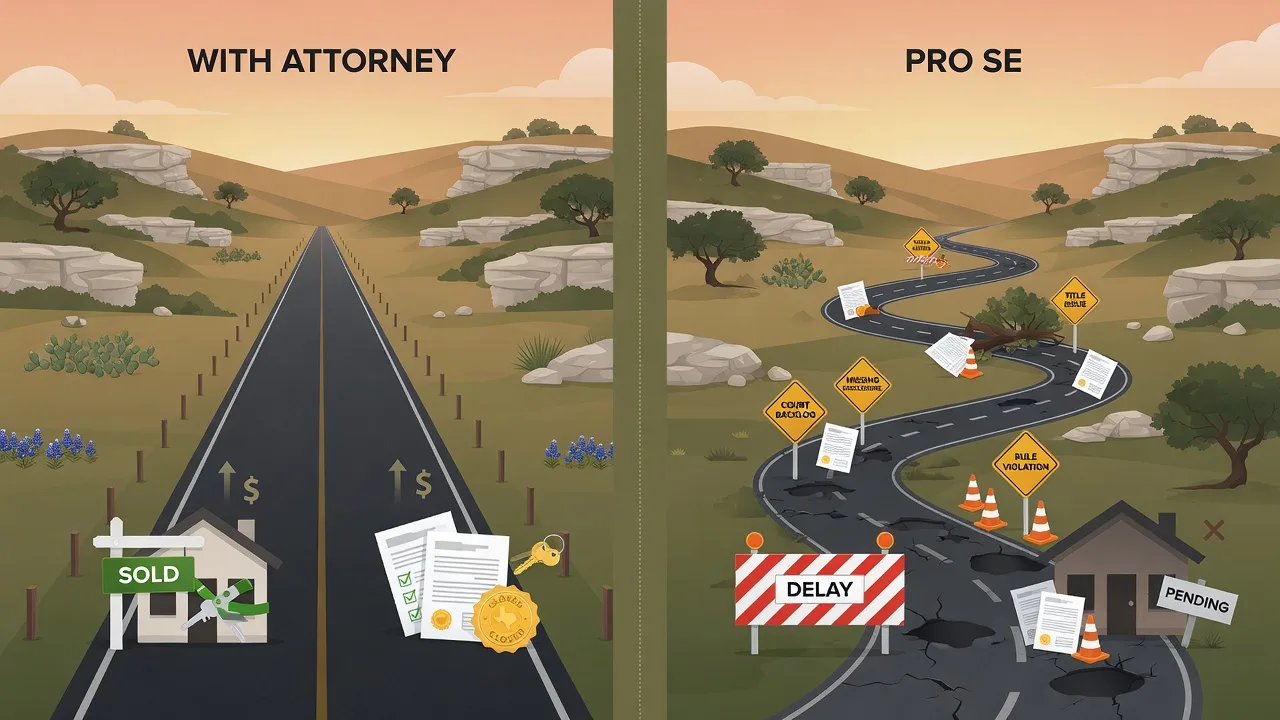
When Pro Se Probate Can Work
In 2025, the Supreme Court of Texas addressed a narrow pro se executor issue in Suday v. Suday. The court held that an executor may represent the estate pro se when the executor is also the estate's sole beneficiary because, under those circumstances, the executor is effectively asserting only her own interests.
The holding was narrow. The court did not announce that executors may generally handle probate proceedings pro se. It also did not decide every creditor-related scenario. The court noted that the estate in Suday had no creditors, but expressly reserved for another case whether and to what extent a sole-beneficiary executor could represent an estate pro se if creditors exist.
The practical takeaway is this: pro se representation is most defensible when the executor is the only person whose interests are affected. Once other beneficiaries, heirs, creditors, or contested issues are involved, the representative is likely acting in a fiduciary capacity that requires licensed counsel.
- The estate may qualify for a narrow pro se procedure, such as certain small estate affidavit filings or some muniment of title proceedings
- The property situation fits the strict limits of that procedure, especially if real property is involved
An affidavit of heirship is not probate, and a small estate affidavit is not a general shortcut for selling any inherited house. If the estate includes real property, the family should confirm whether the property, heirs, debts, and occupancy facts fit the procedure before relying on it.
When Pro Se Probate Does Not Work
Pro se representation becomes problematic — and often breaks down — when the estate includes:
- Real property — with a mortgage, HOA obligations, property tax issues, title defects, needed repairs, or complex ownership history
- Multiple heirs or beneficiaries — with different interests, expectations, or levels of involvement
- Creditor claims — that require evaluation, negotiation, or litigation
- Potential disputes — about the will, the estate's value, or the distribution of assets
- Out-of-state personal representatives — who cannot easily manage the property or appear in court
- Business interests or retirement accounts — that require specialized knowledge to manage
- Tax obligations — that require professional analysis — estate tax, income tax, property tax
When a house is involved, the intersection of property law, probate law, title requirements, disclosure obligations, and ongoing operational responsibilities almost always exceeds what a non-attorney can manage effectively.
Red Flags That Pro Se Is the Wrong Path
Families should be especially cautious if any of the following are true:
- There is no will.
- The will is handwritten, unclear, damaged, unsigned, or potentially invalid.
- There are children from different marriages.
- An heir is missing, estranged, deceased, incapacitated, or a minor.
- One heir wants to keep the house and others want cash.
- The property has a mortgage, reverse mortgage, HOA lien, tax lien, judgment lien, Medicaid estate recovery issue, or code violation.
- The house is vacant, uninsured, deteriorating, or occupied by someone who may not leave voluntarily.
- The estate has medical bills, credit card debt, business debt, or unknown creditors.
- The personal representative lives outside Texas.
- The family wants to sell quickly but has not confirmed who has authority to sign.
- The title company has already raised probate, heirship, or deed concerns.
If any of these apply, the cost of getting legal guidance early is usually lower than the cost of fixing a failed closing later.
The Real Cost of Getting It Wrong
The financial cost of a failed or mismanaged pro se probate can be substantial:
Cost Comparison: Professional Guidance vs. Pro Se Errors
With Professional Guidance
- Attorney fees: often several thousand dollars for standard independent administration, with the final cost depending on the county, attorney fee structure, estate complexity, court requirements, creditor issues, title issues, and whether disputes arise
- Timeline: often several months for uncontested independent administration, depending on the county, court calendar, notice requirements, inventory timing, title review, creditor issues, and sale logistics
- Fewer delays and complications
- Lower risk of procedural mistakes that reduce net proceeds or delay distribution
Without Professional Guidance
- Extended carrying costs — mortgage, insurance, taxes, maintenance for additional months or years
- Title defects that follow the property and reduce marketability
- Personal liability risk — the representative may face surcharge claims, repayment demands, removal, or other consequences for losses caused by improper administration
- Litigation costs — heir disputes, creditor challenges, or buyer claims can generate legal fees far exceeding attorney costs for proper administration
- Reduced net proceeds — every delay and problem reduces what heirs ultimately receive
In practice, the estates that avoid the worst delays are usually the ones that identify the correct probate path early, clear title before marketing the property, address creditor issues properly, and coordinate the attorney, title company, and real estate process before a buyer is waiting to close.
What Families Should Consider
Families considering pro se probate for an estate that includes a house should evaluate the situation honestly:
- How complex is the title?
- Are all heirs and beneficiaries aligned?
- Are there creditor claims?
- How much time can the family realistically commit?
- Does the personal representative have relevant legal, financial, or property-management experience?
- Is the property being maintained and insured?
For most families with a house involved in the estate, the practical answer is not necessarily to hire an attorney for every task — but to at least have legal guidance for the critical decisions and procedural requirements, while handling simpler operational tasks independently.
What Families Can Often Handle Themselves — and What They Should Not
Not every task requires the same level of professional involvement. The mistake is treating legal authority, title clearance, and estate administration as if they are the same as cleaning out the house.
Families can often help with practical tasks such as:
Tasks Families Can Often Handle
- Securing the property
- Photographing and documenting the condition of the home
- Gathering the deed, tax records, mortgage statements, HOA documents, insurance records, utility bills, repair invoices, and surveys
- Maintaining utilities, lawn care, HVAC service, pest control, and basic security
- Meeting contractors, inspectors, estate-sale companies, cleaners, or locksmiths
- Communicating known property facts to the attorney, title company, and real estate agent
Tasks Families Should Not Handle as DIY Legal Work
- Choosing the probate procedure
- Filing pleadings as a fiduciary
- Applying for letters testamentary or letters of administration
- Determining heirship
- Deciding whether creditor claims are valid
- Preparing estate conveyance documents
- Signing a deed without confirmed authority
- Assuming a title company will insure the sale
- Distributing sale proceeds before creditor and administration issues are resolved
The practical division is simple: families can often do the legwork, but legal authority and title clearance should be handled with qualified legal guidance.
Documents to Gather Before Selling a Probate House
Before meeting with a probate attorney, title company, or real estate professional, gather as many of the following as possible:
- Death certificate
- Original will and any codicils
- Court orders already issued
- Letters testamentary or letters of administration, if any
- Prior deed into the decedent
- Most recent property tax statement
- Mortgage statement, payoff information, or reverse mortgage correspondence
- HOA documents, account statements, and violation notices
- Homeowner's insurance policy and vacancy coverage information
- Survey, if available
- Prior title policy, if available
- Repair invoices, permits, roof records, foundation reports, plumbing records, HVAC records, and inspection reports
- Utility account information
- Lease, occupancy agreement, or written arrangement with anyone living in the property
- Names and contact information for heirs, beneficiaries, and known creditors
This packet helps the attorney identify the correct probate path, helps the title company evaluate insurability, and helps the real estate agent avoid marketing a property that cannot yet close.
Frequently Asked Questions
Can an executor sell a house in Texas without going through full probate?
In some cases, yes, but it depends on the facts. A muniment of title may be available when there is a valid will, no unpaid estate debts other than debts secured by real property, and no need for full administration. Other non-administration options may exist in narrow situations, but they are not universal shortcuts. A title company may still require additional documentation before it will insure a buyer's title.
How long does probate take in Texas when a house is involved?
An uncontested independent administration often takes several months. A dependent administration or contested proceeding can take much longer, sometimes a year or more. The timeline depends on the county, court schedule, notice requirements, creditor issues, title review, property-sale logistics, estate complexity, and whether disputes arise.
What happens if the executor makes a mistake during pro se probate?
An executor or administrator may face personal financial risk if negligence, breach of fiduciary duty, improper distributions, missed deadlines, or failure to follow court procedures causes loss to the estate or other interested parties. Possible consequences can include objections, surcharge claims, repayment demands, removal, delayed closing of the estate, or litigation. This is why the decision to proceed pro se carries real financial risk.
Does Texas require an attorney for probate?
In most formal Texas probate proceedings, an attorney is effectively required because the applicant is usually asking to act in a representative capacity for the estate, beneficiaries, heirs, or creditors. A person may represent themselves only when they are truly representing their own interests. Limited pro se options may exist in narrow situations, such as some small estate affidavits, some muniment of title proceedings, or a sole-beneficiary situation, but families should confirm the local court's rules before assuming they can file without counsel.
What is the difference between independent and dependent administration?
Independent administration gives the executor broad authority to act without prior court approval for most transactions — including selling real property. Dependent administration requires court approval for most significant actions, including property sales. Independent administration is faster and more flexible; dependent administration provides more court oversight but involves more procedural requirements.
Can an out-of-state executor handle Texas probate without an attorney?
An out-of-state person may be able to serve as executor or administrator, but handling the probate without Texas counsel is usually unrealistic and may not be allowed in a formal proceeding. The representative may need to appear in court, satisfy local court requirements, coordinate with a Texas title company, maintain the property, address Texas creditor and tax issues, and sign sale documents with proper authority. When a Texas house is involved, out-of-state representatives should assume they need Texas probate counsel unless the court and facts clearly fit a narrow pro se option.
What if there is no will?
If the decedent died without a will (intestate), Texas law determines who has priority to serve as administrator and how the estate is distributed. The process is generally more complex than testate administration because the court must determine heirship, and additional requirements apply. An attorney is strongly recommended in intestate cases.
How much does a probate attorney typically cost in Texas?
Attorney fees vary based on the complexity of the estate and the region. Many probate attorneys charge hourly rates, while others offer flat fees for standard administrations. The cost should be weighed against the risks and expenses of pro se errors — which, as discussed in this article, can be substantially higher.
What does Texas law require regarding maintenance of estate property during probate?
Texas Estates Code Section 351.101 requires an executor or administrator to take care of estate property as a prudent person would take care of their own property and to keep estate buildings in good repair, except for extraordinary casualties unless the court directs otherwise. In practical terms, that means the representative should preserve the property, maintain appropriate insurance, address reasonable repair needs, and avoid preventable deterioration. Failure to use reasonable care can create risk for the estate and the representative.
Sources
- Texas Estates Code, Title 2 — Estates of Decedents; Durable Powers of Attorney
- Texas Estates Code §308.051 — Required Notice Regarding Presentment of Claims in General
- Texas Estates Code §308.053 — Required Notice to Secured Creditor
- Texas Estates Code §308.054 — Permissive Notice to Unsecured Creditor
- Texas Estates Code §309.051 — Inventory and Appraisement
- Texas Estates Code §309.056 — Affidavit in Lieu of Inventory
- Texas Estates Code §351.101 — Duty of Care
- Texas Estates Code §101.001 — Passage of Estate on Decedent's Death. statutes.capitol.texas.gov
- Texas Property Code, Chapter 5 — Conveyances. statutes.capitol.texas.gov
- Texas Property Code, Chapter 12 — Recording of Instruments. statutes.capitol.texas.gov
- Texas Property Code §5.008 — Seller's Disclosure of Property Condition. statutes.capitol.texas.gov
- TexasLawHelp — Probate Court and Representing Yourself. texaslawhelp.org
- Bexar County — Probate a Will. bexar.org
- ALTA — Title Insurance and Real Property Transfers. alta.org
- Steele v. McDonald, 202 S.W.3d 926 (Tex. App.—Waco 2006, no pet.)
- Maryvel Suday and the Estate of Olga Tamez de Suday v. Jesus Lozano Suday, No. 24-1009 (Tex. June 27, 2025) (per curiam), Supreme Court of Texas. txcourts.gov
Related Articles
Executor Guidance
7 Mistakes Executors Make With a Probate House
Common errors that cost estates time, money, and equity — and practical steps to avoid them.
Executor Guidance
Out-of-State Executor, Texas House — What Usually Goes Wrong
Practical guidance for executors managing a Texas property from another state.