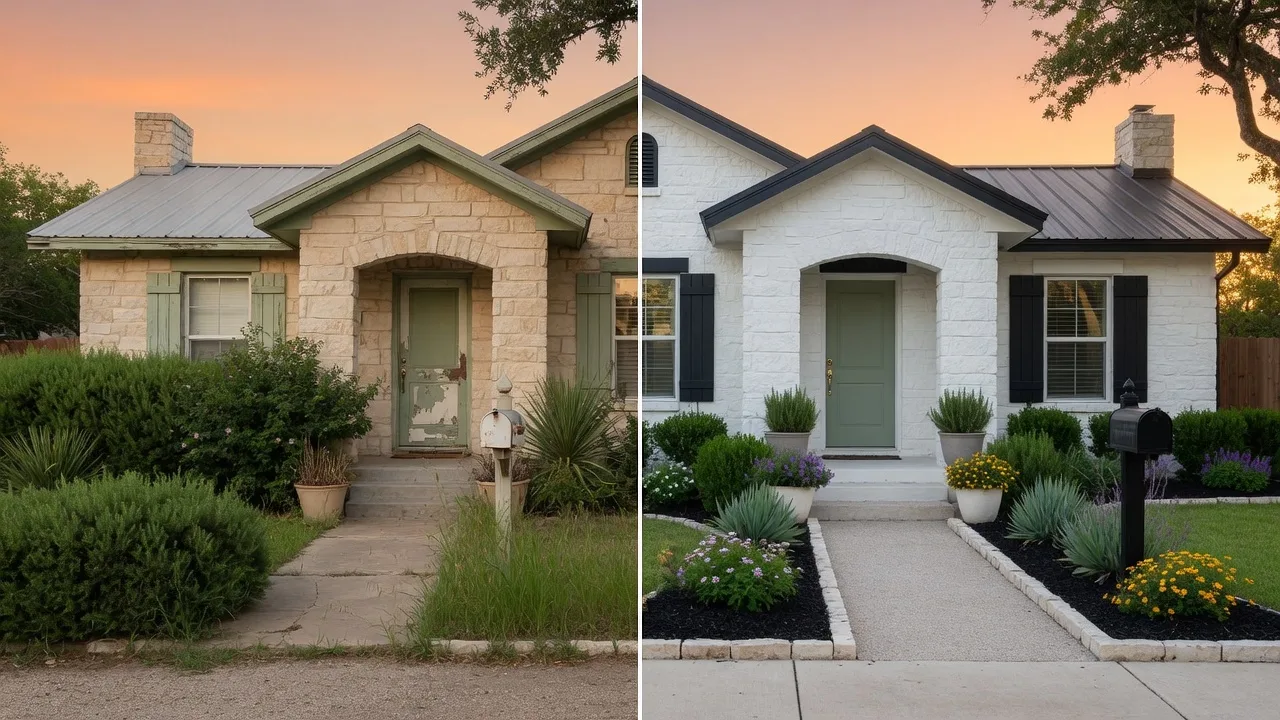

When someone dies and leaves behind a house in Texas, the personal representative faces one of the first and most consequential financial decisions of the probate process: should the property be improved before listing it, or sold in its current condition?
The stakes are straightforward but significant. A modest investment in repairs can sometimes bring substantially higher offers. That same investment can also consume estate cash, extend the timeline, introduce contractor risk, and ultimately fail to recover its cost. Meanwhile, property taxes keep accruing, insurance premiums keep running, and heirs are waiting for resolution.
This article lays out a clear framework for making that decision — grounded in real data, specific to Texas market conditions, and honest about the trade-offs involved. It is not legal or tax advice. It is the kind of practical analysis that helps a personal representative ask the right questions before committing estate funds.
The correct question is not, "How much more could the house sell for after improvements?" It is, "Which legally authorized strategy is most likely to produce the best risk-adjusted net result for the estate?"
Educational Notice
This article is for educational and informational purposes only and does not constitute legal, tax, financial, or real estate advice. Authority, court procedure, title, tax, insurance, and transaction requirements vary by estate and property. Always consult a qualified Texas probate attorney, CPA, and licensed real estate professional before making decisions about estate property.
The Personal Representative's Dilemma: Emotion Meets Financial Reality
Few decisions in estate administration carry the emotional weight of what to do with the family home. For many personal representatives, the house is not just an asset — it is the kitchen where holiday meals were prepared, the yard where grandchildren played, the living room where a parent spent quiet evenings. The idea of selling it without first "making it right" can feel like a failure to honor the person who lived there.

At the same time, the personal representative has a fiduciary responsibility. Texas Estates Code §351.101 requires an executor or administrator to care for estate property as a prudent person would care for their own property and, subject to the statute's qualifications, to keep estate buildings in good repair [6]. That preservation responsibility is different from a duty to undertake cosmetic upgrades or speculative renovations. The practical question is therefore not simply whether work could raise the sale price, but whether the proposed work protects the asset or produces a defensible improvement in expected net proceeds after cost, delay, and risk are considered.
The representative's authority can also depend on the will, the court's orders, and whether the estate is being administered independently or dependently. Texas law gives an independent executor or administrator statutory sale powers in addition to powers granted by a will, while a court-supervised sale in a dependent administration can require an application and order [7]. Before committing estate funds or materially altering the property, the representative should confirm the scope of that authority with Texas probate counsel [8].
The tension between these two forces — the desire to do right by the deceased and the obligation to do right by the estate — is the core of the problem. Getting the answer right requires separating emotion from analysis, and that is harder than it sounds.
Bereavement can affect concentration, working memory, and other cognitive functions [14]. The research cited here proposes a neurocognitive model linking grief with learning and executive processes; it does not measure renovation decisions by personal representatives or prove that bereaved people are more likely to over-improve a house. The practical implication is narrower: major estate expenditures should be evaluated through written comparisons, independent professional input, and a documented decision process rather than urgency, guilt, or sentiment.
The practical takeaway: decisions about property improvements should be made with professional input, documented carefully, and grounded in market data — not emotion.
When Pre-Sale Improvements Make Financial Sense
Pre-sale improvements can make sense when three conditions are met simultaneously: the repairs address a condition that materially limits the buyer pool, the local market demonstrably rewards move-in-ready homes with higher prices, and the estate has the cash and timeline to absorb the work without undue risk.

The Data on Cost Recovery
National industry data provides a starting point, though actual results vary significantly by local market and property condition. The following ranges are drawn from the NAR 2025 Remodeling Impact Report and the JLC/Zonda 2024 Cost vs. Value Report for San Antonio [1][2].
Selected Remodeling Cost-Recovery Benchmarks
National and regional remodeling studies are useful only as screening tools. They model defined project scopes and are not probate-specific guarantees.
- • NAR 2025, national estimate: minor kitchen upgrade — 60% [1]
- • NAR 2025, national estimate: complete kitchen renovation — 60% [1]
- • NAR 2025, national estimate: bathroom renovation — 50% [1]
- • JLC/Zonda 2024, San Antonio: garage-door replacement — 149% [2]
- • JLC/Zonda 2024, San Antonio: minor midrange kitchen remodel — 67.6% [2]
- • JLC/Zonda 2024, San Antonio: midrange bathroom remodel — 55.7% [2]
- • JLC/Zonda 2024, San Antonio: major midrange kitchen remodel — 34.4% [2]
These figures describe specific modeled projects, not a general promise that an estate will recover the same percentage. A light kitchen refresh, for example, is not necessarily equivalent to the "minor kitchen remodel" defined by a national report. The personal representative should rely primarily on written bids, adjusted comparable sales, the property's price band, and the likely buyer pool.
However, these national ranges must be applied with caution. A property-specific analysis — based on actual contractor bids, comparable sales data for the local submarket, and the property's current condition relative to buyer expectations — is far more reliable than national averages.
The "Move-In-Ready Premium" in Texas Hill Country Markets
Buyer response to condition varies by neighborhood, price band, property type, acreage, age, and competing inventory. A metro-wide market statistic cannot establish how much a particular Boerne, Fair Oaks Ranch, or Hill Country property will gain from improvements.
Test the condition premium with recent closed sales that are genuinely comparable. Adjust for location, size, lot or acreage, age, quality, major systems, pool or outbuildings, and seller concessions. Compare updated and as-is properties within the same submarket and price range. If the adjusted sales show a repeatable premium greater than the full cost, delay, and risk of the proposed work, limited preparation may be justified. If the evidence is thin or inconsistent, the article should not imply that condition alone will create a predictable premium [3].
When Condition Limits the Buyer Pool
Some conditions do more than reduce visual appeal; they can complicate financing, appraisal, or insurance. The result depends on the loan program, lender overlays, appraisal findings, insurer underwriting, and the severity of the defect. There is no universal Fannie Mae rule requiring a roof to have at least two years of remaining life. Fannie Mae instead requires adverse conditions and repairs affecting safety, soundness, or structural integrity to be identified and addressed under its property-condition rules [4]. FHA, VA, USDA, and individual lenders may apply different standards. Active leaks, unsafe electrical conditions, inadequate heat, severe structural defects, and certain deteriorated-paint conditions can still affect whether a transaction closes. The personal representative should obtain guidance for the buyer's actual loan program rather than assume that a particular repair is always — or never — required. For most housing built before 1978, separate federal lead-based-paint disclosure requirements may apply even when the Texas statutory Seller's Disclosure Notice is not required [5].
When a condition issue directly limits financing, insurance, or safety, the calculus changes. The estate may not be choosing between a more expensive sale and a less expensive one — it may be choosing between a sale that can close and one that cannot. These threshold repairs are the strongest candidates for pre-sale work because they do not merely improve appearance; they expand the pool of buyers who are able to purchase the property at all.
When Selling As-Is Is the Smarter Path
For every estate where improvements make financial sense, there are others where an as-is sale may be the better decision — financially, logistically, and for the well-being of everyone involved.

Major Systems That Exceed the Value They Add
When a property needs a new roof, foundation repair, HVAC replacement, major electrical rework, or whole-house repiping, the repair costs can exceed the value they add — particularly in a market where investor buyers and cash buyers actively seek as-is properties.
Major-system costs vary too widely to estimate responsibly without a defined scope. Roof area and material, foundation type and movement, HVAC capacity and ductwork, electrical service condition, plumbing material and access, mold extent, permitting, and occupied-versus-vacant status can all materially change the price. Obtain written, itemized evaluations from the appropriate licensed or qualified trades before using any repair number in the estate's decision analysis.
Probate Timeline Constraints
Estates operate under time pressure that most sellers do not face. Creditor claim deadlines, heir agreements, probate court schedules, and carrying costs all push toward faster resolution. Every month the property sits — whether during renovation or while waiting for market response — adds carrying cost. The next section explains how to calculate those costs using the property's actual numbers rather than generic estimates.
A renovation does not just cost the repair budget. It also costs the carrying costs that accrue during the preparation period, the marketing period, and the closing period. The personal representative should evaluate whether the expected condition premium justifies the added delay and expense.
Furthermore, protracted timelines expose the estate to preventable tax liabilities. Because inherited real estate receives a stepped-up tax basis equal to its fair market value on the decedent's exact date of death, a prompt sale typically generates minimal to no federal income tax exposure. However, if extensive renovations drag on for six months to a year in an appreciating Texas market, any market value gained between the date of death and the eventual closing date becomes taxable capital gains. Over-improving a home doesn't just eat up cash and time; it can inadvertently turn tax-free inherited equity into a taxable event for the beneficiaries.
Limited Estate Cash or Urgent Obligations
When the estate has limited liquid reserves, outstanding debts, creditor deadlines, or obligations to heirs that require prompt distribution, tying up capital in a renovation project creates financial risk. An as-is sale can allow the estate to meet its obligations without the uncertainty of a construction project.
Family Disagreements
When multiple heirs disagree about the scope of repairs, the color of paint, the choice of contractors, or the overall strategy, the resulting delays can cost the estate more than any renovation would recover. An as-is sale — which may produce a faster, cleaner resolution — can serve the estate's financial interest better than a prolonged negotiation over repair details.
An as-is sale also minimizes structural risks in a dependent administration. While an independent executor has wider latitude, a court-appointed administrator in a dependent probate must exercise extreme caution. Tying up estate liquidity in cosmetic or discretionary renovations without explicit, prior court approval can backfire significantly. During the final accounting, if heirs object to the renovation costs or if the judge deems the upgrades speculative rather than preservative, the court may disallow the expenses — leaving the personal representative personally liable for reimbursing the estate out of pocket.
When the Buyer Pool Does Not Reward Condition
In certain markets, buyer segments — particularly investors, flippers, and cash buyers — actively prefer as-is properties because they plan to apply their own renovation strategy. In these submarkets, improving the property before sale may reduce interest from the buyers most likely to close without financing contingencies. A local agent with experience in the submarket can identify whether the property's likely buyer pool rewards condition or discounts it.
A Practical Decision Framework
Rather than relying on gut instinct, the personal representative can use a structured comparison. The following framework defines three scenarios and evaluates each on the same criteria — the approach most likely to produce a defensible, well-reasoned decision. For purposes of this article, "preservation work" means repairs that prevent further deterioration or address safety hazards; "market preparation" means cosmetic and minor functional improvements that broaden the buyer pool; and "renovation" means significant structural, systems, or finish work beyond what the property needs to be marketable in current condition.

1 As-Is Sale (with only safety/preservation work)
- Fastest path to market
- Lowest capital outlay
- May attract investors, cash buyers, and renovation-minded purchasers
- Lowest carrying costs during the sale process
2 Limited Market Preparation (clean-out, paint, minor repairs)
- Moderate time to market
- Moderate capital outlay
- Broadens buyer pool to conventional purchasers
- Often produces most of the marketing benefit with limited risk
3 Broader Renovation (kitchen, bath, structural improvements)
- Longest time to market
- Highest capital outlay and risk
- Highest carrying costs during construction
- Cost recovery is least predictable
- May not produce meaningfully higher net proceeds than Scenario 2
In practice, Scenario 2 — limited market preparation — may produce most of the marketing benefit without exposing the estate to the cost and risk of a full renovation. National remodeling data suggest that modest, targeted improvements tend to outperform large-scale renovations in cost recovery, especially in the context of estate sales where timelines and budgets are constrained [1][2]. The conclusion is general, however, and property-specific evidence should drive the actual decision.
Quick Decision Guide
Consider preservation or limited preparation when:
- The work prevents further damage or addresses an immediate safety issue
- A documented financing or insurance obstacle can be resolved economically
- Adjusted local sales support a condition premium
- The estate has authority, liquidity, insurance, and management capacity
- Written bids define a limited scope and realistic schedule
- The conservative net-proceeds analysis shows a meaningful advantage
Favor an as-is strategy when:
- The expected condition premium is smaller than the full cost and risk
- The scope is uncertain or likely to expand after demolition
- Title, authority, insurance, cash, or court-approval issues make construction impractical
- The likely buyer pool already expects renovation
- Beneficiaries are in unresolved conflict
- The projected advantage disappears under reasonable downside assumptions
How to Run the Net-Proceeds Comparison
The decision should come down to a net-proceeds comparison — not intuition, not emotion, and not what a family member thinks the house "should" sell for. Here is the process:

Get a professional as-is market valuation
A Comparative Market Analysis (CMA) from a local agent, based on recent comparable sales in current condition. For additional credibility, consider a licensed appraisal [3].
Obtain two to three written contractor bids
Itemized, detailed bids from established, insured contractors for the recommended scope of work. Verify regulated trade licenses, general liability coverage, workers' compensation status or written disclosure, references, and permit requirements [12].
Estimate the condition premium using adjusted closed sales
Compare recent as-is and updated sales within the same submarket and price band. Adjust for differences unrelated to condition, including location, living area, lot or acreage, age, construction quality, major systems, pool, outbuildings, and seller concessions. Treat the remaining differential as an estimated ceiling — not proof that the proposed work will create the entire difference [3].
Calculate low, base, and high net proceeds for every scenario
For the as-is, limited-preparation, and broader-renovation scenarios, estimate:
- • low, base, and high sale prices
- • all contractor and material costs
- • permits, design, engineering, inspections, and project management
- • cleaning, contents removal, storage, staging, photography, and landscaping
- • additional insurance and security
- • carrying costs through the expected closing date
- • commissions, title and closing charges, concessions, and repair credits
- • an explicit contingency for hidden conditions and change orders
- • the probability and financial effect of delay or project failure
Approve discretionary work only when the conservative increase in expected net proceeds exceeds the full cost, added holding period, contingency, and execution risk by a meaningful margin.
Factor in the representative's time, stress, and timeline constraints
If the net-proceeds calculations are close, the tiebreaker is often the intangible costs: the representative's time managing contractors, the stress of overseeing renovation during a period of grief, family dynamics, and probate timeline pressure. When the numbers are close, the simpler path usually serves everyone better. When the projected advantage is small enough to disappear under a modest cost overrun, appraisal issue, price reduction, or one-month delay, the work is not financially robust.
Texas-Specific Considerations
Texas has its own market dynamics, legal framework, and practical realities that affect this decision. Personal representatives should be aware of several state-specific factors.
The Texas Seller-Disclosure Exemption — and Its Limits
Texas Property Code §5.008(e)(5) exempts a transfer "by a fiduciary in the course of the administration of a decedent's estate" from the statutory Seller's Disclosure Notice requirement [9]. The exemption depends on the seller's legal capacity and the nature of the transfer — not merely on the fact that the home once belonged to a decedent. A sale by an heir, devisee, trustee, beneficiary, or other successor should be evaluated by probate counsel or the title company rather than assumed to qualify.
An exemption from the statutory form should not be described as permission to make false statements, provide misleading half-truths, actively conceal defects, or disregard other applicable disclosure duties [9]. The contract, prior inspections, insurance claims, environmental rules, and federal lead-based-paint requirements may create separate issues [5]. Personal representatives should have counsel review the disclosure approach before marketing the property.
"As-is" describes the parties' contractual allocation of responsibility for the property's existing condition. It does not eliminate the buyer's inspection rights unless the contract says so, cure title problems, guarantee lender or insurer acceptance, or erase legal duties that apply independently of the statutory disclosure form. A cash offer is also not automatically a certain closing; proof of funds, option rights, title issues, contingencies, and the buyer's performance history still matter.
Contractor Licensing, Permits, and Insurance
Texas does not issue a statewide general-contractor license. State licensing or registration does apply to regulated work, including many electrical, air-conditioning and refrigeration, plumbing, and mold-assessment or remediation services [12]. Permit and local contractor-registration requirements depend on the property address, scope of work, and authority having jurisdiction; a city's requirements may differ from those in an unincorporated county area.
Before work begins, verify the applicable permit requirements with the correct building or permitting office. Independently confirm regulated trade licenses, general liability coverage, workers' compensation status or written disclosure, references, contract terms, payment schedule, change-order procedure, and warranty. For substantial work, obtain legal or title guidance regarding lien releases and final payment.
Personal representatives must also anticipate the unique title friction that recent construction creates in Texas. Under Texas law, statutory mechanic's liens can cloud a title even after a contractor has been paid if subcontractors or material suppliers allege non-payment. If major renovation work is completed right before closing, the title company may protect itself by requiring an escrow holdback — frequently 10% to 20% of the gross sale proceeds — to cover the statutory lien filing window. This unexpected holdback freezes estate liquidity and delays the final distribution of funds to heirs long after the real estate transaction has technically closed.

Calculate the Property's Actual Carrying Cost
Do not use a generic monthly estimate. Calculate the property's actual cost of delay:
Monthly carrying cost = annual property tax ÷ 12 + annual insurance ÷ 12 + utilities + HOA or POA charges + lawn, pool, pest, and security service + debt service or interest + expected maintenance reserve.
Use the current tax statement and confirm which exemptions or special appraisals remain applicable after the owner's death. Obtain written insurance guidance for the home's occupancy status and planned work. Run the calculation for the realistic preparation period, marketing period, and closing period — not merely the contractor's estimated construction time.
Confirm Coverage Before the House Sits Vacant or Work Begins
Notify the insurance agent or carrier promptly about the owner's death, the home's occupancy status, and any planned construction [11]. Standard homeowners coverage can be restricted or discontinued after an extended vacancy; the Texas Department of Insurance notes that most companies stop coverage after 60 days of vacancy unless other arrangements are made. Ask in writing whether the estate needs vacant-home, dwelling, builder's-risk, or other coverage and whether inspections, winterization, monitored alarms, water shutoff, or regular property checks are required.
If a recent loss may be covered, coordinate with the insurer before authorizing permanent repairs. Preserve photographs, estimates, invoices, and damaged materials as directed.

Federal Income-Tax Basis for Inherited Property
Inherited property generally receives a federal income-tax basis tied to fair market value at the date of death, subject to exceptions and special rules [10]. A sale near a well-supported date-of-death value may produce a limited taxable gain, but that outcome is not automatic. Ownership form, community-property treatment, alternate valuation, prior depreciation, selling expenses, capital improvements, and post-death appreciation can materially change the calculation.
Obtain a defensible date-of-death valuation and have the estate's CPA determine ownership, basis, allowable adjustments, and the likely tax treatment before choosing a renovation strategy. Ordinary cleaning and maintenance should not be assumed to increase basis, and the tax discussion should not be used as a reason to accept a lower economic result for the estate.
Improvements That May Produce Favorable Cost Recovery in Probate Sales
When the analysis supports improvements, the following projects may produce favorable cost recovery in the estate-sale context — ranked by typical return relative to cost. No project outcome is guaranteed; each should be supported by property-specific market evidence.

Preservation Work and Safety Repairs
Work that prevents further deterioration — tarping a damaged roof, stabilizing plumbing leaks, addressing electrical hazards, boarding broken windows — protects the asset. These steps may not raise the sale price directly, but they prevent additional damage that would reduce it. Texas law may require this work regardless of sale strategy [6].
Clean-Out, Deep Cleaning, and Odor Treatment
Removes immediate buyer objections and improves showability. This step should not be attempted without first addressing personal-property ownership, beneficiary rights, inventory requirements, and preservation issues (see "Do Not Begin With a Dumpster" below). When appropriate, it may be one of the most cost-effective preparation steps [1].
Basic Landscaping and Exterior Cleanup
Mowing, edging, leaf removal, pruning, mulch, and porch cleanup. Low cost, high first-impression impact. Studies show exterior improvements rank among the projects with favorable cost recovery [1][2].
Fresh Interior Paint in Damaged or Highly Personalized Rooms
Addresses the most common visual objections without major construction. Neutral tones help buyers evaluate the home rather than focus on the previous owner's taste. May produce a favorable return when supported by property-specific market evidence [1].
Damaged Flooring Replacement or Professional Cleaning
Stained carpet, damaged tile, or worn laminate can dominate showings and trigger disproportionate buyer objections. Targeted replacement of damaged areas — rather than whole-house replacement — may produce the best return [1].
Minor Fixture, Hardware, and Lighting Updates
New cabinet hardware, updated light fixtures, and modern door handles can modernize a home's appearance at relatively low cost. The visual impact may exceed the cost, though property-specific evidence should confirm the conclusion [1].
Threshold Repairs (Safety, Financing, Insurability)
Repairs that directly affect a buyer's ability to finance or insure the home — such as roof repair, HVAC service, electrical panel upgrades, or handrail installation — may not produce a visible transformation but can meaningfully expand the buyer pool [4].
Improvements That Rarely Pay Off in Probate Sales
Equally important is knowing which projects to avoid. The following improvements frequently fail to recover their cost in the context of estate home sales:
Full Kitchen Renovation
National data shows full kitchen remodels recovering 40–60% of their cost in owner-occupied resale contexts [1]. The JLC/Zonda 2024 San Antonio data reports 34.4% for a major midrange kitchen remodel [2]. At the costs involved, this is rarely justified in an estate-sale context where the buyer pool includes renovation-minded purchasers who will customize to their own taste.
Full Bathroom Renovation
A midrange bathroom remodel reports 55.7% cost recovery in the JLC/Zonda 2024 San Antonio data [2]. A full gut renovation of multiple bathrooms can exceed the value it adds, particularly in markets where buyers expect modern finishes at a price point that does not support the renovation cost.
High-End Cosmetic Upgrades
Premium finishes in a mid-range home create a mismatch. The cost may exceed what the local market supports, and the upgrades can narrow the buyer pool by signaling a higher price point than the neighborhood justifies.
Addressing Functional Obsolescence
Structural design limitations — a two-bedroom floor plan in a four-bedroom market, a bathroom accessible only through a bedroom, a closed-off kitchen — are expensive to correct and rarely recover their cost. These issues may be better addressed through pricing strategy than through structural renovation.
Pool Addition or Major Outdoor Living Space
While pools are popular in Texas, a new pool installation typically costs more than the value it adds in a resale context. Existing pools that are clean and functional are an asset; adding a pool to sell a house is not generally cost-effective.
Before You Begin: Safeguards and Checkpoints
Do Not Begin With a Dumpster
Before authorizing a cleanout, photograph and inventory the contents; secure cash, jewelry, firearms, medications, financial records, photographs, digital devices, keys, and title documents; identify specifically bequeathed or disputed property; and obtain the probate attorney's direction on items that may be sold, donated, transferred, or discarded [8]. Keep receipts and a disposition log. Cleaning should begin only after the representative has addressed ownership, beneficiary, inventory, and preservation issues.
Once those steps are complete, cleaning, odor treatment, debris removal, and basic yard maintenance may improve marketability without committing the estate to a renovation. Do not describe this work as "nearly always recovered" unless property-specific evidence supports that conclusion.
Confirm Authority and Funding Before Ordering Work
Before signing a construction contract, confirm:
- • who currently holds title
- • whether the representative is acting independently or dependently
- • what the will, order, and Letters authorize [7][8]
- • whether court approval or beneficiary consent is required or advisable
- • whether estate cash may be used for the proposed work
- • whether a beneficiary advance, loan, reimbursement arrangement, or lien is contemplated
- • whether the insurer, lender, title company, or probate attorney imposes additional conditions
Obtain the probate attorney's written guidance before borrowing money, accepting beneficiary advances, entering a substantial renovation contract, or materially altering the property.
Documenting the Decision
Regardless of which path the personal representative chooses, the decision should be documented. The representative owes a fiduciary responsibility to the beneficiaries, and maintaining a clear record of how the decision was made protects the estate in the event of a later challenge [6].
Useful documentation includes:
- The will, court orders, Letters, and counsel's written authority guidance
- Title commitment, payoff information, tax statements, and HOA or POA records
- Date-of-death valuation and any later appraisal or CMA
- Dated photographs and videos before contents removal and before work begins
- Inventory records and a log of personal-property disposition
- Inspection reports and specialist evaluations
- Itemized bids, contracts, licenses, insurance certificates, permits, and change orders
- Invoices, proof of payment, warranties, final inspections, and lien releases
- Written low/base/high net-proceeds comparisons
- Insurer communications regarding vacancy and construction
- Beneficiary communications and documented objections or approvals
- The final rationale for selecting the sale strategy
The goal is to create a contemporaneous record showing that the representative gathered relevant information, considered reasonable alternatives, and acted prudently. This documentation does not need to be elaborate — it needs to exist and be consistent with the decision that was made.

Frequently Asked Questions
What is the single most cost-effective improvement before selling a probate house?
Preservation work and deep cleaning. Safety-related preservation — tarping a damaged roof, securing the property, addressing active leaks — protects the asset from further deterioration. After that, professional clean-out and deep cleaning are generally among the most cost-effective preparation steps. They remove common buyer objections (odor, clutter, visible neglect) and improve how the home shows. However, the cleanout must address personal-property ownership, beneficiary rights, and inventory requirements before any items are removed. The personal representative should consult the probate attorney before beginning [6][8].
Should I renovate the kitchen before listing an inherited home?
A full kitchen renovation is rarely cost-effective in an estate-sale context. The JLC/Zonda 2024 San Antonio data reports 34.4% cost recovery for a major midrange kitchen remodel [2]. National data from NAR shows 60% for complete kitchen renovations [1]. What may work instead is a kitchen "refresh": fresh paint on cabinets, new hardware, updated light fixtures, and deep cleaning. This costs a fraction of a full renovation and addresses the visual objections that most affect buyer perception — provided that property-specific comparable sales support the investment.
How do I know if the local market rewards condition?
The answer is in comparable sales data. A local real estate agent can pull recent sales for similar homes in the same submarket and price band and show the adjusted price difference between homes sold in move-in-ready condition versus homes sold as-is. If that differential is repeatable and exceeds the full cost, delay, and risk of the proposed work, the market may be rewarding condition. If it is small or inconsistent, the investment may not be justified. This is the most important data point in the analysis, and it must come from actual closed sales — not opinions or assumptions [3].
What if the estate does not have cash for repairs?
This is a common situation and often resolves the debate. If the estate lacks liquid funds for repairs, the most practical path may be an as-is sale. Investor and cash buyers actively seek as-is properties, and the sale can proceed without any capital outlay from the estate. If there is a compelling case for limited improvements — for example, a small painting project that could prevent a significant buyer-price deduction — the personal representative should consult the estate's attorney about whether a documented advance from beneficiaries or other estate funds is appropriate, and whether the representative has authority to enter into such an arrangement.
How long does the probate process typically take in Texas, and does that affect the improvement decision?
Texas has no single completion timeline for every estate. Duration depends on the type of administration, creditor and tax issues, title defects, litigation or beneficiary disputes, court requirements, and the work needed to sell or distribute the property [7][8]. Rather than relying on a generic statewide range, ask probate counsel to identify the estate-specific milestones that control when funds may be committed, when the property may be marketed, and whether a proposed renovation would interfere with administration or distribution.
Are there tax implications that differ between fixing up and selling as-is?
Potentially. Inherited property generally receives a federal income-tax basis tied to fair market value at the date of death, subject to exceptions [10]. The estate's CPA should determine ownership, basis, allowable adjustments, and the likely tax treatment before the representative commits to a renovation strategy. Ordinary cleaning and maintenance should not be assumed to increase basis. Selling expenses, estate-administration expenses, post-death appreciation, community-property treatment, and alternate valuation may all affect the calculation. The tax discussion should not be used as a reason to accept a lower economic result for the estate.
What if the personal representative lives out of state?
An out-of-state representative can complete a Texas sale, but a renovation adds supervision, access, quality-control, payment, permit, insurance, and documentation problems. The listing agent and title company can coordinate their portions of the transaction, but they do not replace the representative's fiduciary responsibility, probate counsel, or a separately engaged construction manager.
If work is authorized, define the local manager's role in writing: scope, spending limit, access authority, reporting frequency, approval of change orders, invoice review, insurance responsibility, compensation, and required photographs or inspections. Compare those management costs and risks with an as-is strategy before proceeding.
Sources
- National Association of Realtors, 2025 Remodeling Impact Report. Provides national cost-recovery estimates by project type. Cost-recovery percentages cited: minor kitchen upgrade 60%, complete kitchen renovation 60%, bathroom renovation 50%. Accessed July 2026. nar.realtor/remodeling-impact-report
- Journal of Light Construction / Zonda Media, 2024 Cost vs. Value Report, San Antonio, TX. Provides San Antonio-specific cost-recovery data. Figures cited: garage-door replacement 149%, minor midrange kitchen remodel 67.6%, midrange bathroom remodel 55.7%, major midrange kitchen remodel 34.4%. Accessed July 2026. jlconline.com/cost-vs-value/2024
- San Antonio Board of Realtors (SABOR), monthly market report. Provides current days-on-market and median-price data for the San Antonio metropolitan area. The specific report used should be identified by date and edition. Local-market analysis and comparable sales research should be obtained from a licensed real estate agent familiar with the relevant submarket.
- Fannie Mae, Selling Guide, B4-1.3-03, "Property Condition and Requirements." Requires identification and repair of adverse conditions affecting safety, soundness, structural integrity, or remaining economic life. Does not impose a universal two-year roof-life requirement. Accessed July 2026. selling-guide.fanniemae.com
- U.S. Environmental Protection Agency (EPA), "Lead-Based Paint Disclosure Rule" (42 U.S.C. §4852d); U.S. Department of Housing and Urban Development (HUD), "Title X Lead-Based Paint Disclosure Regulation" (24 C.F.R. Part 35). Requires disclosure and specific informational pamphlets for pre-1978 housing. Accessed July 2026. epa.gov/lead/lead-based-paint-disclosure-rule
- Texas Estates Code §351.101 — "Duty of Executor or Administrator to Manage Estate Property." Requires care and management of estate property as a prudent person would care for their own property; includes qualifications regarding repair of estate buildings. Accessed July 2026. statutes.capitol.texas.gov/ESTATES/Chap351.htm
- Texas Estates Code §402.052 — "Powers of Independent Executor"; Chapter 356 — "Sale of Estate Property." §402.052 provides independent executors with broad powers including the power to sell real property. Chapter 356 governs sales in dependent administration. Accessed July 2026. statutes.capitol.texas.gov/ESTATES/Chap402.htm
- Texas Estates Code, Chapter 309 — "Collection of Estate Assets." Addresses the representative's duty to take possession of and collect estate property; relevant to authority for property management decisions. Accessed July 2026. statutes.capitol.texas.gov/ESTATES/Chap309.htm
- Texas Property Code §5.008 — "Seller's Disclosure of Property Condition." Subsection (e)(5) exempts transfers "by a fiduciary in the course of the administration of a decedent's estate" from the statutory Seller's Disclosure Notice. The exemption depends on the seller's legal capacity and the nature of the transfer. Accessed July 2026. statutes.capitol.texas.gov/PR/htm/PR.5.htm
- Internal Revenue Service, Publication 559, Survivors, Executors, and Administrators; Publication 551, Basis of Assets. Discusses stepped-up basis for inherited property, date-of-death valuation, capital improvements, and allowable adjustments. Accessed July 2026. irs.gov/pub/irs-pdf/p559.pdf
- Texas Department of Insurance, Home Insurance Guide. Notes that most standard homeowners policies restrict or discontinue coverage after 60 days of vacancy unless alternative arrangements are made. Provides guidance on vacant-home and dwelling coverage. Accessed July 2026. tdi.texas.gov
- Texas Department of Licensing and Regulation (TDLR) — Electrical and Air Conditioning Licensing; Texas State Board of Plumbing Examiners — Plumbing Licensing. Texas does not issue a statewide general-contractor license. State licensing or registration applies to regulated trades including electrical, HVAC, plumbing, and mold-related services. Permit requirements depend on the jurisdiction. Accessed July 2026. tdlr.texas.gov
- Appraisal Institute, The Appraisal of Real Estate. Referenced only for general appraisal methodology for condition-adjusted comparable sales analysis. No specific edition, chapter, or proposition is cited for a particular proposition in this article. Executors should consult a licensed appraiser for property-specific valuations.
- "Competitive neurocognitive processes following bereavement," Brain Research Bulletin, 2023. Proposes a neurocognitive model linking grief with learning and executive processes. Does not measure renovation decisions by personal representatives or prove that bereaved people are more likely to over-improve a house. Cited only for the narrow proposition that bereavement can affect concentration and cognitive function. sciencedirect.com
Personal Note
If you are a personal representative navigating this decision, here is what I would want you to know: there is no single right answer, and the fact that you are thinking carefully about it is a good start. The question is not whether the house "deserves" to be fixed up — it is whether the improvement serves the estate's financial interest and the people it supports.
Families land on both sides of this decision. Sometimes the numbers support targeted improvements, and the results are straightforward. Just as often, the more efficient move is a clean, fast sale that lets the family move forward without the burden of a renovation project on top of everything else they are managing.
If you are working through this and want to review the property-specific numbers — what comparable sales indicate, what the market is doing right now, or how to think about the net-proceeds comparison — I am available for that conversation. This is complex territory, and a property-specific review can help the personal representative and the estate's advisors evaluate the options with current, localized information.
— Bill Ross, Certified Probate Expert
Hill Country Homesteads Group, Brokered by KW Boerne
Phone: (210) 294-9190
Email: Bill@HillCountryHomesteads.com
Office Address: 116 Herff Rd, Suite 203, Boerne, TX 78006
Related Reading
Fix Up or Sell As-Is? A Guide for Estate Executors in Texas
A comprehensive framework for the core decision
Can a Probate House Be Sold As-Is?
Legal authority, disclosure rules, pricing, and buyer types
The Hidden Carrying Costs of Keeping an Estate Home Too Long
What every month of delay actually costs the estate
How Long Does It Really Take to Sell a Probate House?
Realistic timelines for probate home sales in Texas