

This article provides general educational information about heir occupancy in Texas estate administration. It is not legal advice. Bill Ross is a Texas real estate agent, not an attorney. His Certified Probate Expert designation is a professional credential, not a license to practice law. Occupancy rights, eviction procedures, and fiduciary obligations depend on Texas law and the individual circumstances. Court organization, local rules, scheduling, and filing practices can vary by county. Consult a licensed Texas probate attorney for guidance specific to your situation.
Few situations create more awkwardness, confusion, and simmering conflict in a family estate than the heir who simply will not leave the house.
Maybe the heir moved in to care for the parent before death and stayed after. Maybe they saw the house as their future home and feel entitled to remain. Maybe they are struggling financially and have nowhere else to go. Whatever the reason, the scenario is surprisingly common: one heir is living in the estate house, the other heirs want the property sold or distributed, and the occupant is not budging.
This article walks through the legal and practical framework that applies in Texas. It covers who has the right to stay, who does not, what the executor can do, what the executor cannot do, and how to find a resolution that protects the estate without destroying the family.
When the Key Does Not Turn Over
The scenario often unfolds the same way. A homeowner dies. A will may name an executor, or the court may appoint an administrator when appropriate. The personal representative begins gathering assets, addressing debts, and preparing the house for sale or distribution. And then comes the discovery: someone is living in the house, and they are not planning to leave voluntarily.
The occupant may be an adult child who lived with the decedent, a sibling who moved in during the final months of caregiving, or a grandchild who needed a place to stay. In some cases, the occupant is a surviving spouse, which creates a different set of legal protections entirely.
The executor's first instinct may be to demand that the occupant leave immediately. That instinct can backfire. Texas law draws careful lines around occupancy rights in estate property, and the consequences of crossing those lines wrongfully can include legal liability, court sanctions, and worse family conflict than the one the executor was trying to resolve.

Occupancy Rights vs. Ownership Rights
Living in the property does not, by itself, determine either ownership or the right to remain there. Under Texas Estates Code Section 101.001, property devised by a will generally vests in the devisees at the decedent's death, and intestate property generally vests in the decedent's heirs at death. That ownership remains subject to the decedent's debts and the estate's administration.
After letters testamentary or letters of administration are issued, the personal representative generally has the right to possess and manage estate property during administration under Texas Estates Code Section 101.003. The personal representative's right of possession should not be confused with beneficial title.
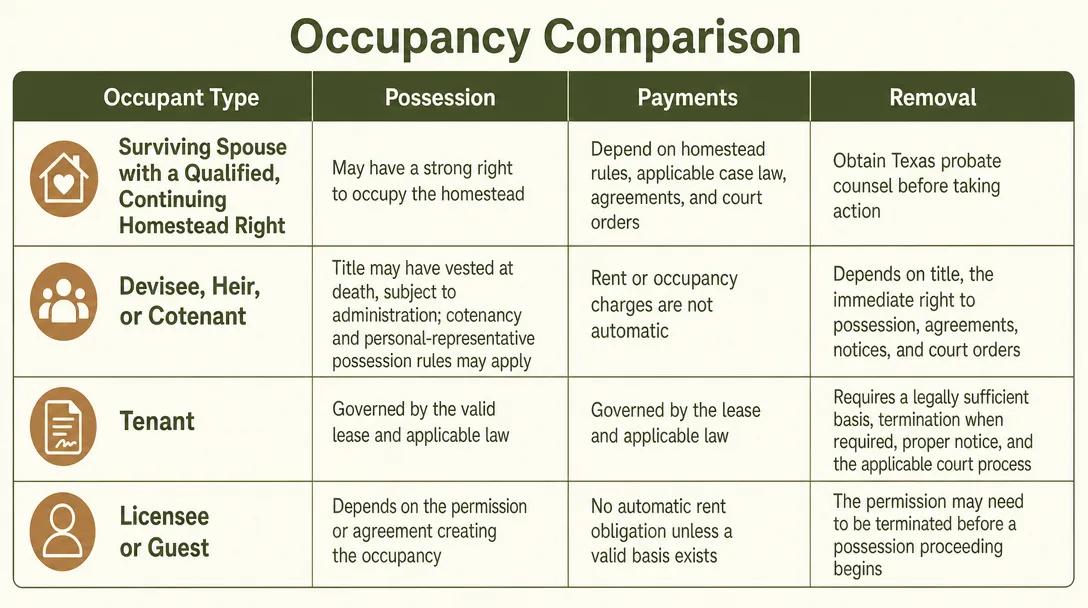
Depending on the facts, an occupant might be a devisee, heir, co-owner, tenant, licensee, guest, surviving spouse with homestead rights, or someone with no present right of possession. Long-term residence alone does not automatically create a landlord-tenant relationship. The occupant's legal status should be determined before rent is demanded or possession proceedings begin.
Key distinction: Occupancy does not establish ownership, and ownership does not always establish an immediate right to exclusive possession. Title and possessory rights must be analyzed separately.
This distinction becomes especially important when the executor is trying to decide whether to list the house for sale. For California-based heirs, our cross-state guide covers the logistics of managing a Texas property sale remotely. Unresolved possession, ownership, or homestead issues can delay a closing and may prevent a title company from insuring the transaction until those issues are resolved. Depending on its underwriting requirements, the title company may request affidavits, releases, a possession agreement, proof that homestead rights have ended, or an appropriate court order.
Surviving-Spouse Homestead Rights
If the property qualified as the decedent's Texas homestead, a surviving spouse may have a constitutional and statutory right to use and occupy it for life, so long as the spouse elects to do so. That right may burden the interests of devisees or heirs even when the house was the decedent's separate property.
Texas law also protects minor children in a narrower, court-supervised manner. Under Texas Constitution Article XVI, Section 52 and Texas Estates Code Chapter 102, a guardian of the decedent's minor children may, under an appropriate court order, be permitted to use and occupy the homestead while the children remain minors. This protection should not be confused with a general right of every child or adult heir to remain in the property.
This protection is substantial, but it should not be described as an unconditional rule that a surviving spouse can never be removed or that the property can never be sold. Counsel must determine whether the property qualified as the homestead, whether the right continues, whether it was validly waived, abandoned, or otherwise terminated, whether the spouse consents to a transaction, and whether applicable law permits the proposed sale notwithstanding the homestead right. A temporary absence does not necessarily establish abandonment.
Texas generally limits an urban homestead to 10 acres. A rural homestead may contain up to 200 acres for a family or 100 acres for a single adult. Whether property is urban or rural depends on the statutory and constitutional facts, including its location and use; it is not determined merely by a "county classification."
What This Means for the Executor
- Do not assume. The surviving spouse may have rights that override the will's instructions. The executor should confirm homestead status with the estate attorney before taking any action.
- Do not threaten eviction. Attempting to remove a surviving spouse from the homestead can expose the executor to legal liability.
- The house may still be sold with the required consent and authority. A transaction may be possible if the surviving spouse agrees in writing, all other required owners or interest holders participate, the personal representative has the necessary authority, and the title company's requirements are satisfied. The spouse's consent alone does not necessarily authorize the sale.
Important: Obtain Texas probate counsel before attempting to remove a surviving spouse or sell a claimed homestead. Additional analysis is required when the property exceeds the applicable acreage limit, the spouse was living elsewhere, the spouses signed a marital agreement, the spouse may have waived or abandoned the right, or a sale is proposed to satisfy an authorized estate obligation.
(See Williams v. Williams, 569 S.W.2d 867 (Tex. 1978).)
Written Occupancy Agreements
In some cases, the occupant's right to stay in the house is governed by a written agreement. The agreement may have been signed by the decedent before death or by the executor afterward.
Subject to applicable Texas law, the will, court orders, and the personal representative's authority, a written occupancy agreement generally governs the parties' arrangement. It should identify the occupant's legal status, payment obligations, utilities, insurance, maintenance, access, termination rights, and the required move-out procedure.
The owner's death ordinarily does not, by itself, terminate an otherwise valid lease. Whether the lease binds the personal representative, devisees, heirs, or another successor — and who is entitled to act as landlord and collect rent during administration — depends on the lease, title, the personal representative's statutory authority, and applicable law. The occupant's rights remain subject to expiration of the term, valid termination provisions, material default, agreed termination, and any other termination rights recognized by law.
If no lease exists but the executor and occupant sign a post-death occupancy agreement, that agreement should be in writing and should address:
- Monthly rent amount and due date
- Utility responsibility and how bills get paid
- Duration of occupancy and notice requirements for termination
- Maintenance obligations and who handles repairs
- Property access for showings, inspections, and appraisals
- Insurance responsibilities and whether the occupant needs renter's insurance
A written agreement reduces the chance of misunderstanding and provides a clear record if the arrangement leads to a dispute later. It also helps the executor demonstrate to the court and the beneficiaries that the estate is being managed prudently.
Rent, Utilities, Taxes, and Maintenance
Once it is clear who has the right to occupy the property, the next set of questions involves money. Who pays for what? Can the estate charge rent? What happens if the occupant stops paying utilities?
Can the Executor Charge Rent?
Whether the personal representative may require rent depends on the occupant's legal status, the personal representative's right of possession, any lease or occupancy agreement, prior notice, applicable court orders, and the terms of the will. The executor should not assume that the estate can retroactively impose fair-market rent merely because an heir lived in the house.
If the occupant already owns an undivided interest as a devisee or heir, ordinary cotenancy rules may apply. A cotenant is not necessarily liable for rent merely because that person occupies the property alone. Liability may depend on an agreement, an ouster or denial of another cotenant's possessory rights, a court order, or another recognized basis for an accounting.
Before demanding rent or treating an heir as a tenant, the executor should have probate counsel determine the occupant's legal status and the estate's authority.
A Note on Independent vs. Dependent Administration
An independent executor generally may take many actions without obtaining a separate court order each time, subject to the Estates Code, the will, and any applicable court order. Leasing estate real property can implicate Texas Estates Code Chapter 357, and unusual or disputed arrangements should be reviewed by probate counsel.
A dependent administrator operates under greater court supervision and may need court authorization for leases, major transactions, or other actions governed by the Estates Code. However, whether advance approval is required for a particular repair, utility payment, or preservation expense depends on the nature of the expenditure and the applicable administration procedures. Necessary preservation expenses should not be described categorically as requiring advance approval in every dependent administration.
Utilities
Unpaid utility bills can escalate into a serious problem. If the occupant stops paying electric, water, or gas bills, the utility company may shut off service. A shutoff in winter can cause frozen pipes and expensive water damage. A shutoff in summer can cause mold growth from humidity and lack of air conditioning.
The occupancy agreement should state who must place utilities in that person's name, who pays each charge, and how unpaid amounts will be handled. In some circumstances, the estate may pay an expense temporarily to protect the property, but that does not automatically make the amount deductible from the occupant's inheritance.
Property Taxes and Insurance
The personal representative has a duty to preserve estate property during administration, but the person who ultimately bears taxes, insurance, utilities, and maintenance expenses depends on the occupant's legal status, homestead or life-estate rights, the will, any agreement, and applicable court orders. For example, a surviving spouse exercising homestead rights may bear obligations comparable to those of a life tenant, including responsibility for certain current taxes and ordinary maintenance. Probate counsel should determine the proper allocation.
(See Trimble v. Farmer, 305 S.W.2d 157 (Tex. 1957).)
Maintenance
Routine maintenance is another area that needs clarity. If the occupant causes legally actionable damage, the personal representative or other party holding the claim may be able to pursue the occupant personally. Whether an established claim may be satisfied from that person's distributive share requires a valid legal basis and proper estate-accounting procedures; the executor should not assume that alleged damage can simply be deducted from an inheritance. An occupant should not make substantial alterations or improvements without written authorization. Reimbursement for unauthorized work is not automatic and may depend on the agreement, the benefit to the property, the occupant's status, the personal representative's authority, and court approval.
Damage and Insurance Risk
Even an occupant who expects to inherit an interest may not have the same incentives, duties, or authority as the personal representative. The representative should document the property's condition and address unauthorized alterations, deferred maintenance, and damage promptly.
The personal representative should disclose the property's actual occupancy to the insurer and obtain written confirmation that the policy matches the risk. Our property insurance guide covers coverage requirements for vacant estate homes. The appropriate coverage may differ depending on whether the property is owner-occupied, occupied by an heir, rented, unoccupied, or vacant. A renter's policy generally protects the occupant's personal property and liability; it ordinarily does not insure the estate's dwelling. A vacancy endorsement is relevant only when the property meets the insurer's definition of vacant or unoccupied.
Practical step: The executor should inspect the property at the outset, document its condition with dated photos, and schedule regular follow-up inspections. Any inspection or access provision must comply with the occupancy agreement, applicable notice requirements, and the occupant's legal rights.
Can Occupancy Value Be Charged Against an Inheritance?
Not automatically. An appraisal or rental-market analysis may help establish an amount, but it does not establish the estate's legal right to charge that amount.
Before treating occupancy value, utilities, repairs, or property damage as a deduction from an heir's distributive share, the executor should identify a valid legal basis, such as an enforceable agreement, an allowed estate claim, a court order, or a properly approved settlement or accounting. The executor should not unilaterally create retroactive rent and subtract it from an inheritance merely because doing so appears equitable.
If the occupant is also a cotenant, surviving spouse, caregiver, claimant, or beneficiary, additional rules may apply. A caregiver's request for compensation should be evaluated through the applicable agreement or estate-claims process rather than informally netted against rent.
A statutory family allowance is a separate probate concept. Under Texas Estates Code Chapter 353, eligibility generally concerns the surviving spouse, minor children, and adult incapacitated children who meet the statutory requirements. It is not a general allowance available to every heir who occupies the property.
Document fair rental value only when it is relevant to a legally supportable claim, agreement, settlement, or accounting. An executor should obtain legal advice before waiving, imposing, or deducting a disputed occupancy charge.
Eviction Limitations in Texas
The word "eviction" triggers anxiety in most executors, and for good reason. Eviction is a legal process governed by specific rules, and in the context of estate administration, the rules are even more nuanced.
Eviction is a formal legal proceeding. In Texas, a forcible-detainer action seeking immediate possession is filed in justice court. It should not be called a "small claims" case, even though justice courts also hear some small claims.
Before filing, the executor's attorney must determine the occupant's legal status and whether a lease, tenancy, license, or other right of occupancy must first be terminated. Terminating a month-to-month tenancy under Texas Property Code Section 91.001 and delivering a notice to vacate under Section 24.005 can be distinct steps. The required notices and time periods depend on the agreement and the facts.
Eviction cases proceed under the current version of Texas Rule of Civil Procedure 510. Justice court determines the immediate right to possession. Related title, probate, accounting, or fiduciary claims may be litigated in another court, and the existence of those claims does not automatically convert the eviction case into a probate-court possession proceeding.
A surviving spouse who has a valid, continuing homestead occupancy right ordinarily cannot be removed merely because the executor or heirs want to sell the property. Counsel must determine whether that right applies and continues before any possession action is attempted.
The available remedy depends on the occupant's legal status, possessory rights, and the nature of the dispute:
- A surviving spouse may have a strong homestead occupancy right. If the property qualified as the decedent's homestead and the spouse's right continues, the spouse ordinarily cannot be removed merely because the executor or heirs want possession or a sale. Qualification, waiver, abandonment, consent, and other legally recognized circumstances can affect that right.
- An occupant under a valid lease may have contractual rights. Death does not ordinarily terminate the lease automatically, but expiration, agreed termination, lease provisions, material default, and other rights under applicable law may affect the occupant's right to remain. Counsel should also determine who has authority to administer or enforce the lease.
- Related probate proceedings may be necessary. Texas justice courts have jurisdiction over eviction suits seeking immediate possession. Probate, title, fiduciary, damages, or accounting claims may proceed in another court with jurisdiction, sometimes concurrently. Differences in county court organization do not, by themselves, transfer a forcible-detainer case out of justice court.
- (See Westwood Motorcars, LLC v. Virtuolotry, LLC, 689 S.W.3d 879 (Tex. 2024).)
- Self-help measures carry legal risk. Do not use lockouts, utility interruption, removal of belongings, intimidation, or other self-help measures as a substitute for obtaining lawful possession. Texas Property Code Chapter 92 contains limited lock-change and utility provisions for qualifying landlord-tenant relationships, but those provisions may not apply to an heir, devisee, cotenant, licensee, guest, or surviving spouse. Because an improper self-help action can create liability, the executor should act only on advice from Texas counsel.
Important litigation caution
Litigation can consume estate and personal resources and intensify family conflict. When the property is not in immediate danger and no deadline requires prompt court action, counsel may consider negotiation or mediation. Immediate legal relief may be necessary when the property is being damaged, insurance is at risk, or important rights or deadlines must be protected.
Mediation: The Middle Path
When circumstances permit, the parties may consider mediation before or during litigation. Mediation can provide a structured way to pursue a negotiated resolution, but urgent property damage, insurance concerns, possession issues, or legal deadlines may require immediate action. Texas law permits a court to refer an appropriate pending dispute to mediation or another alternative dispute-resolution procedure. Whether mediation is encouraged or ordered depends on the court, local practice, and the particular case.
In a mediation, a neutral third party (the mediator) facilitates a conversation between the executor, the occupant, and any other interested parties. The goal is to reach a voluntary agreement that everyone can accept. The mediator does not decide who is right or wrong. The mediator helps the parties identify their interests, explore options, and craft a solution that addresses the underlying concerns.
Mediation can produce creative outcomes that a court would not order. A mediated settlement can address a move-out date, access, property condition, temporary occupancy payments, expense allocation, sale cooperation, and distribution of proceeds. Any credit against a beneficiary's share should be stated expressly in an attorney-reviewed settlement and incorporated into the estate's accounting or an appropriate court order when required.
Mediator and attorney fees vary by location, case complexity, number of participants, preparation time, and session length. The parties should obtain written estimates instead of relying on a universal cost range. Litigation may cost substantially more than mediation, particularly if the case proceeds through trial or appeal, but fees vary too widely to state a reliable universal range.

When Litigation Becomes Necessary
Despite everyone's best efforts, some occupancy disputes cannot be resolved through negotiation or mediation. When an occupant fails to pay rent that is legally owed, causes or threatens actionable property damage, or unlawfully obstructs an authorized sale or the personal representative's right of possession, court intervention may be necessary.
The specific legal route depends on the circumstances:
Forcible Detainer in Justice Court
If the occupant has no continuing right of possession and the personal representative or another prospective plaintiff has the superior immediate right to possession, that party may be able to file an eviction suit in the appropriate justice court after completing any required termination and notice steps. Standing and the right to possession should not be assumed merely because someone holds the office of executor. The time required for an eviction case varies with service, the court's docket, continuances, trial, post-judgment deadlines, and any appeal.
Probate Court Intervention
The correct forum and procedure depend on the relief requested, the occupant's status, the probate court's statutory jurisdiction, and whether the dispute concerns immediate possession, title, fiduciary conduct, or estate administration.
Partition Action
Only persons who actually receive undivided ownership interests become cotenants. A will, sale, distribution agreement, buyout, or court order may produce a different result. Texas Property Code Chapter 23 supplies the general right of a joint owner or claimant to seek partition. Chapter 23A adds special procedures only when the property satisfies the statutory definition of "heirs' property" in Section 23A.002.
Paying legal fees from estate assets: Payment of legal fees from estate assets is not automatic. The rules can differ for fees incurred by the personal representative and fees incurred by an individual heir or beneficiary. Reimbursement may depend on statutory authority, good faith, just cause, benefit to the estate, the will, and court review or approval.
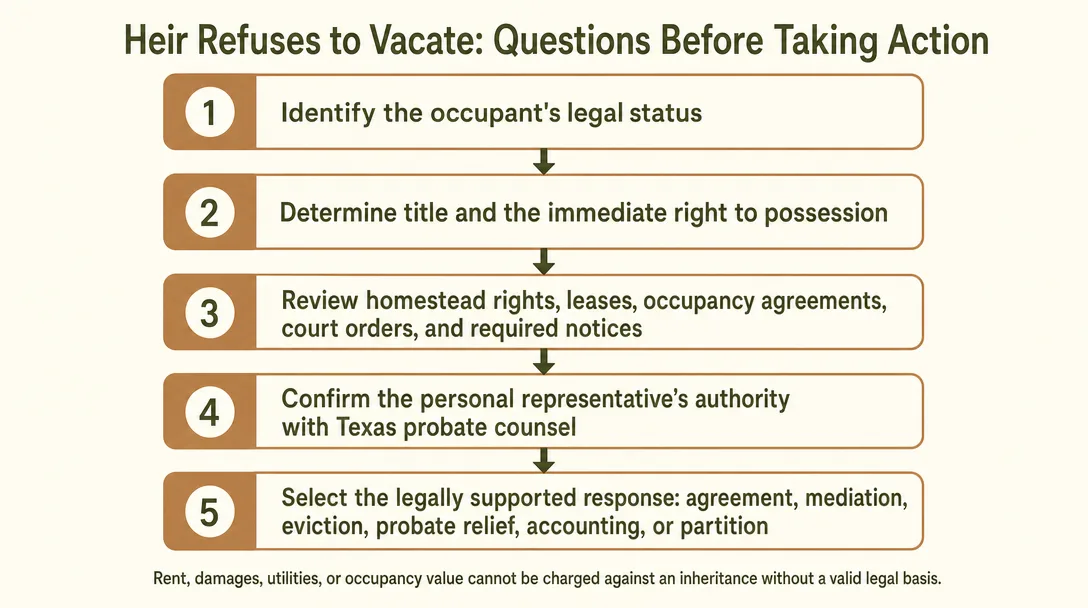
Decision Tree: What Should the Executor Do?
The decision tree infographic above summarizes the key questions an executor should work through. Here is the thought process in text form for executors who prefer a written checklist:
1 Step 1: Identify the occupant's status
Determine whether the occupant is a surviving spouse with a continuing homestead right, a guardian occupying with minor children under an applicable court order, a devisee or heir with vested title, a cotenant, a tenant, a licensee, a guest, or a person with no present possessory right.
2 Step 2: Review the documents
Examine the will, letters testamentary or administration, court orders, deeds, leases, written occupancy agreements, marital agreements, and relevant notices.
3 Step 3: Determine the personal representative's authority
Identify whether the administration is independent or dependent and whether the representative has a statutory right of possession or needs court authorization.
4 Step 4: Separate title from possession
Title may vest at death even though the personal representative has the right to possess and manage the property during administration.
5 Step 5: Select the lawful remedy
Depending on the facts, that may involve a written occupancy agreement, negotiated move-out, mediation, a notice terminating an applicable occupancy right, a justice-court eviction, a probate proceeding, an accounting, or partition.
Related Articles
This article is part of a broader series on estate home management and family dynamics in Texas probate. If you are facing an heir living in inherited house refuses to leave Texas, these related articles may be helpful:
- What If One Heir Wants to Keep the House and the Others Want Cash? — A detailed guide to buyouts, partition actions, and resolving co-heir disputes.
- Why Probate Home Sales Become Family Conflict Flashpoints — Understanding the emotional and relational dynamics that make estate sales so difficult.
- What Happens If a Probate House Sits Vacant in Texas? — The risks of an unoccupied estate property and how to manage them.
- 7 Mistakes Executors Make With a Probate House — Common pitfalls and how to avoid them.
- How and When Do Heirs Receive Money From a Texas Probate Home Sale? — Understanding the distribution process and timeline.
- Someone Is Living in the Home: What to Do — Starting-point guidance for occupied estate homes.
Practical Checklist for Executors
Here is a practical checklist for executors dealing with an heir who is living in the estate house and will not leave:
- Determine the occupant's legal status.
Are they a surviving spouse with a possible homestead right, a guardian occupying with minor children under a court order, a devisee, an heir or cotenant, a tenant, a licensee, a guest, or someone with no present possessory right? Being an adult child describes a family relationship, not a legal occupancy status.
- Review any existing written agreement.
Check for a lease, a caregiving agreement, or any other document that governs occupancy.
- Document the property's condition immediately.
Take dated photos of every room, the exterior, and any existing damage.
- Verify insurance coverage.
Check whether the policy covers an occupant who is not the owner and whether the property is still fully covered.
- Open a conversation with the occupant.
The first step should be coordinated with Texas probate counsel. A prompt written notice or demand may be necessary in some cases to terminate an occupancy arrangement, preserve a claim, prevent waiver, or document the personal representative's position.
- Consider a written occupancy agreement.
Even if the occupant is not paying rent, a written agreement clarifies everyone's obligations and protects the estate.
- Document all communications and expenses.
Keep records of every conversation, email, payment, and expense related to the property and the occupant.
- Consult the estate attorney before taking any removal action.
Do not attempt self-help eviction. Do not change locks or cut off utilities. Get legal advice first.
- Consider mediation before litigation.
Mediation may be faster, less expensive, and less damaging to family relationships than contested litigation, but its suitability depends on the urgency, the parties' willingness to negotiate, and whether immediate court relief is needed.
- Determine with counsel whether occupancy value is legally relevant.
If it is, document the valuation and the legal basis for asserting it; do not assume that fair-market rent automatically becomes an estate claim or inheritance deduction.
Frequently Asked Questions
Can an executor legally evict an heir from an estate house in Texas?
Possibly. The answer depends on the occupant's ownership and possessory rights, any lease or occupancy agreement, the personal representative's authority, and applicable homestead protections. The executor should have Texas counsel determine the occupant's status and complete all required termination and notice steps before filing a forcible-detainer action.
Does a surviving spouse have the right to stay in the house during probate?
If the house qualified as the decedent's homestead, the surviving spouse may have a constitutional and statutory right to use and occupy it while that right continues. The protection is substantial but is not accurately described as an unconditional rule that the spouse can never be removed. Qualification, waiver, abandonment, consent, and court orders can affect the analysis.
Can minor children remain in the probate homestead?
Possibly, but not merely because they are heirs. Texas Constitution Article XVI, Section 52 and Texas Estates Code Chapter 102 permit a guardian of the decedent's minor children, under an appropriate court order, to use and occupy the homestead while the children remain minors. Texas probate counsel should determine whether the protection applies and what order is required.
Can an executor charge rent to an heir living in the estate house?
Not automatically. The answer depends on the occupant's legal status, the personal representative's right of possession, any agreement, notice, cotenancy rules, and applicable court orders. Retroactive fair-market rent should not be imposed without a recognized legal basis.
What happens if an heir living in the estate house stops paying utilities?
The parties should address utilities in a written agreement. The estate may pay an expense temporarily to preserve the property, but repayment or deduction from the occupant's inheritance is not automatic. Allocation depends on the agreement, the occupant's status, estate accounting rules, and any court order.
Can the value of living in the house be deducted from an heir's inheritance?
Only when there is a valid legal basis, such as an enforceable agreement, an allowed claim, an approved settlement, a proper accounting, or a court order. An appraisal can establish value but does not itself create the right to make a deduction.
What if the heir living in the house is damaging the property?
Damage to the property requires prompt attention. The personal representative should document the condition without entering unlawfully, notify the insurer when appropriate, preserve repair estimates and other evidence, and consult the estate attorney. Depending on the personal representative's authority and the court's jurisdiction, possible remedies may include negotiated access, an inspection agreement, emergency or injunctive relief, a possession proceeding, or a claim for damages. The appropriate remedy cannot be determined solely from the occupant's status as an heir.
Does the estate's insurance cover damage caused by an occupying heir?
Not necessarily. Coverage depends on the policy's language, the cause of the loss, the property's actual occupancy, whether the insurer was given accurate information, and how the policy defines an 'insured.' A resident relative may fall within a policy's definition of an insured even if that person is not separately named on the declarations page. Conversely, an undisclosed change in occupancy or use may create underwriting or coverage issues. The personal representative should disclose the actual circumstances to the insurer or agent and request written confirmation of the applicable coverage.
What is a forcible detainer action and how does it apply here?
A forcible-detainer case is the formal Texas eviction proceeding used to determine the immediate right to possession. It is generally filed in justice court and governed by Texas Rule of Civil Procedure 510. Timing depends on service, the court's docket, trial, and any appeal.
Sources
- Texas Estates Code Chapter 101 — Estate Assets in General https://statutes.capitol.texas.gov/Docs/ES/htm/ES.101.htm
- Texas Estates Code Chapter 351 — Powers and Duties of Personal Representatives in General https://statutes.capitol.texas.gov/Docs/ES/htm/ES.351.htm
- Texas Estates Code Chapter 357 — Renting Estate Property https://statutes.capitol.texas.gov/Docs/ES/htm/ES.357.htm
- Texas Estates Code § 402.001 — General Scope and Exercise of Powers https://statutes.capitol.texas.gov/GetStatute.aspx?Code=ES&Value=402.001
- Texas Constitution Article XVI, §§ 51-52 — Homestead https://statutes.capitol.texas.gov/Docs/CN/htm/CN.16.htm
- Texas Estates Code Chapter 102 — Probate Assets: Decedent's Homestead https://statutes.capitol.texas.gov/Docs/ES/htm/ES.102.htm
- Texas Estates Code Chapter 353 — Exempt Property and Family Allowance https://statutes.capitol.texas.gov/Docs/ES/htm/ES.353.htm
- Texas Property Code Chapter 91 — Provisions Generally Applicable to Landlords and Tenants https://statutes.capitol.texas.gov/Docs/PR/htm/PR.91.htm
- Texas Property Code Chapter 92 — Residential Tenancies https://statutes.capitol.texas.gov/Docs/PR/htm/PR.92.htm
- Texas Property Code Chapter 24 — Forcible Entry and Detainer https://statutes.capitol.texas.gov/Docs/PR/htm/PR.24.htm
- Texas Rules of Civil Procedure, current Rule 510 https://www.txcourts.gov/media/1462348/texas-rules-of-civil-procedure-march-1-2026.pdf
- Texas Government Code Chapter 27 — Justice Courts; Texas Estates Code Chapter 32 — Jurisdiction
https://statutes.capitol.texas.gov/Docs/GV/htm/GV.27.htm
https://statutes.capitol.texas.gov/Docs/ES/htm/ES.32.htm - Texas Civil Practice and Remedies Code Chapter 154 — Alternative Dispute Resolution Procedures https://statutes.capitol.texas.gov/Docs/CP/htm/CP.154.htm
- Texas Property Code Chapter 23 — Partition; Chapter 23A — Uniform Partition of Heirs' Property Act
https://statutes.capitol.texas.gov/Docs/PR/htm/PR.23.htm
https://statutes.capitol.texas.gov/Docs/PR/htm/PR.23A.htm - Texas Estates Code Chapter 352 — Compensation and Expenses of Personal Representatives and Others https://statutes.capitol.texas.gov/Docs/ES/htm/ES.352.htm
- Texas Department of Insurance — Home-policy occupancy and underwriting https://www.tdi.texas.gov/tips/auto-and-home-policy-underwriting.html
- Texas Justice Court Training Center — Current Deskbooks https://www.tjctc.org/tjctc-resources/deskbooks.html
- Williams v. Williams, 569 S.W.2d 867 (Tex. 1978) — Premarital waiver of surviving-spouse homestead rights https://law.justia.com/cases/texas/supreme-court/1978/b-6738-0.html
- Trimble v. Farmer, 305 S.W.2d 157 (Tex. 1957) — Life tenant's responsibility for ordinary property taxes https://law.justia.com/cases/texas/supreme-court/1957/a-6175-0.html
- Westwood Motorcars, LLC v. Virtuolotry, LLC, 689 S.W.3d 879 (Tex. 2024) — Immediate possession as the sole issue in an eviction suit and the ability of related claims to proceed separately https://www.txcourts.gov/media/1458544/220846.pdf
Discuss the Real-Estate Side of the Property
If you are an executor dealing with an occupant who will not leave the estate house, you do not have to figure it out alone. Bill Ross and the team at Hill Country Homesteads Group can help with the real-estate side of an occupied estate property and connect you with qualified Texas probate counsel and other professionals. Questions about possession, eviction, homestead rights, fiduciary authority, or court procedure must be answered by a licensed attorney.
Request a Consultation